
The WTF Series: Triple constraint
March 10, 2016 | Ben Kittrell

One of the hardest parts of software development is managing stakeholder expectations.
Of course, everyone wants as much as they can get, as fast as possible, for the lowest price. Why wouldn’t you?

Ben Kittrell
The problem is that most programmers get frustrated when a stakeholder asks for too much too fast, and don’t know how to push back. Some of us aren’t exactly social butterflies. That’s why we borrowed a project management term called the triple constraint.
This is usually explained by drawing a triangle and writing one word at each corner: “scope”, “cost” and “time.” These corners represent what will be included in the project, how much it will cost and how long it will take, respectively. 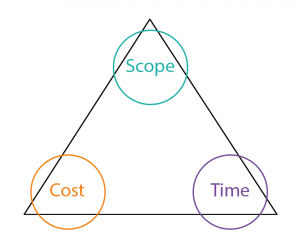
With the triple constraint, you can’t change one corner without affecting the others. If you add features, it’s either going to cost more or take more time. If you want to get it done faster, you have to remove features or pay more. It’s a handy way to explain that you can’t get something for nothing. The model, of course, can be applied to many different industries.
Another popular way of using the triple constraint is to say “Among the three options of fast, good and cheap, you can choose two.” If you want it fast and good, it’s not going to be cheap. If you want it cheap and fast, it’s probably not going to be very good.
This not only helps the developer set guidelines for what’s possible, it helps stakeholders understand what their options are. Usually, after I explain this to a client, they’re happy to say something like “Well we have to get this done in two months and this is our budget, so what features can we cut?”
Ben Kittrell is the co-founder of Doodlekit and an advisor for startups and small businesses. Kittrell also is host of Spare Room Radio, a podcast that features Kansas City entrepreneurs.

2016 Startups to Watch
stats here
Related Posts on Startland News
Study: Gov should take long-term approach to grow new businesses
A recent study by the Ewing Marion Kauffman Foundation reports that while governments have long supported entrepreneurship, new business creation is waning. The study — Guidelines for Local and State Governments to Promote Entrepreneurship — found that new businesses comprised about 8 percent of all U.S. businesses in 2011, down from roughly 15 percent in the…
Kansas City’s Innovation Partnership program to expand
Kansas City’s program to streamline the integration of technologies into City Hall is set to expand in hopes of attracting more entrepreneurial participation. The City of Fountain’s Innovation Partnership program plans to ramp up marketing and resources to welcome more companies hoping to test drive their technologies with the city, said Ashley Hand, Kansas City’s…
Mid-America Angels race for record-setting investment year
After investing nearly $1 million in the first quarter of 2015, regional investment network Mid-America Angels is on pace for its best year yet. Mid-America Angels injected $870,000 of funding into two area companies during the first three months of 2015, which sets it on a pace to surpass $3 million in investments for the…
- « Previous
- 1
- …
- 1,395
- 1,396
- 1,397