
The WTF Series: Triple constraint
March 10, 2016 | Ben Kittrell

One of the hardest parts of software development is managing stakeholder expectations.
Of course, everyone wants as much as they can get, as fast as possible, for the lowest price. Why wouldn’t you?

Ben Kittrell
The problem is that most programmers get frustrated when a stakeholder asks for too much too fast, and don’t know how to push back. Some of us aren’t exactly social butterflies. That’s why we borrowed a project management term called the triple constraint.
This is usually explained by drawing a triangle and writing one word at each corner: “scope”, “cost” and “time.” These corners represent what will be included in the project, how much it will cost and how long it will take, respectively. 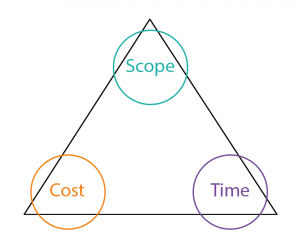
With the triple constraint, you can’t change one corner without affecting the others. If you add features, it’s either going to cost more or take more time. If you want to get it done faster, you have to remove features or pay more. It’s a handy way to explain that you can’t get something for nothing. The model, of course, can be applied to many different industries.
Another popular way of using the triple constraint is to say “Among the three options of fast, good and cheap, you can choose two.” If you want it fast and good, it’s not going to be cheap. If you want it cheap and fast, it’s probably not going to be very good.
This not only helps the developer set guidelines for what’s possible, it helps stakeholders understand what their options are. Usually, after I explain this to a client, they’re happy to say something like “Well we have to get this done in two months and this is our budget, so what features can we cut?”
Ben Kittrell is the co-founder of Doodlekit and an advisor for startups and small businesses. Kittrell also is host of Spare Room Radio, a podcast that features Kansas City entrepreneurs.

2016 Startups to Watch
stats here
Related Posts on Startland News
Lenexa studio joins national coworking relief effort for Nepal
Despite the nearly 8,000 miles between them, a Kansas City-area coworking studio is helping with relief efforts in Nepal after a 7.8 magnitude earthquake destroyed hundreds of buildings and claimed thousands of lives. Lenexa-based Plexpod has joined the international “Coworking for Nepal” movement that has attracted dozens of studios to encourage fundraising for Nepal relief…
KC’s first innovation officer reflects on work, city’s tech future
After more than two years of service, Ashley Hand is leaving the driver’s seat of Kansas City’s innovation efforts. Hand, who soon will be departing as Kansas City’s chief innovation officer, was tasked with implementing innovative strategies to improve how city government can better serve Kansas Citians. The city will be accepting applications for the…
Welcome to Startland News
Scrappy. Determined. Gritty. Those often were the words attributed to the Kansas City Royals as the team unexpectedly surged into the 2014 World Series and captured the national spotlight. Those very words are apt for this city, which has been built on the grit and determination of successful entrepreneurs like Ewing Kauffman, Joyce Hall, Henry…
Kansas budget woes render uncertainty for angel tax credits
As state budgetary concerns loom in the background, early-stage firms in Kansas are hoping a bill to extend the Sunflower State’s Angel Investor Tax Credit program will become a priority for legislators. Scheduled to sunset after the 2016 fiscal year, the program annually allocates $6 million in credits to entice investments in early-stage, growth-oriented companies…