
The WTF Series: Triple constraint
March 10, 2016 | Ben Kittrell

One of the hardest parts of software development is managing stakeholder expectations.
Of course, everyone wants as much as they can get, as fast as possible, for the lowest price. Why wouldn’t you?

Ben Kittrell
The problem is that most programmers get frustrated when a stakeholder asks for too much too fast, and don’t know how to push back. Some of us aren’t exactly social butterflies. That’s why we borrowed a project management term called the triple constraint.
This is usually explained by drawing a triangle and writing one word at each corner: “scope”, “cost” and “time.” These corners represent what will be included in the project, how much it will cost and how long it will take, respectively. 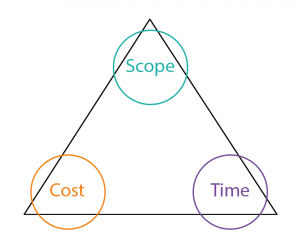
With the triple constraint, you can’t change one corner without affecting the others. If you add features, it’s either going to cost more or take more time. If you want to get it done faster, you have to remove features or pay more. It’s a handy way to explain that you can’t get something for nothing. The model, of course, can be applied to many different industries.
Another popular way of using the triple constraint is to say “Among the three options of fast, good and cheap, you can choose two.” If you want it fast and good, it’s not going to be cheap. If you want it cheap and fast, it’s probably not going to be very good.
This not only helps the developer set guidelines for what’s possible, it helps stakeholders understand what their options are. Usually, after I explain this to a client, they’re happy to say something like “Well we have to get this done in two months and this is our budget, so what features can we cut?”
Ben Kittrell is the co-founder of Doodlekit and an advisor for startups and small businesses. Kittrell also is host of Spare Room Radio, a podcast that features Kansas City entrepreneurs.

2016 Startups to Watch
stats here
Related Posts on Startland News
Play-It Health lands in top-ranked digital health accelerator
As with many successful startups, the idea for Play-It Health was born out of personal experience with an unsolved industry need. Kim Gandy, a former clinician and now the founder and CEO of Play-It Health, recognized that patients were having trouble engaging and adhering to their medical regimen. In the worst cases, this led to…
LaunchKC, Techweek to welcome 10 tech firms to KC in style
In roughly four months, Kansas City will welcome a crop of tech startups bolstered by thousands of dollars in funding and a rockstar arrival. Kansas City’s LaunchKC competition — which aims to attract 10 tech firms to relocate to KC with $50,000 grants — has partnered with national tech conference Techweek to offer the winners…
New platform GUILDit offers art entrepreneurs visibility
A new program called GUILDit to promote and support art entrepreneurship is coming to Kansas City. The program is a bi-monthly gathering where art entrepreneurs take the stage to give six-minute presentations followed by questions and answers in the hopes of crafting a stronger Kansas City art economy, and to further connections between local artists.…