
Founder facing gender bias: Don’t call me a victim; call me investors
March 6, 2019 | Elyssa Bezner

It’s like pulling teeth to get key investors and resource organizations to help push female entrepreneurs forward, said Carlanda McKinney, citing implicit bias and a lack of effective support mechanisms.
[pullquote]
Editor’s note: The following is part of three-piece package, Women’s Work: Startups fueled by female founders struggle for equity.
• Founder facing gender bias: Don’t call me a victim; call me investors
• Even gatekeepers struggle to bring KC’s women-led companies in from the cold
• WIRED together: How mentorship led 22 women to a million-dollar investment
[/pullquote]
“I don’t think it’s intentional at all. I think it’s a byproduct,” said McKinney, co-founder of Raaxo, an online tech platform used to design and produce custom-made bras for women. “I feel very strongly that if Raaxo was a male-led company doing something that male [investors] could relate to more, we probably would have gotten funding already.”
McKinney knows this, she said, because she’s seen companies that are not as far along as her Kansas City-based startup get funding with less of a foundation built.
“Our starting product is a bra, so many people are like, ‘Why would anyone need that? Why would anyone pay them? Is this really a problem?’ But when [I’m] pitching to a room full of women, they get it,” she added.
While her statements could be viewed as blaming others for a lack of success, her journey reflects the reality that Raaxo struggles to get funding despite a market fit for the platform, McKinney said.
“We are also a seed-stage company in a city that wants to invest in Series A companies,” she added, noting that after routing founders to beginner entrepreneurship classes and grants competitions, most support organizations are unable to give direction beyond that point.
“[My co-founder and I] are asking ourselves what we should we do to get around that,” she added. “We’ve decided to look outside of Kansas City because there are more, existing women-led startups — that are also early-stage, making a product that is specifically catered to women.”
Click here to read more about McKinney’s beginning stages with Raaxo.
Bias experiences aren’t locked in stone
Though the biometrics industry is male-dominated, that lack of gender balance hasn’t been an issue for woman-owned, Olathe-based security firm StoneLock, said CEO and co-founder Colleen Dunlap.
“It really has nothing to do with what we do,” said Dunlap. “Our community is very interconnected.”
Unlike the team at Raaxo, she and co-founder David Dunlap have never pursued outside funding, the StoneLock CEO noted.
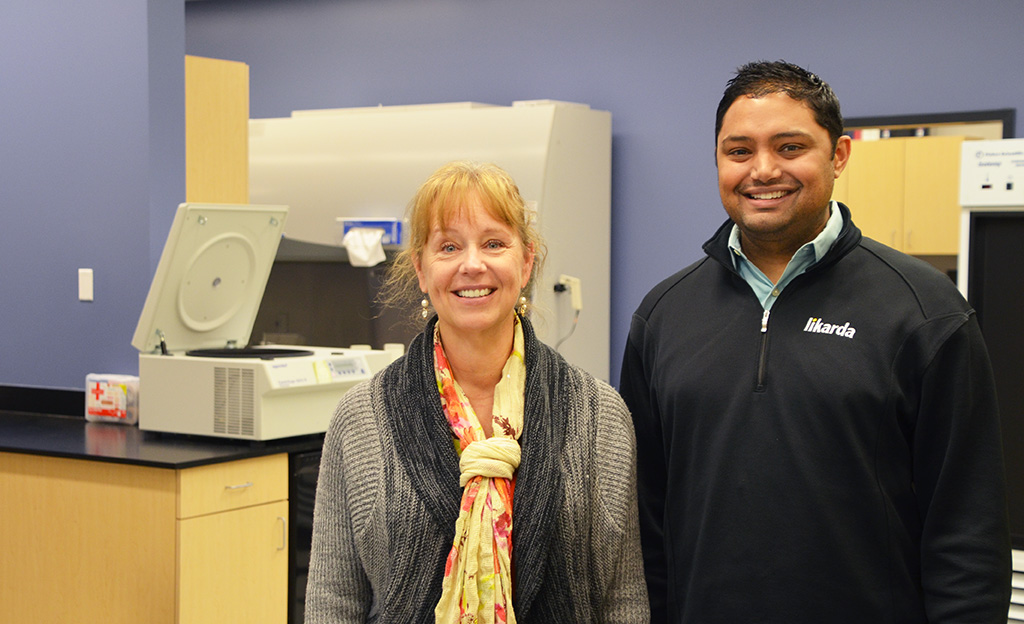
Lisa Stehno-Bittel and Karthik Ramachandran, Likarda
“But what I can say is that in our industry, companies [are judged] based on what their technology does, and what they are able to accomplish,” Dunlap said. “In my world, what I see is it really comes down to, ‘Does the technology have enough research behind it?’”
Inherent biases against women-led companies are prevalent in all communities, said Lisa Stehno-Bittel, president and co-founder at Kansas City biotech research firm Likarda. Stehno-Bittel’s expertise typically is requested for presentations and panels, she has observed, but never when speaking to other firm’s boards, she said.
“Organizations like to put me out there as a female entrepreneur to give a talk, but when it’s a position where I’d be making decisions, a place where I would have authority — somehow those invitations don’t come,” said Stehno-Bittel.
“I think there’s also more hesitation by women asking for money along with some inherent biases against women-led companies,” she added. “So there’s some external factors and internal factors that keep the numbers [of women-led companies] lower.”
A look from the inside
When beginning to look for funding for Likarda, the thought of seeking outside capital was a needed mental shift, Stehno-Bittel said.
“I remember early on talking to another female entrepreneur and telling her it was so stressful taking my own family’s funding to [start Likarda], I couldn’t imagine taking other people’s money,” she said. “I told her, ‘I don’t think I could sleep at night,’ and her response was, ‘Get over it. That’s how businesses have to grow.’”
[pullquote]
“When I was working in politics, one of the things that people used to say a lot was that men will run for office unprompted, but you have to ask a woman to run for office an average of eight times before she’ll consider it. I think fundraising is similar in a lot of ways.”
— Melissa Roberts, senior program officer, Ewing Marion Kauffman Foundation
[/pullquote]
Female entrepreneurs being slower to set high-growth goals in general can contribute to those goals not being met, resulting in a smaller number of highly scalable, women-led companies, added Rania Anderson.
“They can think about their business more incrementally rather than in quantum leap,” said Anderson, one of the co-founders for women-focused angel group Women’s Capital Connection and author of “WE: Men, Women, and the Decisive Formula for Winning at Work.”
“Certainly a lot of women entrepreneurs have grown huge businesses with those goals and achieved those goals,” she added. “I’m just talking about in the whole market of women-led businesses versus male-led businesses, you’ll see smaller women-led businesses.”
Male founders can tend to be “monomaniacal” about the idea behind the company during pitches without considering the entire timeline of a startup, said angel investor and Stratex Solutions principal Dan Stifter, the observation resulting in his definite preference for women-owned startups.
“I know that I’m stereotyping a little bit here: I don’t know if women are naturally more coachable or it’s just that society is forcing them to have to listen to guys who look like me,” laughed Stifter. “In general, I am more inclined to invest in females than males.”
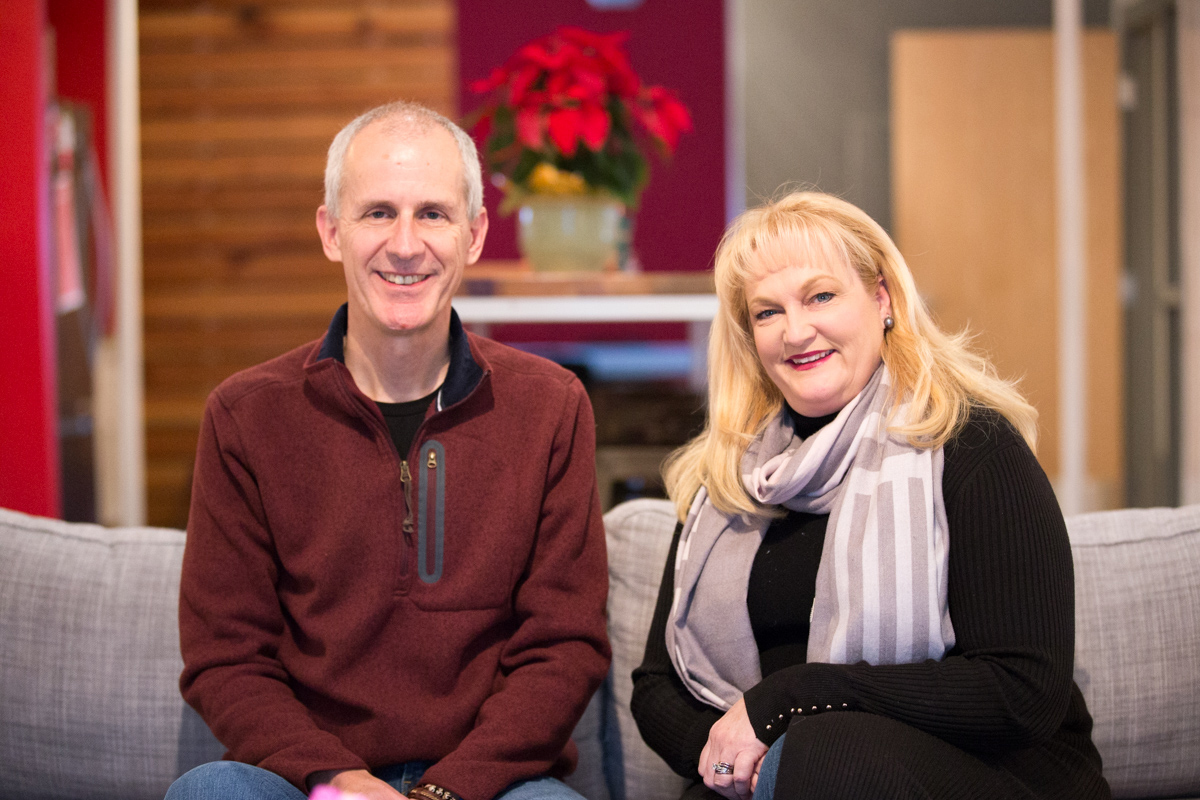
Dan Stifter and Raina Knox, Stratex Solutions
Through years of work with the Mid-America Angels Capital Investment Network, Digital Sandbox KC, and BetaBlox, (before settling down with Stratex CEO Raina Knox to further develop her SaaS firm), the investor never witnessed obvious bias against females on behalf of his peers, despite the predominantly male usual suspects, he said.
“I have zero sense that, in any of those places, it’s harder for women than it is for men,” Stifter added. “That being said, I’ve seen guys my age and older uncomfortable in a ‘It scares me to talk to girls’ way — I definitely see guys like that, no doubt — but does that manifest where the real money is? I hope it doesn’t matter, but some of the data certainly suggests that it does, right?”
A biased inquisition
“[Bias] is a big factor from the investor side of the table,” said Melissa Roberts, senior program officer for entrepreneurship at the Ewing Marion Kauffman Foundation, noting women are more likely to approach situations with caution and seek additional education before making decisions, which also contributes to slower starts.
[pullquote]
“It’s the little things that sometimes make it difficult for women entrepreneurs. Unconscious bias is a big part of those little things.”
— Melissa Roberts, senior program officer, Ewing Marion Kauffman Foundation
[/pullquote]
A study by Harvard Business Review indicates investors posed different types of questions to male and female entrepreneurs, she said, noting male entrepreneurs get asked “promotion-based” questions relating to the potential for gains and their female counterparts are asked “prevention-based” questions relating to the potential for losses.
“The craziest realization for me when reading that study was that I do it too,” added Anderson. “And I am all about advancing women!”
The study made Anderson closely examine the questions asked by herself and other investors during meetings with entrepreneurs, she said.
“I realized how pervasive our biases are and how if we don’t acknowledge them or aren’t at least aware of them, then we can’t change our behavior,” she added.
The relationship between investors’ gender and the concentration of funding certainly seems real, said Conner Hazelrigg.The impact of the male-versus-female dynamic among judges in pitch or grant competitions has played heavily in performance ratings for her startup 17° 73° Innovation Co., which deploys portable solar-charging stations — called Sunshine Boxes — to areas without power, she said.
“When the judges were female, I always did better,” said Hazelrigg. “I just have this very vivid memory [of a time] I was presenting during a competition, and there was this female judge. She was engaged with me the entire time — not just with my presentation but with me directly — and was holding eye contact and nodding her head. It became more of a conversation to her about what I was doing than anybody else.”
“Now typically when I’m presenting, I’m looking for those people who inherently get what I’m doing, and almost 100 percent of the time they happen to be females in the audience that have that deeper connection,” she added.
Despite societal hurdles, all entrepreneurs have the same potential to succeed, Hazelrigg emphasized.
“Females may have to walk the walk a little bit more, but that only allows her to gain more power,” she said.
[divide]
More from Women’s Work: Startups fueled by female founders struggle for equity:
• Even gatekeepers struggle to bring KC’s women-led companies in from the cold
• WIRED together: How mentorship led 22 women to a million-dollar investment
Featured Business

2019 Startups to Watch
stats here
Related Posts on Startland News
Black Feast Week returns to feed restaurants new diners, combat hunger in Kansas City
Opening Black Feast Week — designed to promote Black-owned restaurants, chefs, and culinary creativity — by feeding 150 single Black mothers for free was an intentional act of community care, said Joshua “JT” Taylor. “We’ve always tried to prioritize helping people who are most marginalized,” said Taylor, senior content producer and chief administrative officer at…
‘Night Without Borders’ opens coffee house doors to honor heritage through harmony
Culture transcends borders, said Danny Soriano, surrounded Friday night in a popular Crossroads coffee shop by music, dance, art, food, and drinks that all shared a common link: Latino flavor. “Whether it’s Puerto Rico, Dominican Republic, Mexico, Argentina, we all come together as Latinos, as Hispanics, and celebrate our heritage,” said Soriano, who organized a…
GEWKC returning to familiar venue (but its new destinations might surprise ticket holders)
When Global Entrepreneurship Week pulls into the station later this fall, Kansas City participants can expect a fresh experience inside one of the region’s most iconic landmarks, said Callie England, noting an intentional effort behind the scenes should help reroute the “best of the best” events onto custom agendas. “While you’ll see a few familiar…