

Why coastal investors ignore the Midwest and what’s next for federal startup policy
January 14, 2016 | Kat Hungerford

Here are this week’s watercooler conversation-starters on why inland states struggle to find funding, coming issues in federal entrepreneurship policy and the success of innovation districts that are cropping up around the U.S. (and in Kansas City). More in this series here.
International Business Times: Finding venture capital far from the coasts
Of the $48.3 billion spent in the U.S. on venture capital in 2014, 80 percent of those dollars went to companies in just five states, with California receiving a whopping 56 percent. Although there’s a lot feeding into why that happens, the article distills it down to:
- Most investors are based on the coasts, and they like to work face-to-face with the companies on which they spend money.
- Investors are often biased against inland states, assuming there’s nothing here of interest.
- Coastal investment firms control massive amounts of capital, making them less likely to fund the small rounds with which companies located inland start.
On the brighter side, the article warns us not to give up hope. Thanks to angel investing becoming a mainstream practice and many central states launching their own investment funds, the gap is (very slowly) closing. The high cost of living and rabid competition is also driving many founders away from the coasts, and the money often follows them.
Kauffman Foundation: What’s next for entrepreneurship policy?
An election year usually means limited action on the federal policy front, but 2016 holds prospective wins — and challenges — for entrepreneurs.The Kauffman foundation highlighted these areas of change:
- The sharing economy will continue to disrupt traditional industries, especially those riddled with inefficiency and high costs like healthcare. Policy will continue to struggle to keep up, so expect more legal and political wars to follow.
- Equity crowdfunding will launch, but it will be slow-going to develop the infrastructure necessary to support the hoped-for reality.
- President Obama will leave on a high note for startup policy as having the first administration that recognized the need for a separate set of policies to help startups. He set this trend via initiatives like Startup America, the JOBS Act, and moving the Small Business Administration to the cabinet-level. He’ll also convene an entrepreneurship ministerial at the Global Entrepreneurship Congress this March.
Urban Land: Making the case for more innovation districts
Over the last decade, innovation districts have hatched all over the globe. These tech-centric developments are different from traditional business districts in that they are almost universally anchored by a major university, hospital, corporation or research institution. They also often house companies of varied industries at different growth stages and have focus to work together to foster new ideas, products and tech.
U.S. examples of the new model include: the St. Louis, Mo. Cortext Innovation Community; the Durham, N.C.-based Duke Clinical Research Institute and the Cornell Tech Campus in New York City.
These carefully-planned, intentional innovation centers are slowly taking the place of isolated corporate campuses. Kansas City is already home to smaller-scale examples of the innovation district model with its Think Big Coworking building and the forthcoming Westport Commons.

Featured Business


2016 Startups to Watch
stats here
Related Posts on Startland News
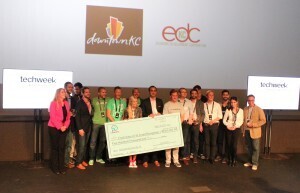
Meet the 10 startup winners of LaunchKC’s $50K
LaunchKC announced the winners of 10, $50,000 grants Friday during a celebration at the inaugural Techweek Kansas City conference. More than 40 judges evaluated pitches from 20 contest finalists, who pitched their companies Friday morning at Union Station before a crowd of about 100 people. LaunchKC kicked off in February and nabbed nearly 500 total applicants…

KC picks who they think will win LaunchKC’s $50K grants
Twenty startups are hoping to snag $50,000 during the LaunchKC grant competition. Nearly 500 companies applied to be part of the contest, which will be announcing the winners at Techweek Kansas City at 3 p.m. Friday. Below are predictions from a few members of the tech, startup and entrepreneurship community meandering around Techweek on who…

A chat with Tinder co-founder Jonathan Badeen
Tinder co-founder Jonathan Badeen’s roots run deep in the Kansas City area. A native of Leawood and a graduate of Barstow High School, Badeen stopped by Techweek Kansas City Thursday to discuss the popular app — Tinder — that he helped create. Badeen, who’s also a fan of the University of Kansas Jayhawks and Kansas…
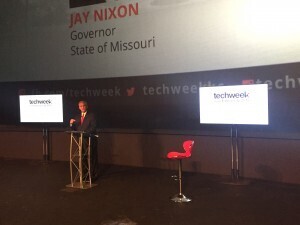
Nixon announces $1.2M in grants to KC programs
Missouri Gov. Jay Nixon made an appearance at Techweek Thursday to announce $1.19 million in grants to three Kansas City organizations through the Missouri Technology Corporation. Of the $1.19 million, $565,000 is going to LaunchKC, $500,000 is going to the Digital Sandbox KC and $125,000 is going to the Independence Economic Development Council. The 2016 Missouri…