
What’s a ‘smart city’ and why should KC care?
August 13, 2015 | Startland News Staff

Aaron Deacon, managing director of KC Digital Drive, was instrumental in forming the Kansas City area’s Digital Playbook in 2012, which aimed to capitalize on the opportunity afforded by Google Fiber. His organization works on tech projects to boost Kansas City’s economy and is hosting a fundraising bash to further that mission.
Smart phones. Smart watches. Smart thermostats. Smart homes. Smart TVs. It seems like everything is smart these days.
It’s easy either to get overwhelmed by jargon or to roll your eyes at the coming “technotopia”that accompanies the talk of a “smart city,” but if you do, you may miss the opportunity that Kansas City has in front of us. And it’s a big one. But we have to unpack some of the language and history in order to put that opportunity into perspective.
2012: KC’s Smart City Odyssey
When KC Digital Drive was asked to start working on our Digital Playbook in 2012, we looked around the world at other cities with gigabit fiber and noticed that this thing called “smart city” was a priority in many of them. So we took Kansas City Mayor Sly James and former Kanas City, Kan., Mayor Joe Reardon down to the Cisco Telepresence facility in Overland Park to learn more.
Over the room-sized videoconference system, we connected with leaders in Amsterdam, Barcelona, Singapore, and Moscow to explore a trend that was growing quickly in Europe, Asia and South America but was having a hard time gaining traction in the U.S. These early telepresence roundtables grew into the Gigabit City Summit event we hold each year. From these sessions, KC Digital Drive began to learn lessons that would shape our unique approach to smart city building. This was advanced when Mayor James, Mayor Reardon, and I spoke at the Smart City Expo in Barcelona, inserting Kansas City into a global conversation and beginning to extend our tech reputation beyond simply gigabit fiber.
Smart City: WTF?
So what do people really mean when they say “smart city,” and why is it such a polarizing phrase? It’s important to remember that the term was first used in branding by large infrastructure companies. Smarter Cities was a technology application engineered by IBM’s Colin Harrison back in the mid 2000s.
This large-scale system was designed as enterprise software and hardware that could help a city more efficiently manage its resources and sustainability goals. Cisco developed a Smart+Connected City brand and product line in parallel. The idea was that an integrated system of sensors, devices, and equipment, all connected by the Internet and managed by software, could make the city more effective in managing energy, water, waste, public safety, and the like. Traffic lights could adapt to traffic patterns. Water leaks would be more easily detected. The energy grid could be re-routed to avoid power loss.
Rio de Janeiro was a flagship test market for IBM, while Cisco was working to build “greenfield cities” from the ground up like Songdo, South Korea or Skolkovo in a Moscow suburb. And frankly, the approach was a little bit weird—cool no doubt, but highly engineered, of uncertain impact, and strangely lacking the human factor. The promise of efficiency was tantalizing, but our approach was measured.
As “smart city” has become more generic and less branded, we’ve investigated a growing number of consortia, movements and organizing principles that get at some variation of the same idea.
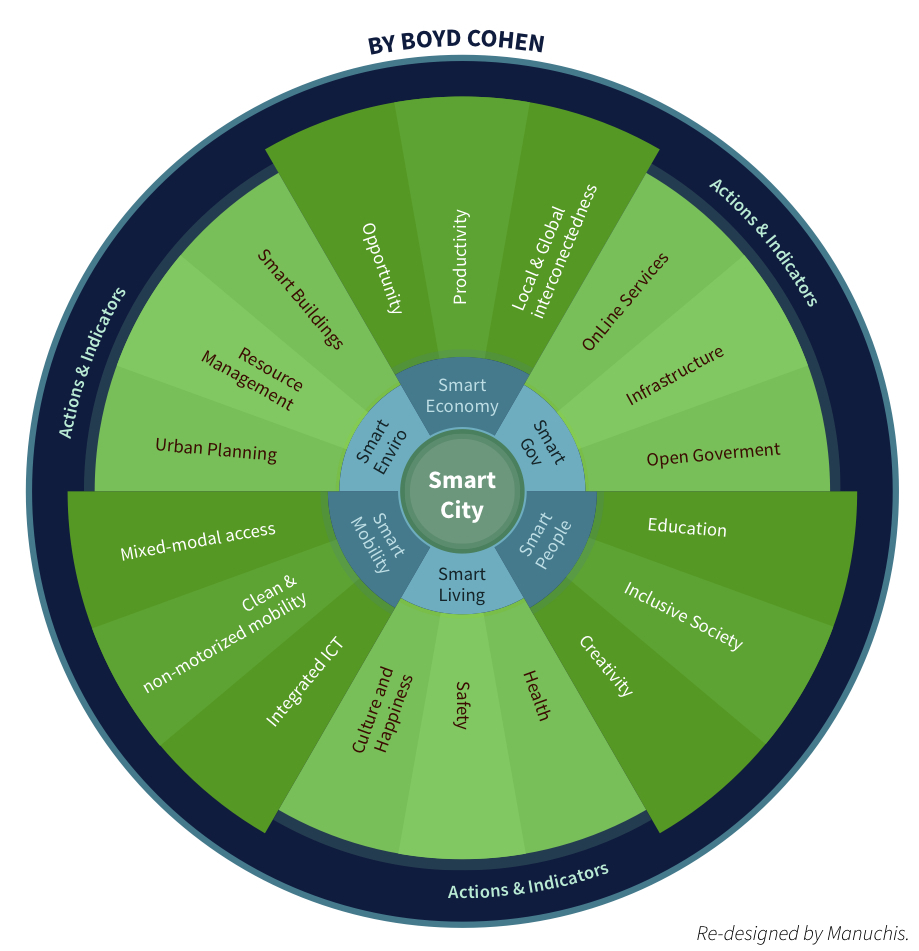 The key observation from this work is that Kansas City has a lot to learn, but also a lot to offer. As we’ve met with city leaders from around the world and compared notes back home, it’s clear that the leadership in Kansas City — our mayors in particular — are out in front, that the problems we’re addressing and the solutions we’re evaluating here don’t feel hopelessly behind the times when we go out into the world. That’s refreshing, and it’s not an accident. It takes leadership.
What It Means for KC
So what is the opportunity for KC?
First and foremost, the opportunity is self-determination — how we adapt these frameworks and craft our own future. What all these different movements and initiatives are grappling with is how a city should cope with the transition to digital. And how to do that in a way that is just, equitable, and makes peoples’ lives better.
When Harvard professor Susan Crawford spoke here last January, she compared her observations about gigabit fiber in Kansas City with other global leaders in connectivity. She talked about the “rigid hierarchy” of Seoul that proves a constraint for entrepreneurs, and she described Stockholm as “desperate for grit” needed to spur innovation. The U.S., she said, offers freedom and grit, but “Kansas City’s competitive advantage is not the same as San Francisco or New York City…Kansas City is all about community and family and roots and belonging.” This cultural disposition creates a unique opportunity to consider how man and machine relate to one another in the future.
KC’s assets
And Kansas City has a couple more tangible advantages. This may sound self-serving, but one of them is KC Digital Drive. Our mayors saw fit to draft a community vision around technology that drew broadly from its citizens and spanned the digital realm from inclusion to innovation. And they provided the startup resources for our organization to sit outside City Hall, where we can more effectively balance the top-down needs of the city and the bottom-up demands of citizens. An agenda around digital change with a firm focus on the people of Kansas City is a great foundation.
The other advantage we have is the infrastructure. It may seem like other cities are catching up quickly, but there are still only 12 communities in the US where a majority of residents in a community can get gigabit Internet for under $100. Two of them are in Kansas City, and the sweeter of those two deals is the far less famous one. A $300 installation fee in North Kansas City (via liNKCity) gets you free gigabit service for 10 years. Google Fiber has still only announced a handful of U.S. markets, and we know well how much work is required to build the network. AT&T and Consolidated Communications offer competitively priced fiber, and Time Warner and Comcast help create the most competitive broadband market in the country.
And then we have the smart city project, the Cisco Smart City, another infrastructure initiative that is in its infancy. With a first-of-its-kind WiFi backbone by Sprint, and a yet-to-be-unveiled network of sensors and kiosks, we’ll once again have real physical assets in place that create a platform for innovation. Cisco’s partnership with Think Big Partners plan to create a “Living Lab”to help uncover the business opportunities that infrastructure can support.
Does any of this infrastructure come with a guarantee? Of course not. But it all adds up to something big. What it means for Kansas City to be a smart city, therefore, is getting to be a city about ideas, about real work, about being ahead of the curve, about seizing opportunity, about acknowledging our failures, and about an effort to do better. These are the characteristics of people, not technology or gadgets or systems. When we look “forward to the future” at next week’s event, this is the future we are looking toward.
It is a future that offers the people of Kansas City a chance to learn, a chance to build, and a chance to chart our own course. Science fiction author William Gibson made the oft-quoted observation that “the future is already here—it’s just not very evenly distributed.” We’re on the plus side of that distribution here, and we should all be eager for the opportunity to do something about it.
Featured Business

2015 Startups to Watch
stats here
Related Posts on Startland News
This voter-approved investor backed Zhou B Arts, KD Academy and a new hotel at 18th and Vine; now it has a new home
EDCKC absorbing initiative built to strengthen KC’s urban core after $60M in investments A move to transition the Central City Economic Development (CCED) program under the umbrella of a larger KCMO impact agency is expected to boost the urban core-focused initiative’s ability to uplift both the people and the places at the heart of Kansas…
Hidden costs of grief: Chef’s murder illustrates economic toll of gun violence in KC
Editor’s note: This story was originally published by The Beacon, a member of the KC Media Collective, which also includes Startland News, KCUR 89.3, American Public Square, Kansas City PBS/Flatland, and Missouri Business Alert. Click here to read the original story from The Beacon, an online news outlet focused on local, in-depth journalism in the public interest.…
‘The American dream is the Midwest’: LaunchKC powers next generation of startup job creators
Editor’s note: The following is part of an ongoing feature series exploring impacts of initiatives within the Economic Development Corporation of Kansas City through a paid partnership with EDCKC. [divide] Relocating to Kansas City after winning a LaunchKC grant — and the community and infrastructure support that comes with it — gives Russel Karim’s startup a…