
Artist Vi Tran to KC-based innovators: Wipe ‘local’ label from your vocabulary
October 4, 2018 | Tommy Felts

Some roots are best left behind, but not forgotten, said multi-faceted Kansas City artist Vi Tran. Others are worth holding close.
Speaking at Startland’s recent Innovation Exchange, the actor, playwright, musician and owner of The Buffalo Room decried the idea that innovators who choose to stay in places like Kansas City are any less worthy than their peers in larger cities.
It’s not about being a “local” artist or startup versus a “national” act or company, he said, noting technological advances have broken down walls that limit innovators’ potential in far-flung communities.
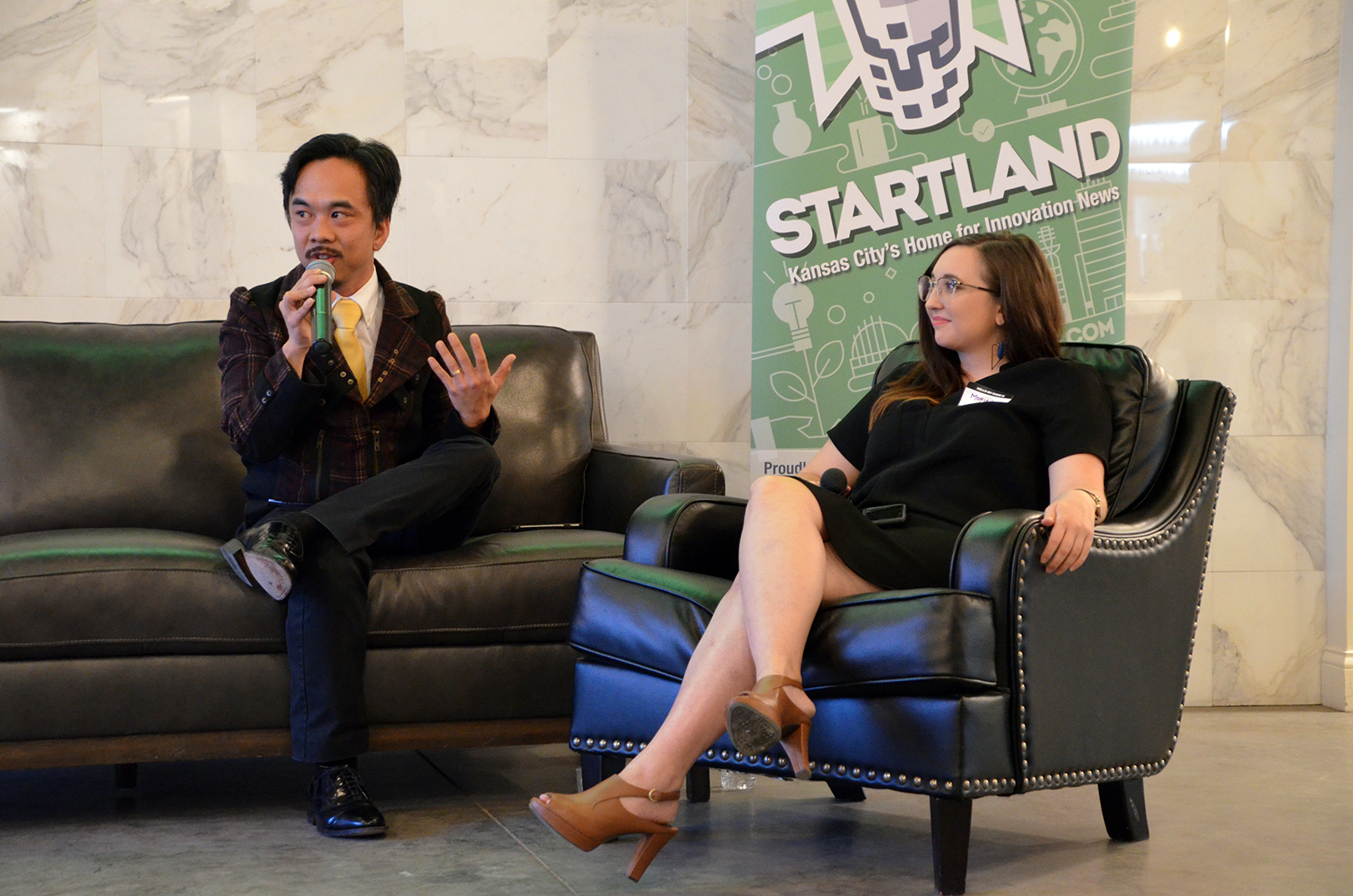
“In every other profession, you get to choose where home is. No one is slagging on a doctor for being a ‘local doctor’ in Cincinnati,” said Tran during a fireside chat with ArtsKC’s Moriah Hilson at the Startland event.
The entertainment industry is particularly aggressive in labeling people as a “local band,” “local artist” or “local actor,” he said, describing the adjective as a derogatory way to degrade someone’s value.
“I encourage all artists to remove that from their vocabulary,” Tran said. “There’s a pejorative that’s attached to ‘local.’ … You’re a Kansas City-based artists. You’re not common. You’re special. And you belong.”
“I’m based out of Kansas City because I choose to make Kansas City my home. If I wanted to go somewhere else, I would,” he added. “If I felt like there was nothing else for me to learn here, if there was nothing left for me to create here, then I would follow a lot of my peers and move to another market. But I’m no longer 20-something, so living in a closet in New York is no longer appealing to me. I have a mortgage in Waldo. I run a business. I like what I’ve built here.”
Tran’s fireside chat followed a panel conversation at the Innovation Exchange — sponsored by the Brain Family and supported by ArtsKC, Organic Soul KC, Tom’s Town Distilling Co. and 28 Event Space — moderated by Startland’s Austin Barnes.
Panelists Chentell Shannon, a ceramicist at Convivial; JT Daniels, a social activist and muralist; and Royce “Sauce” Handy, a rapper and hip hop artist, explored the journeys of artists as innovators and entrepreneurs. Sauce also served as the event’s musical guest.
Keep reading below the gallery from the event.
Tran discussed his own evolution as a refugee who found his way to the musical stage.
“I was born in the shadow of Saigon, Vietnam, and raised in the cattle country of Southwestern Kansas, so I like to consider myself equal parts sea salt and wheat fields,” he said, theatrically opening his segment with Hilson. “And that’s my elevator pitch — thank you!”
After growing up in Garden City, Tran attended Kansas State University and majored in theater and English, got his masters in theater directing, and then continued creeping eastward toward Kansas City — calling the city home since 2004, he said.
His life experience, coupled with stories from his parents formed the basis of a folk musical refugee memoir, “The Butcher’s Son,” which he wrote about his family’s escape from Vietnam.
“My parents worked in the slaughterhouses,” Tran explained. “My father was born with a silver spoon in his mouth. He was the heir to a real estate empire. And my mother was born with next to nothing. They fell in love in the middle of one of the most horrific wars in recent history. So it’s their story — the story of sacrifice.”
His parents taught him that whatever his calling in life, he must attack it with intentionality, he said.
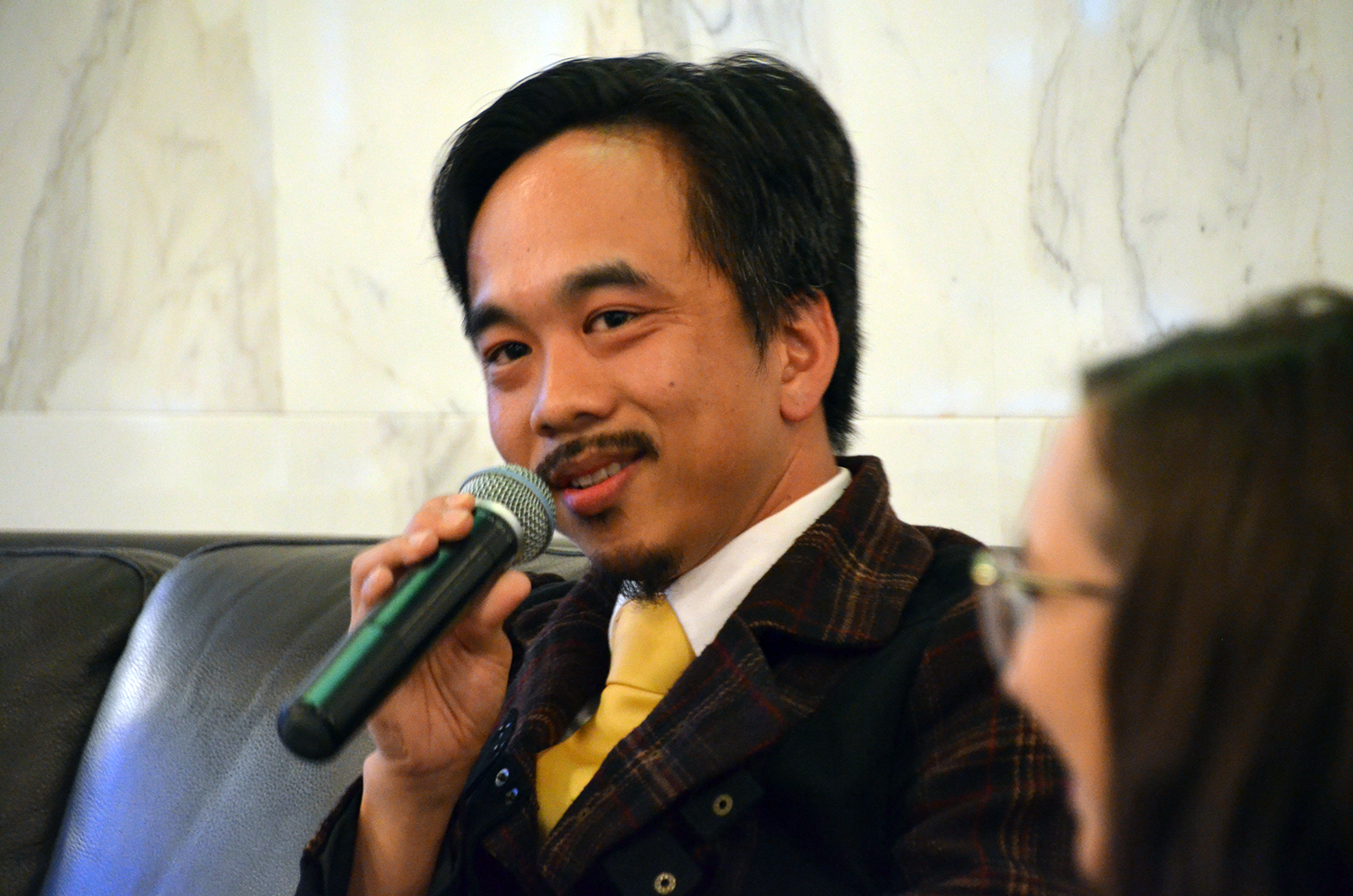
Vi Tran
“I was supposed to go to law school or med school — just like all of us Asians. The only reason I’m an artist is because I lost my 4.0,” Tran joked. “My parents told me, ‘We didn’t bring you over here to play out a stereotype. If you chose to go to law school or med school, we’d be super proud of you. But we brought you here so you could choose. And you chose this … now do it.’”
Despite that support, he wasn’t raised without pressure at home, he said.
“I do have refugee guilt driving me. It was not, ‘We had to walk five miles in the snow’ [coming from his parents]. It was, ‘We didn’t bring you halfway around the world, out of Communist Vietnam, through Khmer Rouge-controlled Cambodia, through the refugee camps of Thailand and the Phillipines, for you to not take out the trash,” Tran said to laughter from the audience.
Their intensity fueled his drive, he admitted.
“In the back of my brain, I’m like, ‘I can’t go blow this. I guess I’m making it as a performer now because failure is not an option,’” Tran said.
Featured Business

2018 Startups to Watch
stats here
Related Posts on Startland News
André’s planted its flag in KC 70 years ago; chocolatier says that’s just a taste of what’s to come
Nearly 5,000 miles from Switzerland, a small group toured the inner sanctum of an iconic 70-year-old Kansas City company — a family-run brand that helped redefine accessible luxury in the Midwest, one Swiss chocolate-covered almond at a time. “What people get excited about André’s is the legacy, that we take a lot of pride in…
Here’s how ULAH’s new boutique model aims to rack success for local brands, not inventory debt
The new KC Collective consignment-based program for local brands at ULAH is a win for both the Westwood boutique and Kansas City creatives, said Joey Mendez and Buck Wimberly, announcing a fresh model to help the struggling store stay open and financially stable. “We’ve always had local brands,” said Mendez, co-founder of ULAH, explaining the…
Tiki Taco ticks up giving alongside expansion; CEO owns up to taco shop’s neighborhood impact model
A month-long campaign in the popular Kansas City-based chain offers easy add-on: joining KC GIFT’s network of donors Restaurant executive Eric Knott wants Tiki Taco’s operators to own the neighborhoods into which the popular taco shop expands, he said, but that doesn’t just mean dominating the fast-casual market in each pocket of Kansas City. “Our…