
Innovation unplugged: KC company’s ultra-cold tech could preserve vaccines, save lives
February 10, 2021 | Austin Barnes

Despite playing a critical, specific role in the fight against COVID-19, one North Kansas City tech startup could be a shot in the arm of healthcare beyond the ongoing pandemic, said Edward Collins.
[pullquote]
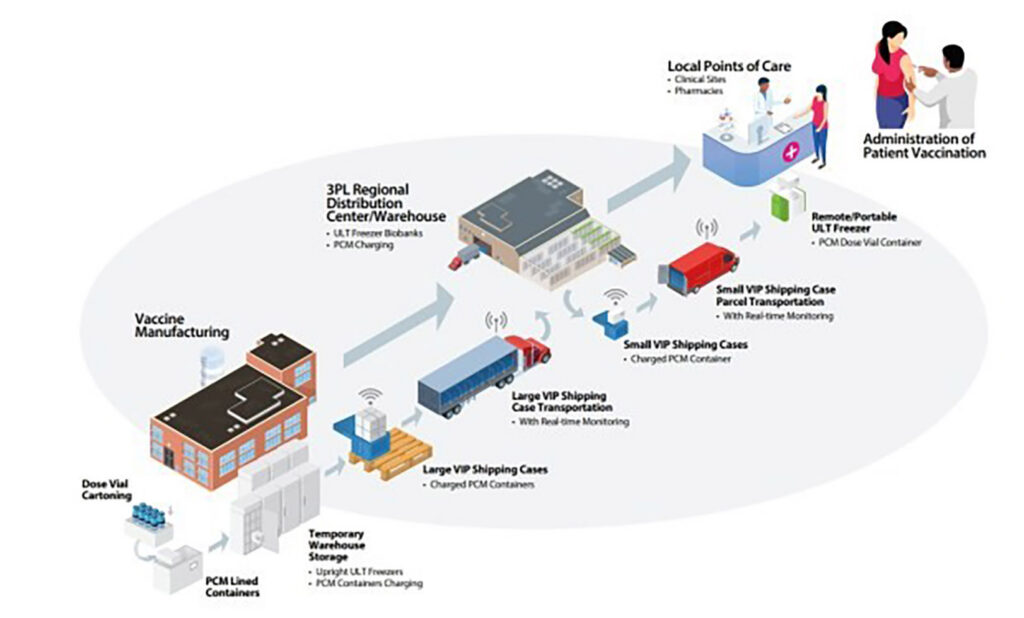
Vaccine Pods provides pharmaceutical companies, government organizations and NGOs the ability to streamline cold chain logistics by directly shipping a container with the vaccine safely stored in an ultra-low temperature (ULT) freezer that is powered by the container’s integrated power source.
[/pullquote]
“When COVID came about and affected so many people around me — I wanted to make a difference or at least do something to help,” Collins, a serial entrepreneur and retired battalion chief with the Kansas City Missouri Fire Department, said of his motivation to launch Vaccine Pods — a bootstrapped company that’s using mobile, solar-powered units to revolutionize the way vaccines are delivered, stored, and distributed.
“The [World Health Organization] put out a report that [found] 50 percent of all vaccines worldwide are thrown away every single year because of improper temperature control,” he explained of the root problem Vaccine Pods aims to solve.
Click here to learn more about Vaccine Pods.
“We were looking at the supply chain for the [COVID] vaccines and the cold chain management and realized that there was a break in the supply chain — primarily in and around the controlling of temperatures for the vaccines as they get distributed.”

Edward Collins, Vaccine Pods
Collins’ medicinal hubs promise to keep vaccines chilled to temperatures between minus 20 to minus 86 degrees celsius and offer customers such features as around-the-clock location monitoring and security, and a modular, detachable pod that runs on batteries — for upward of six days — that can be used in tight locations such as parking lot distribution centers or rural areas.
“Those carry 7,000 doses and our large freezer inside the pod carries 300,000 doses. It’s important to us that we don’t just recognize what we think is the problem, but to identify other people’s problems and then be responsive to those — to pivot and adjust to what the world needs, rather than something we want to sell.”
Developed over nine weeks, Vaccine Pods relies on support from Lenexa-based HCI Energy and Athens, Ohio-headquartered Stirling Ultracold, Collins added.
“HCI Energy, they’re incredible. They’ve been [providing similar power supplies] in the telecommunications field for years,” he said, noting the partnership uses a modified version of HCI Energy’s existing Hybrid Cube — which relies on onboard battery storage technology and a high efficiency power inverter.
Click here to learn more about Hybrid Cube and HCI Energy — ranked 11th on the Startland-powered list of Kansas City’s Top Venture Capital-Backed Companies.

Vaccine Pods interior
Stirling Ultracold boasts the only electric, commercial grade freezer in the world capable of reaching negative 86 degrees celsius — as required specifically for the Pfizer-manufactured COVID vaccine, Collins said.
“We think we have the opportunity to save millions of lives,” he added, detailing a future rollout that could see the pods stocked with additional freezers, kept at different temperatures to facilitate the distribution of a variety of vaccines — beyond COVID — from Asia to the United States to Africa and beyond.
“We’re the United States of America — the greatest country on earth — and we can’t get vaccines out to remote areas. This solves that problem.”
Watch a video story on Vaccine Pods from KMBC 9 below, then keep reading.
And while Vaccine Pods holds the potential for global impact, the mark it can make on Kansas City holds personal meaning for Collins, who in part has worked to end the virus in honor of his longtime friend and fellow Kansas City firefighter, Capt. Robert “Bobby” Rocha, who in November publicly lost his battle with COVID-19.
“He was a great man and an even better fireman. It was an honor to be able to call him a friend and we’re going to dedicate the first unit in his name,” said Collins. “Hopefully we can keep his memory alive.”
Further inspiration to help the metro heal from the effects of the pandemic came from Collins’ wife, who died last July — unrelated to COVID, he explained.
“If we make money as a byproduct [of saving lives] then so be it. But at the end of the day, we’ll lay our heads better on the pillow knowing we’ve done the right thing by helping people,” Collins said, urging Kansas Citians who’ve survived the pandemic to remember one thing.
“Life is fleeting. It’s precious.”
Featured Business

2021 Startups to Watch
stats here
Related Posts on Startland News
ECJC relocates office, updates brand
The Enterprise Center in Johnson County is shaking things up. The non-profit organization that connects entrepreneurs to the resources they need to grow revealed Thursday an updated website, brand identity, and new office location. “This move is the culmination of a long, strategic transition to ensure that as Kansas City’s entrepreneurial community changes, we change…
Former Sprint COO LeMay dishes on KC capital, failure
There are few people in Kansas City more connected into the area’s investor, corporate and startup community than FarmLink CEO Ron LeMay. Also now managing director of Kansas City-based OpenAir Equity Partners, LeMay frequently sees the successes and failures of the metro area’s capital landscape. The former Sprint COO recently spoke with dozens of Kansas…
RFP365 partners with Kansas City, raises $950K
On the heels of a six-figure raise, area tech firm RFP365 recently landed the City of Kansas City as a client for its software that eases the request for proposal process. The company’s deal with Kansas City was born from the city’s “Innovation Partnership” program, which affords entrepreneurs the opportunity to “test drive” their technologies…
Study: Gov should take long-term approach to grow new businesses
A recent study by the Ewing Marion Kauffman Foundation reports that while governments have long supported entrepreneurship, new business creation is waning. The study — Guidelines for Local and State Governments to Promote Entrepreneurship — found that new businesses comprised about 8 percent of all U.S. businesses in 2011, down from roughly 15 percent in the…