
Big win for UMKC: Unlocking top tier research status gives KC new competitive edge
February 14, 2025 | Tommy Felts

A new milestone for the University of Missouri-Kansas City — achieving status as Kansas City’s first Carnegie R1 research institution — is expected to help boost the region’s ability to start, grow and scale more startups, leaders said this week, emphasizing the role university-led research plays in innovation across industries and communities.
“It’s absolutely massive for Kansas City,” said Tim Cowden, president and CEO of the Kansas City Area Development Council (KCADC), noting the critical timing of such developments as the region prepares for the international spotlight of the World Cup. “R1 status elevates Kansas City on the world stage, attracting businesses, creating high-paying jobs and fostering a competitive edge in the global marketplace.”
The Carnegie Foundation on Thursday officially announced UMKC as one of 187 institutions given the R1 designation. It reflects a university’s commitment to high research activity, defined by a threshold of $50 million in total research spending and 70 research doctorates awarded annually. (UMKC spent $55 million, and awarded 134 doctorates.)
“From 2018 to 2023, UMKC more than doubled its research expenditures and almost quadrupled total research and sponsored grants,” said Mauli Agrawal, chancellor of UMKC. “And we are just getting started.”
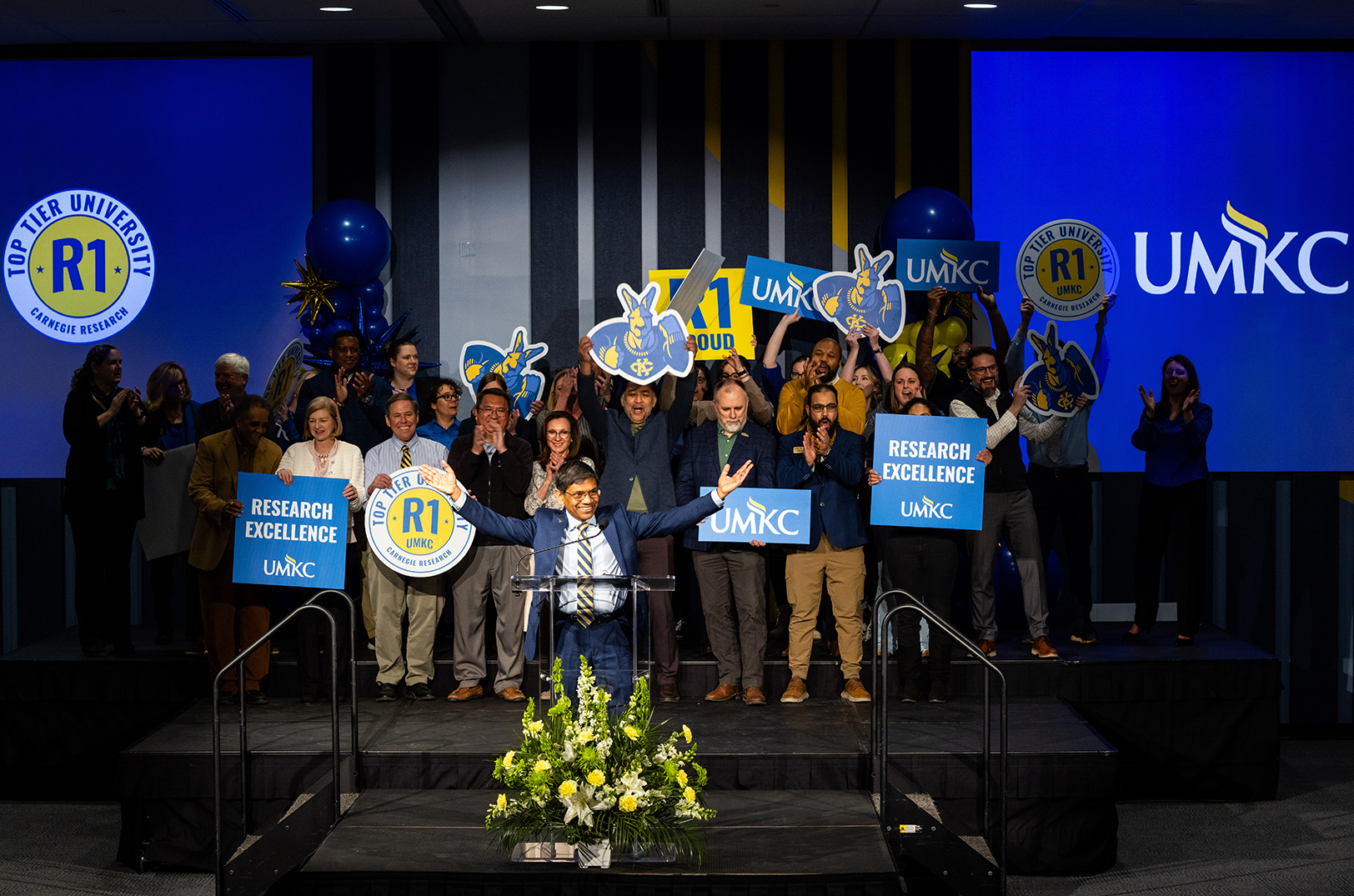
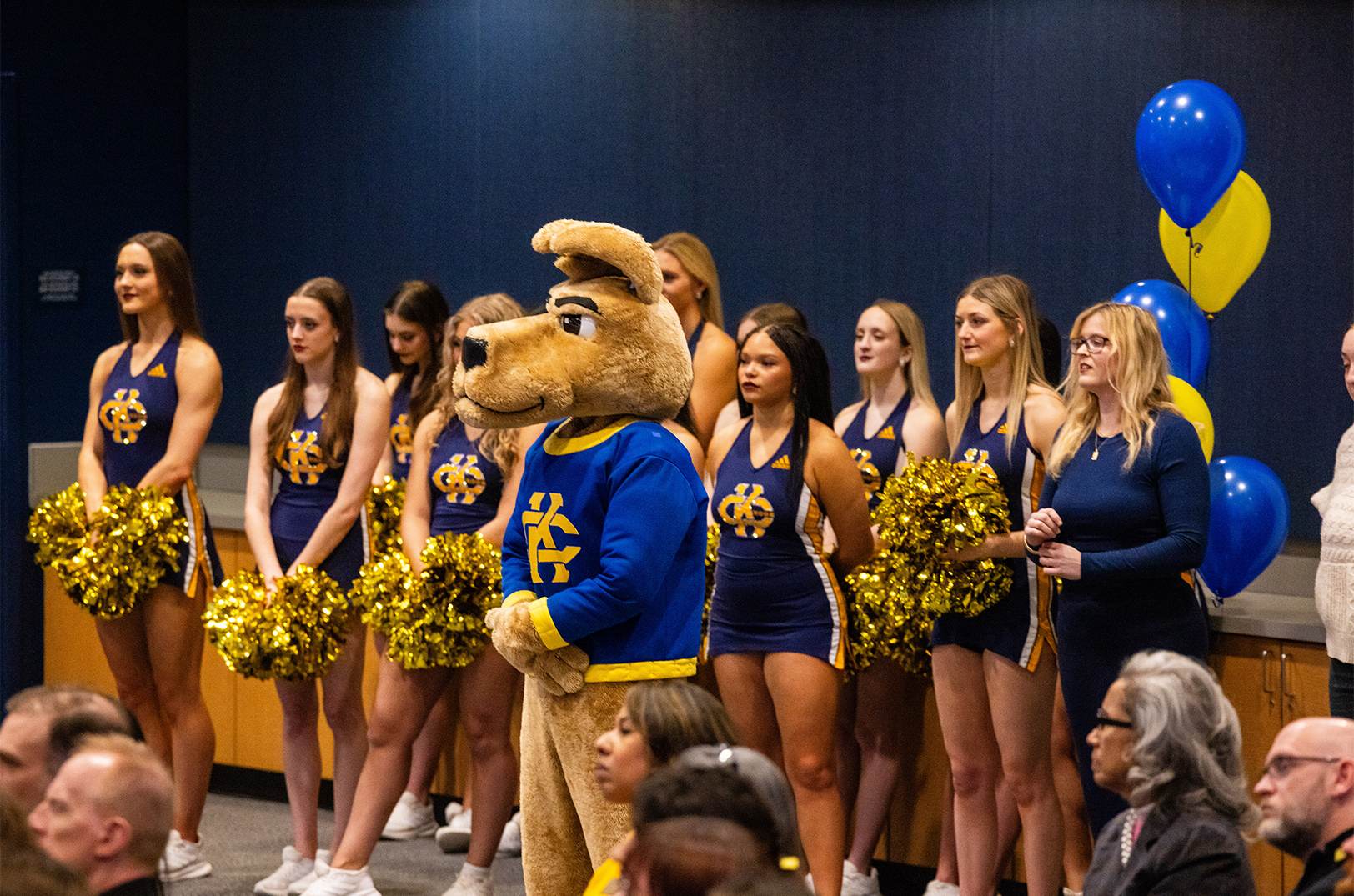
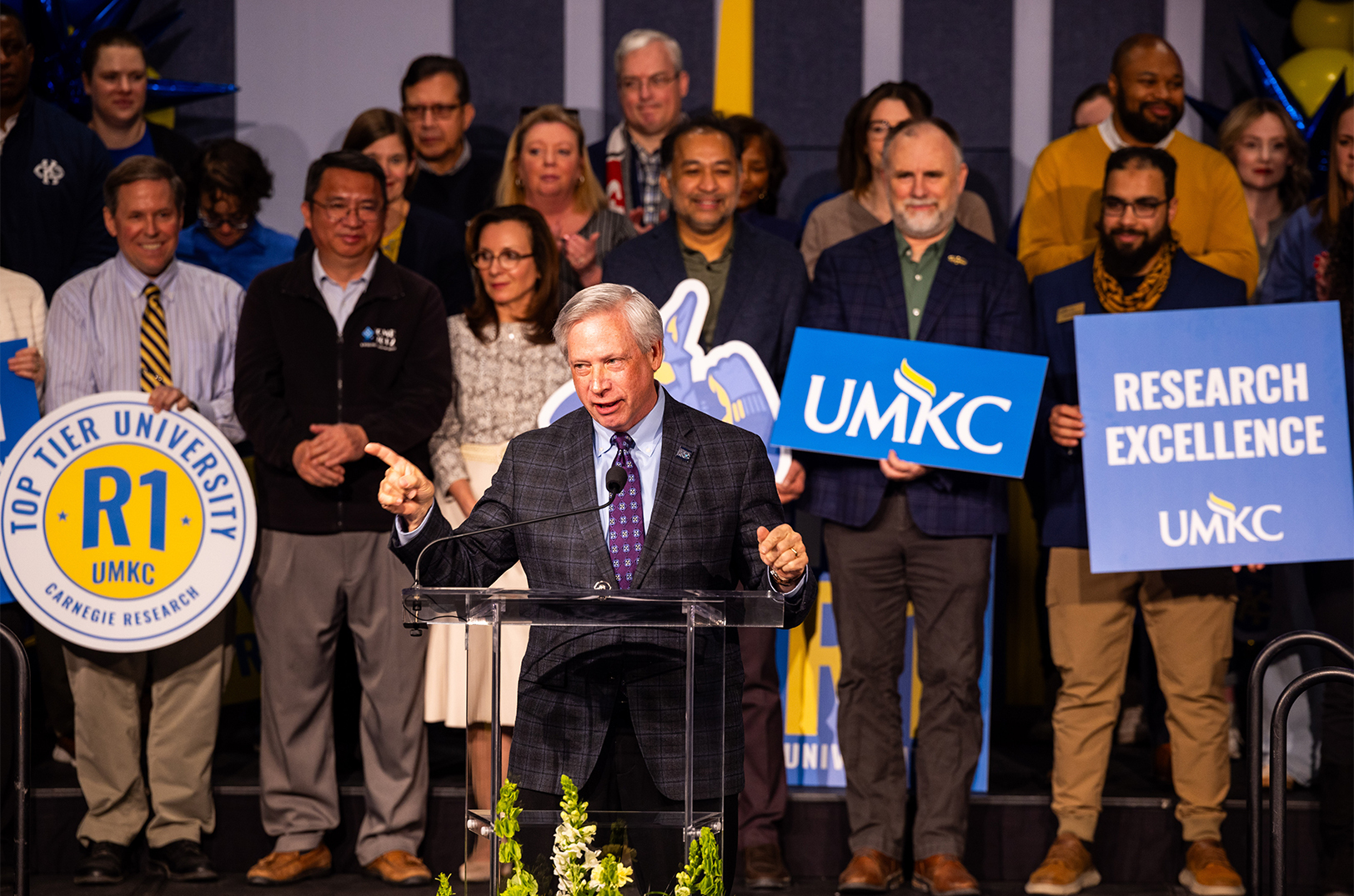
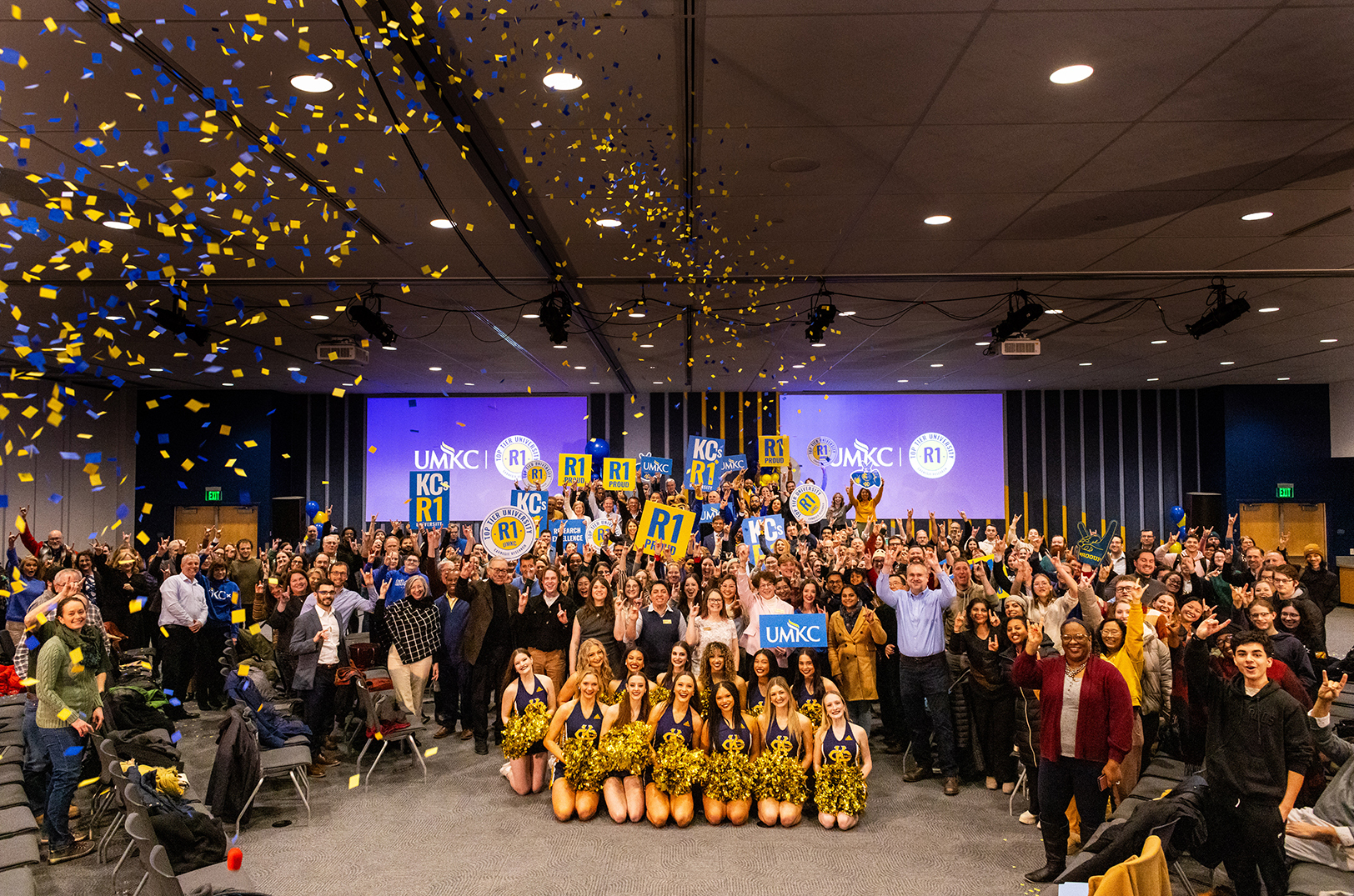
University leaders, students, economic development advocates and community members gathered on campus for a rally Thursday to celebrate the news — a big win for UMKC that was achieved five years ahead of a 2030 goal set in the university’s strategic plan.
“Carnegie is basically the crown at the top that recognizes you as one of the top research universities in the country,” Agrawal said, alluding to such existing R1 institutions as Columbia, Georgetown, Harvard, Johns Hopkins, Princeton, Stanford and Yale.
Click here to learn more about the behind-the-scenes efforts at UMKC to achieve R1 status.
“The affirmation of UMKC’s research enterprise as an R1 institution is a public demonstration of what Kansas City has known for a long time: UMKC is a world-class research institution,” said Melissa Roberts Chapman, president of the KC BioHub and Kansas City’s regional innovation officer. “What particularly excites me about this announcement is that UMKC’s efforts to grow its research enterprise have been paired with a strong focus on commercialization and entrepreneurship support.”
“This means that UMKC will continue to grow as a leader in scientific discovery, but also grow in the application of that research and its development into companies that drive our regional economy and improve the human condition,” she added.
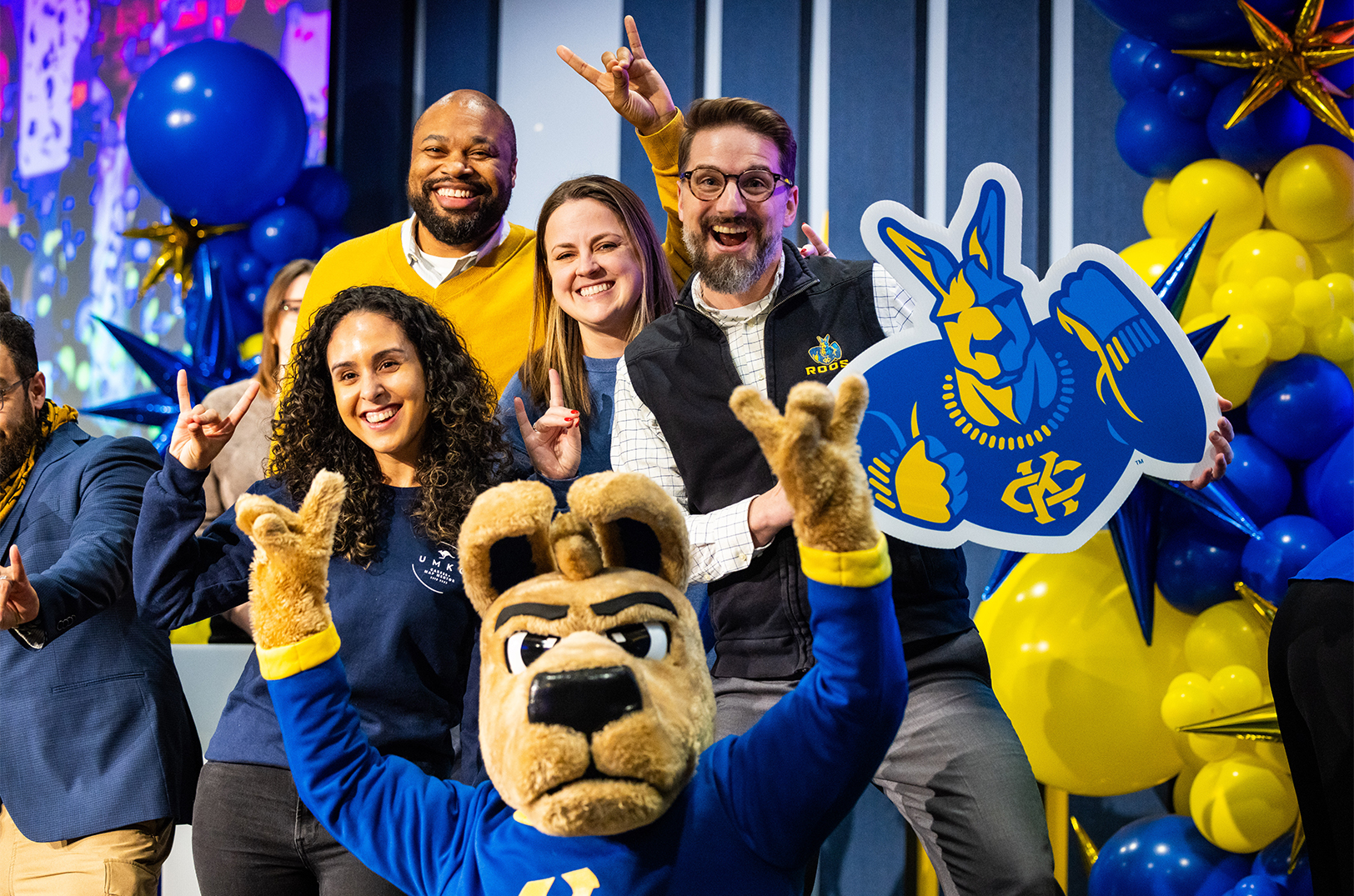
Kasey the Kangaroo, flanked by UMKC officials, celebrates the university’s new Carnegie R1 research status; photo courtesy of UMKC
UMKC’s key research areas include advancing healthcare, defense and more with specialties in electromagnetic radiation and energy; advanced and critical materials; unmanned platforms; artificial intelligence, cybersecurity and data science and digital humanities.
Tangible impacts — from attracting world-class talent and culture to boosting the learning environment for students — will have a lasting ripple effect, said Dr. DeAngela Burns-Wallace, president and CEO of the Ewing Marion Kauffman Foundation.
“Carnegie R1 status enhances UMKC’s ability to address critical issues, like access to opportunity and fostering entrepreneurial ecosystems, that are central to our work,” she said. “The university’s dedication to innovative, community-driven research will amplify efforts to create a more dynamic Kansas City economy.”
In addition to UMKC, Missouri University of Science and Technology — another University of Missouri System campus — and St. Louis University also achieved R1 in 2025.
Click here for the full list of this year’s research activity designations.
Other nearby R1 universities include the University of Missouri in Columbia and Washington University — as well as regional innovation research hubs at the University of Kansas, Kansas State University and University of Nebraska-Lincoln.
Leveraging these collective resources in tandem with UMKC’s new designation can cultivate a new era stretching far beyond campus boundaries, said Roberts Chapman.
“Now, we can say publicly what we have known for a long time: that our region is home to four R1 research institutions,” she said. “Together, our four R1 universities rival the research expenditures and impact of a top-25 research university. To realize that potential, they must continually expand their capacity and willingness to work collaboratively.”
“The next horizon for the growth and development of our regional research enterprise will be for our four research institutions to coordinate and collaborate as effectively and seamlessly as if they were one world-class institution,” Roberts Chapman added.
Featured Business

2025 Startups to Watch
stats here
Related Posts on Startland News
She scored music on Netflix and LA’s star-studded stages; now BodaciousThang is getting vulnerable in KC
When Cheyenne Jolene steps on stage in the shoes of her alter ego, the singer-songwriter’s voice carries both raw emotion and unapologetic truth. Performing as BodaciousThang, Jolene blends R&B, hip hop, rock, and soul into what she describes as “genre bending” music. Her songs are steeped in authenticity and storytelling, offering listeners intimate glimpses into…
SNAP cuts are ‘worse than they look on paper’: Food access advocates warn shelves could go bare overnight
Chef Shanita McAfee-Bryant doesn’t mince words about perceptions of the hungry Kansas Citians she serves daily through her award-winning culinary social venture. “These are the people who — if you listen to the rhetoric — are deemed ‘lazy,’” the founder of The Prospect KC’s NourishKC Community Kitchen told Startland News. “We know the narratives being…
LISTEN: Fermenting a clean future through products from meat alternatives to skin creams and baby formula
On this episode of Startland News’ Plug and Play Topeka founder podcast series, we chat with Francesca Gallucci of Natáur, a Baltimore-based biotech company that’s reimagining how essential nutrients are made. Combining synthetic biology, metabolic engineering, and eco-friendly fermentation, they’re producing bio-based taurine (and other naturally occurring sulfur compounds) without relying on petroleum. Gallucci takes…
KCMO slashes fees for outdoor dining permits, launches dining trail for grant winning projects
Kansas City has officially eliminated outdoor dining permit fees, reducing the cost from $850 to zero, thanks to the momentum created by a city-led initiative to encourage investment in outdoor dining experiences, city leaders announced this week, unveiling new plans to promote funded businesses and their projects. Launched in 2024, the Outdoor Dining Enhancement Program…