
UMKC Enactus team kicks open front door to Kansas City innovation scene with final four win
May 24, 2019 | Austin Barnes

As the number of teams left standing in the Enactus U.S. nationals started to dwindle, members of the competitive entrepreneurial development program’s team at the University of Missouri-Kansas City rode a pulsating wave of excitement and emotion, recalled Ali Brandolino.

University of Missouri-Kansas City’s Enactus team; Photo courtesy of Darcy Howe
“I started crying,” added Brandolino, UMKC Enactus vice president of operations. “It was the most incredible feeling in the entire world to be able to go [to the final four]. We knew in that moment, ‘Let’s get our crap together.’”
Click here to read more about the 80-plus student team’s fourth place finish in the Enactus U.S. Nationals, held earlier this month.
A long time coming for UMKC Enactus, previous years of competition — which included presenting such projects as FeedKC and Educate to Elevate — saw the team routinely placing in the top 16, explained Ben Williams, managing director of the Regnier Institute for Entrepreneurship and Innovation at UMKC, as well as the advisor for Enactus.
Prioritizing teamwork could have given the team an added edge to rise in the rankings, he noted.
“One of the things that this organization allows students to do is really take ownership of pieces. Ali, after being on the presentation team last year said, ‘I’m going to take ownership over this process,” Williams recalled.
To grow, any organization needs to have intentional processes in place, he said. Enactus is no different.
“I think the projects have slowly gotten more and more impactful. The team has gotten more and more impactful in figuring out what to do with such a large group of students. … That took a long time for the team to figure out,” Williams further elaborated, detailing the team’s trajectory.
Making the final four never crossed the mind of Enactus executive board member Mark Babcock, he said.
“My brain was like, ‘Oh, everyone else is great.’ Like, I just didn’t even consider it. I don’t know why, cause we’re pretty awesome,” he said. “Then they called everyone else and then I was like, ‘Wait, they didn’t say our name.’ And it was like, ‘Oh, crap. That means we made final four.’”

University of Missouri-Kansas City’s Enactus team; Photo courtesy of Darcy Howe
As another school year winds down on the UMKC campus, Enactus members aren’t planning trips or taking it easy: They’re focused on strategy and their eyes are locked on a first place finish in a probable 2020 return to the finals, said Andrea Savage, UMKC Enactus project leader.
“[I said,] ‘let’s get together, let’s start working on projects. We’re kind of working on that aspect with people who attended nationals and have that energy so that they can have something to work off of,” she said. “We also have four projects in the pipeline right now, of just people saying, ‘This is what I’m passionate about in the community and this is how I want to go about approaching it.”
Anticipated Enactus projects — which are based on global goals outlined by the United Nations — for the 2020 competition year include solving problems within the transportation and foster care systems, and working in the solar energy and water conservation spaces.
“That doesn’t necessarily mean that there’s not other ideas on the team,” added Babcock. “… There’s a million ideas that we as a team want to be able to focus our energy on.”
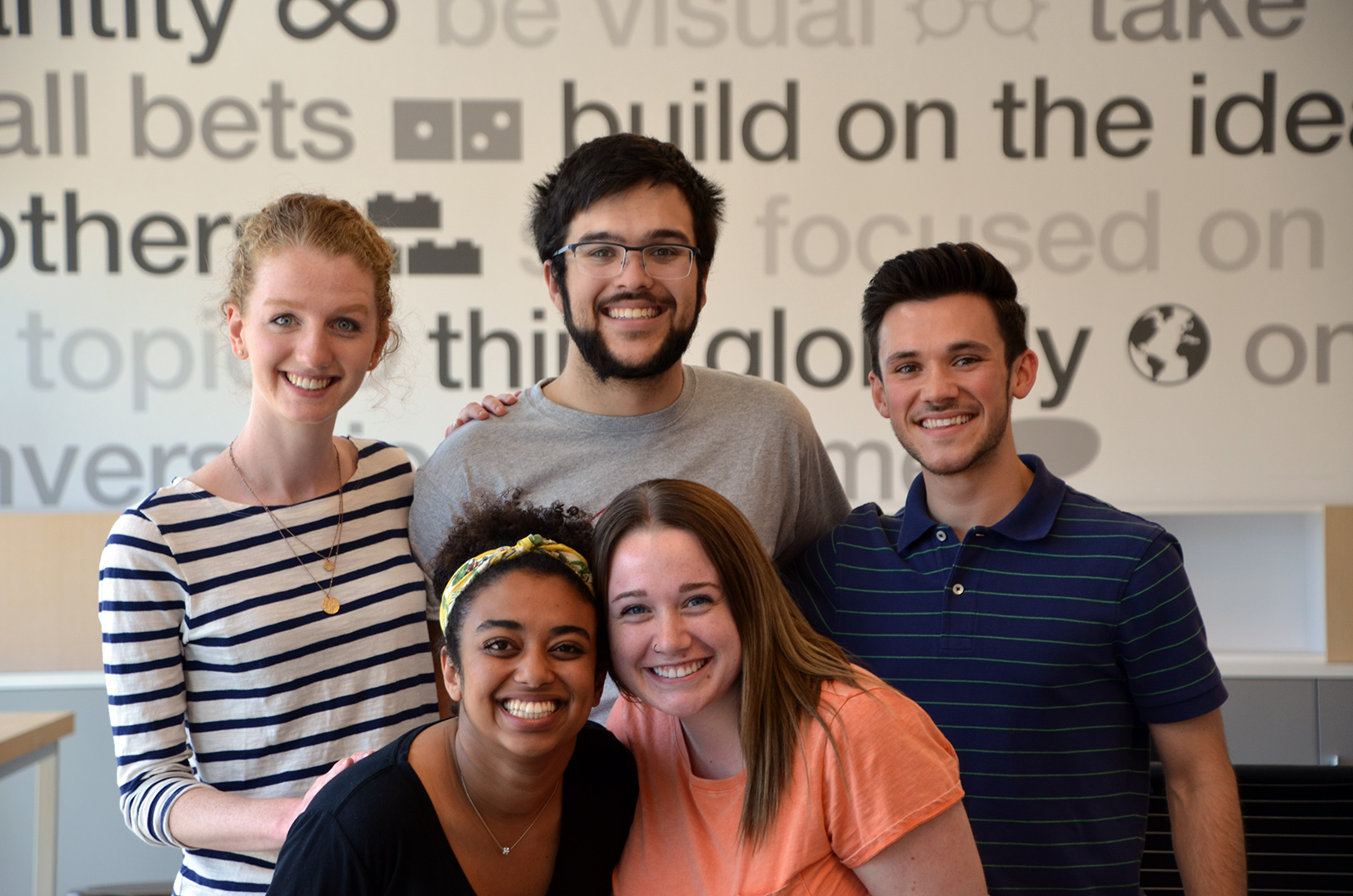
Andrea Savage, Mark Babcock, Alec Rodgers, Salem Habte, and Ali Brandolino, UMKC Enactus
Beyond project plans, the Enactus team is eager to see what new blood can do for their path forward, as a new executive boards begins their term with the program, added Salem Habte, president of the UMKC group.
“There’s no better way to get the students to really engage with Kansas City’s entrepreneurial community than to put them in project-based learning environments where they are forced to find a solution to a problem and measure that solution,” Habte explained of the ecosystem building work Enactus does in the metro.
“I think that’s really the x-factor for Enactus … we can do whatever we want, but the goal is to measure our impact. Giving students the freedom to figure it out and actually get messy and talk to people in the community — and make mistakes,” she said. “It’s what is going to push innovation [forward.]”
Habte, Savage, and Brandolino were also given the chance to serve internationally on behalf of Enactus in 2019. In April, the trio represented UMKC at the Unilever Future Leaders League case competition in London.
While International impact is equal parts impressive and important, the main goal of Enactus is to serve as a front door to local innovation, Williams highlighted.
“They’re finding needs in the community and trying to build scalable and sustainable solutions. Sounds an awful lot like a startup, right? So what they’re doing now is they’re preparing for life as entrepreneurs. They’re going out there into the world,” Williams said, referencing the program’s legacy.
“If you look at some of our graduates … Megan Darnell is the program manager over at Fountain City Fintech, helping develop the fintech ecosystem in Kansas City. Chad Feather is an analyst at KCRise Fund, helping develop the entrepreneurial community and provide capital to those entrepreneurs in need. Tin Ho [runs Lean Start Lab].”
Such community impact can be difficult to achieve when the majority of the entrepreneurial ecosystem — especially capital — isn’t aligned with the college age group, added Savage.
“We’re resource rich in information and connections, but we’re not necessarily that resource rich,” she explained.
While a handful of entrepreneurs, startup founders, and organizations — such as the Kansas City Plaza Rotary — have dedicated their time to work with Enactus in the past, more could be done if the group was better connected to the ecosystem and financial support from its movers and shakers, added Habte.
Helping hands could lead Enactus to further victory and enable them to blend the cultures of UMKC and Kansas City innovators, empowering the next generation of ecosystem builders to rise up and take action, the group noted.
Featured Business

2019 Startups to Watch
stats here
Related Posts on Startland News
Security firm Nodal nabs $100K, ramps up hiring
Good news is stacking up for Kansas City-based Nodal Industries. The security hardware tech company recently snagged $100,000 in seed funding as part of an opportunity to participate in the 500 Startup accelerator program, based in Mountain View, Calif. The funding will allow Nodal to hire up to eight people, as well as ramp up production…
Play-It Health lands in top-ranked digital health accelerator
As with many successful startups, the idea for Play-It Health was born out of personal experience with an unsolved industry need. Kim Gandy, a former clinician and now the founder and CEO of Play-It Health, recognized that patients were having trouble engaging and adhering to their medical regimen. In the worst cases, this led to…
LaunchKC, Techweek to welcome 10 tech firms to KC in style
In roughly four months, Kansas City will welcome a crop of tech startups bolstered by thousands of dollars in funding and a rockstar arrival. Kansas City’s LaunchKC competition — which aims to attract 10 tech firms to relocate to KC with $50,000 grants — has partnered with national tech conference Techweek to offer the winners…
New platform GUILDit offers art entrepreneurs visibility
A new program called GUILDit to promote and support art entrepreneurship is coming to Kansas City. The program is a bi-monthly gathering where art entrepreneurs take the stage to give six-minute presentations followed by questions and answers in the hopes of crafting a stronger Kansas City art economy, and to further connections between local artists.…