
Uber finds KCMO’s proposed ride-sharing regulations ‘troubling’
July 22, 2016 | Bobby Burch

In a move that will likely reignite lively discussions among government, businesses and residents, the City of Kansas City, Mo. is now considering changes to its ride-sharing regulations for companies like Uber.
By directive of the Kansas City Council, city officials are reviewing rules drafted in April of 2015 that aim to ensure public safety and encourage business participation for “vehicle for hire” firms. While devised amid heated discussions and demonstrations by Uber drivers, the regulations called for a more structured relationship between ride-sharing firms and the city in regard to information sharing and driver permitting.
Caught in a balancing act between public safety and accommodating popular transportation options, the city’s rules allowed Uber to operate, but ultimately drove away Lyft, which still cannot legally offer services within city limits.
Now roughly a year later, city officials say they’ve learned more about how ride-sharing firms can more safely and effectively operate in the City of Fountains. For weeks the city has culled public input on the proposed changes, which at this point focus largely on new processes for background checks, driver permitting and operational fees.
Rick Usher, assistant city manager for Kansas City, Mo., said that discussions on the proposed rules are centered primarily on safety.
“This is really a conversation about how effective the changes the council approved last year have been and where we think we need to go,” Usher said. “The major purpose of the code is public safety and beyond that is making access to new jobs.”
Usher said that he hopes to send the Kansas City Council a document of consensus on their proposed changes by this fall. Usher added that the city has discussed the proposed changes with Uber and Lyft, and plans to continue working with the firms. He encourages area residents to voice their opinions on KCmomentum.org in an ongoing virtual discussion on the regulations.
Here’s a quick summary on the proposed changes from the city:
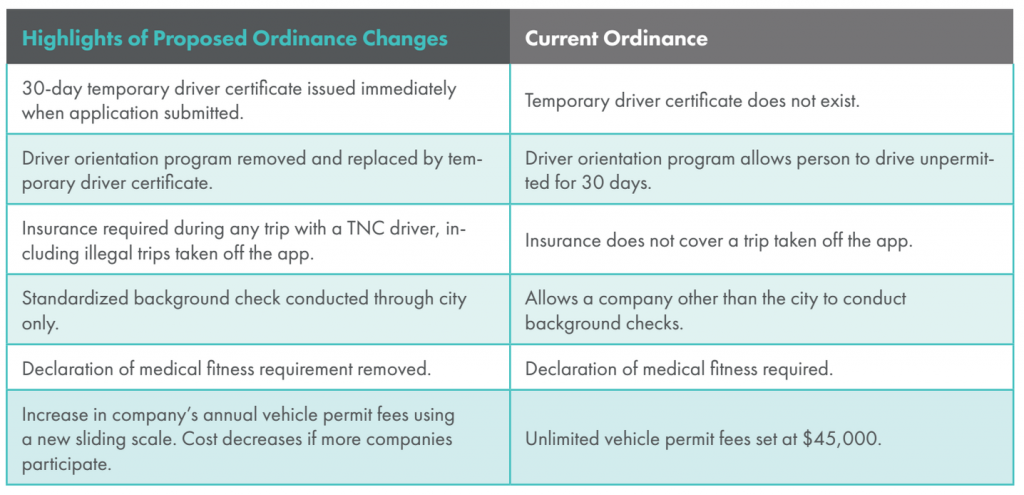
While the city is looking at a number of changes for vehicle for hire operations, arguably its two top considerations are regarding background checks and temporary driver certificates.
In Kansas City — and in all cities in which it operates — Uber hires a third-party firm to conduct background checks on its drivers. At least two Uber drivers with criminal records passed the company’s third-party vendor, which led the city to “question the quality and reliability” of the vendors. To remedy that, regulators would like to create a standardized background check, which would use a city-approved vendor.
The standardized background check process also would close a loophole on the 30-day trial period for drivers to ensure they complete the permitting process to legally operate in Kansas City. The change would create a 30-day temporary driver certificate issued immediately when the driver’s application is submitted. Regulators say that the proposed certificate would provide a way for customers, police and regulators to quickly ensure that the driver has at least started the permitting process.
The city received about 2,600 applications from Uber drivers in the fiscal year 2015 – 2016 — a more than 50 percent increase from the year prior, according to the city’s Regulated Industries Division. The city, however, offered permits to only 1,147 Uber drivers during that period.
While they’ve yet to be finalized, the prospective rules already have rattled Uber. Lauren Altmin, Uber’s spokeswoman in Missouri, said that, if passed, the regulations would make new obstacles for drivers to join the company.
When asked if Kansas City facilitating its own background checks on drivers would be an issue, Altmin said it would be unprecedented for Uber.
“After careful review, we find the proposed updates to Kansas City’s TNC regulations troubling,” Altmin said. “Drivers in Kansas City must already undergo a burdensome and duplicative process before they are licensed by the city. The changes up for consideration make it even more difficult for individuals to start earning money. We remain open to working with Regulated Industries, city council and Mayor James to find common ground for regulations that embrace innovation and promote economic opportunity.”
Promoting economic opportunity is also on the mind of Ryan Weber, president of the Kansas City Tech Council. Ryan said that the council — which represents dozens of small, medium and large tech firms in Kansas City — hopes regulators keep in mind that ride-sharing options are important to employers in the region.
Weber added that ride-sharing options maintain Kansas City’s status as a tech-friendly city and that it must embrace the sharing economy to become a top tech hub in the Midwest.
“I hope they keep in mind the precedent they could be setting,” Weber said. “If they are unable to come to terms with the ridesharing companies and they ultimately shut down, there will be a lot of frustrated employers and riders in Kansas City . … Our member companies have told us they exclusively use these services not just for business travel, but also to transport job candidates from the airport to the interview. It would be a big loss for our region’s ability to attract tech workers.”
Jim Ready, manager of Kansas City’s Regulated Industries Division, is joining Usher in reviewing the city’s current Uber regulations. He said there’s no need for users of Uber to fear the firm’s departure from the city.
Ready added that there’s a chance the city may ultimately decide to retain the ordinances as they stand.
“It’s all just discussions at this point,” Ready said. “We’ve got thoughts and ideas but it could come to pass that we or the City Council won’t make any changes. … We’re trying to figure out what works best. We want Uber to stay, we want Lyft to come and we want others to come in. We want business here — we don’t want to run folks out — but we’re also doing our best to safeguard the public.”
Featured Business

2016 Startups to Watch
stats here
Related Posts on Startland News
This AI keyboard can write your next email with the push of just one button; its creator says it could revolutionize workplaces
Hardware — not just software — should be at the forefront of the AI’s future, Jerry Hsu shared. After the successful release of its GPT-powered AI mouse, Jethro V1, in late 2024, Overland Park-based Virtusx — which is revolutionizing workplaces through integrating hardware and software to make AI-driving products more accessible and user-friendly — has…
Alexa, show me the winners: Storytailor leads Pure Pitch Rally prize tally ahead of tech launch
Storytailor’s marquee Pure Pitch Rally win comes at the perfect time for the Kansas City startup, its founders said. They’re preparing to roll out a new immersive storytelling platform through a partnership with Amazon’s Alexa+ next year — a move expected to bring their tech to more than 200 million Prime users. “It’s the most…
LISTEN: How the Midwest opened this German agtech company’s eyes to opportunity in the US
On this episode of our 12-part Plug and Play Topeka podcast series, we connect with Débora Moretti, co-CEO of NutriSen — a Berlin-based agtech startup building real-time molecular sensors to measure nutrient concentrations in plants directly on the field. Moretti shares how her team, alongside co-founder Tobias Vöpel, is merging biosensor technology, data-driven insights and…
Crossing lanes: KC Streetcar collaborators back aboard for expansion, dropping new merch, anthem
Opening the extended KC Streetcar line Friday completes a loop for creatives whose collaborations with the popular public transit system first emerged nearly a decade ago along Main Street — a time when Kansas City’s surging vibrancy helped curb streetcar doubters. “For us, it’s always been about representing Kansas City — the people, the culture,…