
The WTF Series: Compute Midwest inspires with floating trains, NASA’s plans
November 3, 2016 | Ben Kittrell

On a daily basis, Ben Kittrell translates the jargon-filled world of technology for clients of his tech consultancy. The Words that Frustrate (WTF) series aims to offer readers some clarity in an industry dominated by techies’ confusing argot.
On Wednesday, Compute Midwest brought world-class innovators to the Kauffman Center for the Performing Arts in Kansas City for a day of mind-blowing inspiration.
In its fifth year, the conference has continued to grow and announced that they’ll be adding a conference in Chicago next year.
It started with a futuristic look at what’s next for transportation according to Bibop Gresta, the COO of Hyperloop Transportation Technologies. Based on a white paper by Elon Musk, a hyperloop system would essentially be a “maglev” train in a vacuum tube.
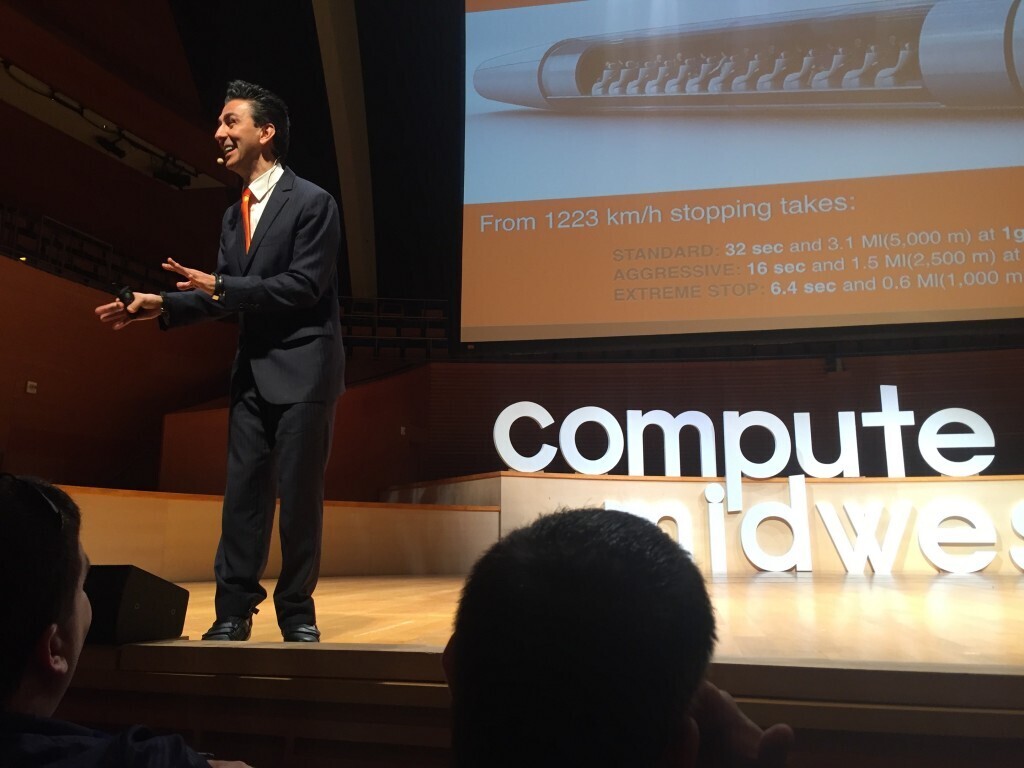
Bibop Gresta, the COO of Hyperloop Transportation Technologies
Maglev is a transportation system in which a train glides above a track thanks to magnetic repulsion and is propelled by a linear motor. It would travel at 700 miles-per-hour which could take you from Kansas City to Las Vegas in 30 minutes. Using renewable energy, the system would actually produce more energy than it uses and it would cost less than roads or rails to build.
Bob Metcalfe, inventor of Ethernet and founder of 3Com, delivered a humorous history lesson on the evolution of networks. If you’re having a WTF moment right now (words that frustrate), Metcalfe describes Ethernet as “the plumbing of the Internet.” His memories of the days before networks underscore just how much the Internet has changed our lives in a short amount of time.
In what was definitely the most entertaining talk, Kansas City native Adam Leibsohn, COO of Giphy made a hilarious, GIF-laden presentation.
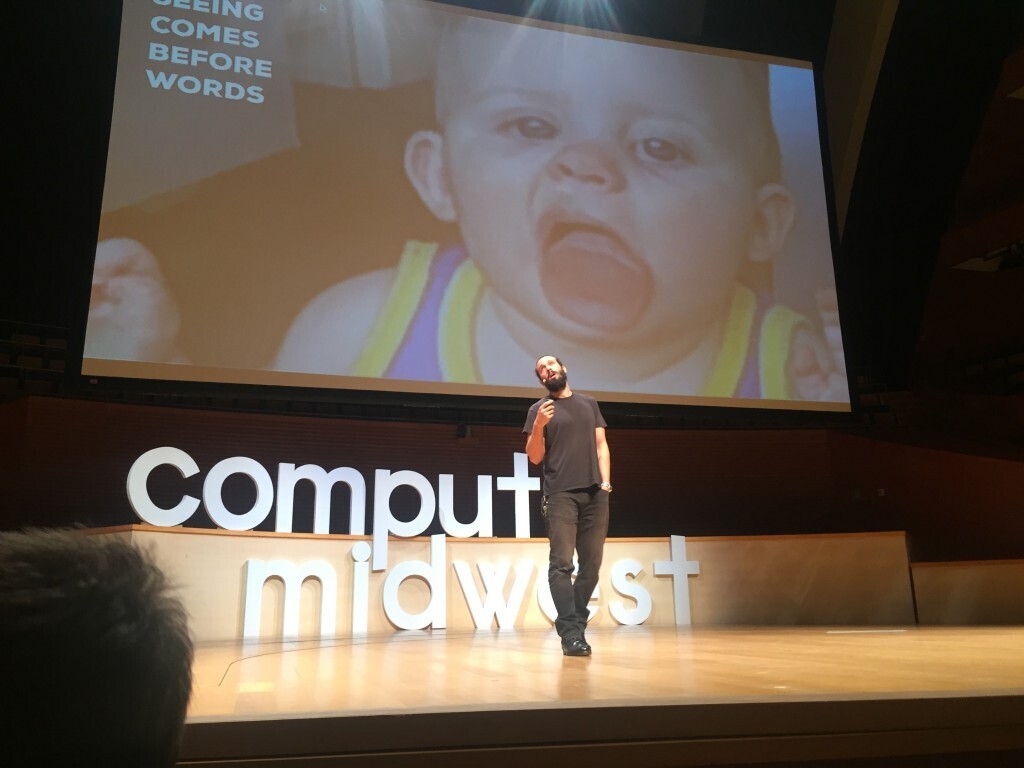
Adam Leibsohn, COO of Giphy
For those unfamiliar, a GIF — graphics interchange format — is a format for image files that supports both animated and static images that was created in 1987. It’s also an acronym whose pronunciation has sparked debates around the world.
Accompanied by an image of rapper 50 Cent in a car with Spongebob Squarepants’ Patrick in the backseat, Leibsohn definitively declared that a rule for the pronunciation, “Hard Gs for Hard Gs.” That pronunciation is a diversion, however, from its creator, Steve Wilhite, who said GIF is a spoken with a “soft G.” Looks like this important debate will rage on into the future.
Leibsohn made the case that human’s growing use of looped animated images from pop culture is a new form of communication. He believes that people “don’t have time for linear entertainment” such as a movie or book that “doesn’t make sense if you start in the middle.” His vision for the future is ‘micro-entertainment’ that fits into our five-second attention span.
In what was the most cosmic presentation, the engineering director for NASA returned to Compute Midwest to talk about the Mars rover coming up in 2020. Jordan Evans said that the new rover has expanded vision and research capabilities, and may include a separate helicopter to survey the Mars landscape. It will also bring equipment that NASA must test for the 2030 man mission to Mars, including a device that converts CO2 to Oxygen.
During the break, I printed myself. I stopped by a 3D printing station, had my body scanned and, voila, I transformed into a gray figurine.
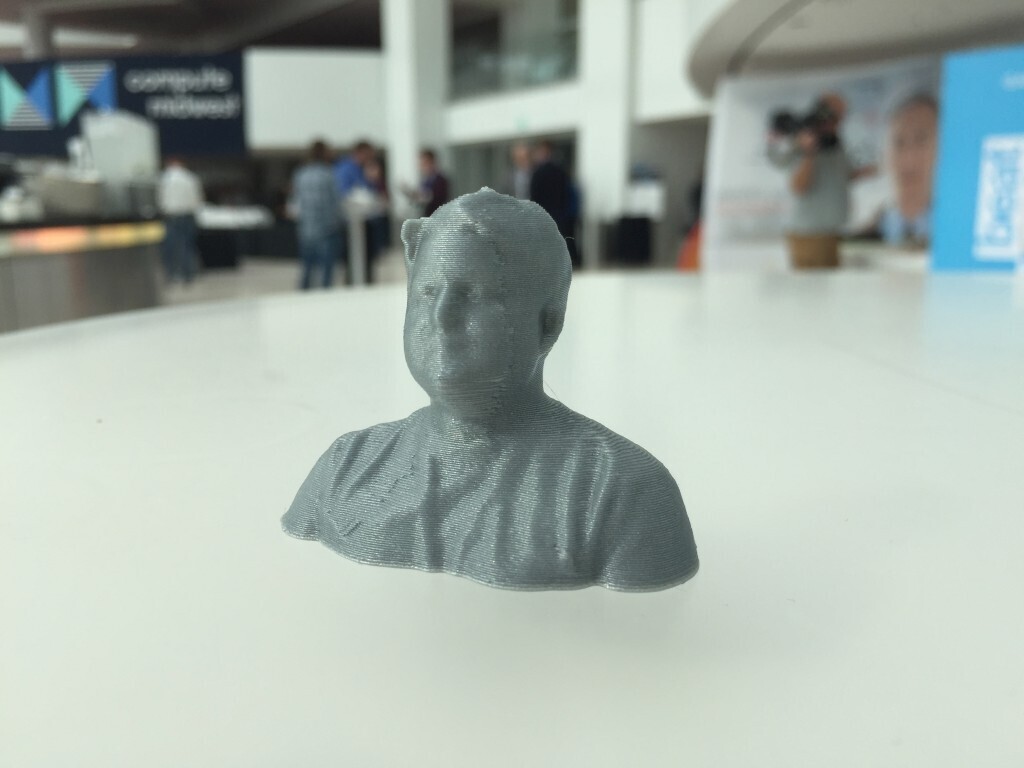
3D version of Ben Kittrell
After I placed myself in my bag, Biobots founder Danny Cabrera kicked off a discussion on the future of 3D printing. He created a 3D printer that uses biological material, which offers researchers an easy and affordable tool that integrates hardware, software and materials. Asked about concerns for how his devices may be used, Cabrera said that it’s currently limited to simple single cell tissue, but the goal is “to be able to design and print a living organism from your laptop.”
Kansas City’s Davyeon Ross discussed his firm, ShotTracker, and its recent funding raise from Magic Johnson and David Stern. Ross sat down with Fitz Tepper, a writer for the popular tech blog TechCrunch, for a fireside chat. They discussed Ross’ “bromance” with former NBA commissioner and now investor David Stern and ShotTracker’s mission.
“What WiFi is for coffee shops, we want ShotTracker to be for gyms,” Ross said.
As an innovator, you always need intellectual fuel. You need to know what the people at the cutting edge are working on and thinking about. That’s why Compute Midwest is my favorite conference every year.

2016 Startups to Watch
stats here