
TEDxKC speaker Shantanu Bala: Tech moves communication beyond words
August 23, 2017 | Startland News Staff

Editor’s note: Startland News is exploring a few of the most impactful quotes from speakers at Friday’s TEDxKC event at the Kauffman Center for the Performing Arts.
[divide]
“The blind cannot only lead the blind, but lead any of us who can see to experiences that we’ve never seen before.”
— Shantanu Bala
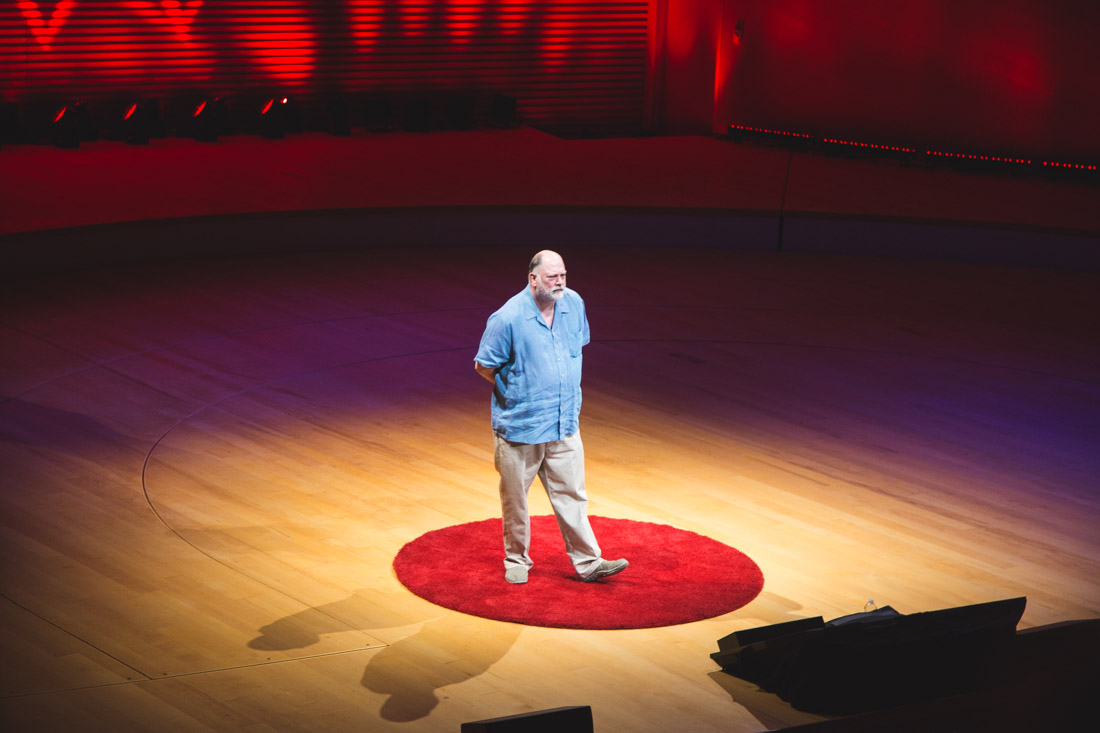
Think about the technology you interact with on a day-to-day basis, Somatic Labs founder Shantanu Bala encouraged the TEDxKC audience.
“You’re probably looking at a screen, whether that’s a laptop, a smartphone or a tablet. You’re checking emails, notifications, messages or alerts,” he said. “A lot of this information is presented in a context that is inaccessible to someone who’s blind.”
Although modern technology users have access to a new era of voice-controlled interfaces, like Alexa, Siri and the Google Assistant, such artificial intelligences that respond to speech also add another channel of disruption and intrusion, Bala said.
Communication involves a lot more than just words, he said.
“Even if you’re not bilingual, you all understand a second language. You understand the meaning of a handshake or a warm hug. You understand to pull your hand away from a hot stove,” Bala said. “And you understand this faster than you can read words printed on a page or even hear them spoken out loud.”
For any of the 285 million people in the world who are blind, a task as ordinary as checking the time can involve asking another person or turning up the volume on a phone and having it yell out that information, he explained.
“This is a cumbersome experience and it’s an accessibility problem, but I would also question the necessity of occupying anyone’s eyes or ears when we can intuitively understand things that we grasp with our hands,” Bala said.
Imagine if you treated your entire body as a programmable computer, he challenged the crowd.
Bala’s Somatic Labs offers software and hardware products that aim to enable a future of wearable devices that communicate through human feeling and touch.
“I’ve spent past eight years working on systems of silent and invisible communication because I believe the same computer interface that could help someone who’s blind to check the time without needing a pair of headphones, is the same interface that could power the future of human-computer interaction,” he said.
[divide]










2017 Startups to Watch
stats here
Related Posts on Startland News
ECJC relocates office, updates brand
The Enterprise Center in Johnson County is shaking things up. The non-profit organization that connects entrepreneurs to the resources they need to grow revealed Thursday an updated website, brand identity, and new office location. “This move is the culmination of a long, strategic transition to ensure that as Kansas City’s entrepreneurial community changes, we change…
Former Sprint COO LeMay dishes on KC capital, failure
There are few people in Kansas City more connected into the area’s investor, corporate and startup community than FarmLink CEO Ron LeMay. Also now managing director of Kansas City-based OpenAir Equity Partners, LeMay frequently sees the successes and failures of the metro area’s capital landscape. The former Sprint COO recently spoke with dozens of Kansas…
RFP365 partners with Kansas City, raises $950K
On the heels of a six-figure raise, area tech firm RFP365 recently landed the City of Kansas City as a client for its software that eases the request for proposal process. The company’s deal with Kansas City was born from the city’s “Innovation Partnership” program, which affords entrepreneurs the opportunity to “test drive” their technologies…
Study: Gov should take long-term approach to grow new businesses
A recent study by the Ewing Marion Kauffman Foundation reports that while governments have long supported entrepreneurship, new business creation is waning. The study — Guidelines for Local and State Governments to Promote Entrepreneurship — found that new businesses comprised about 8 percent of all U.S. businesses in 2011, down from roughly 15 percent in the…