
4 Techweek takeaways: KC can’t escape ‘cowtown’ (and shouldn’t try)
September 14, 2017 | Tommy Felts

Kansas City shouldn’t run from its “cowtown” label, Techweek KC presenters said Wednesday.
“We can celebrate agriculture, and we can also be hip and metropolitan,” said Kimberly Young, president of the KC Animal Health Corridor.

Techweek KC 2017
Sitting aloft the rooftop deck at Travois in the Crossroads, a panel of experts gathered an audience interested in learning about the future of the animal health corridor, which stretches from Manhattan, Kansas, to Columbia, Missouri. The region boasts 300 animal health companies — the largest concentration of animal health assets in the world, Young said.
The view Wednesday gave a vista of modern downtown, with the shimmering Kauffman Center for the Performing Arts at the forefront.
But, as Young noted, about a mile away rests an area inextricable from Kansas City’s history: the West Bottoms, a low-lying section in one of the oldest parts of the city that made it famous for its livestock exchange, stockyards and meatpacking.
“Cowtown” is Kansas City’s legacy and heritage, she said, as well as its future.
“The animal health corridor is the new Kansas City stockyards,” agreed Phil Glynn, president of Travois, a small business that raises capital for housing and economic development in Indian Country and played host to the Techweek event at its West 19th Terrace office space.
The symbolism of the Crossroads setting didn’t appear lost on Young.
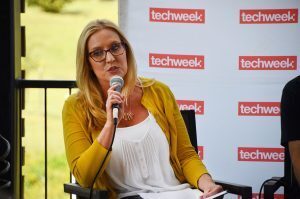
Kimberly Young, KC Animal Health Corridor
“We really are at the intersection and cross-section of technology and agriculture,” she told the crowd.
While work within the animal health corridor encompasses innovation aimed at everything from keeping livestock free from disease to protecting water sources halfway across the globe, talk Wednesday atop Travois quickly went to the dogs.
“When we think about animal health, we think about technology devices for our family pets,” said Young, who moderated the Techweek panel discussion. “In America, our pets are just as important to us as our children. We expect whatever is available for us to also be available for our pets.”
Below are three more takeaways from Wednesday’s conversation on the “Future of the Animal Health Corridor and Puppies in Tech.”
“Increase quality of life for humans by increasing quality of life for pets.”
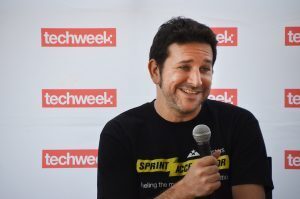
Davide Rossi, FitBark
Animal health is paramount for the quality of life for humans, Davide Rossi, co-founder and CEO of FitBark, said.
Kansas City-based FitBark is a data-driven pet technology company focused on motivating dogs and their owners to get active and stay healthy together.
“We all agree that pets need this,” Rossi said. “We want our pets to be around long. We want them to live great lives.”
FitBark builds collar sensors and software infrastructure to help humans in more than 120 countries take action on their pet’s activity, quality of sleep, calorie balance, behavior and overall health.
A secondary reward is in the side effect, Rossi said.
“Everybody keeps telling us, ‘Since starting to use this product with my dog, I have become more active myself.’ This is the magic behind what we do.”
“You can’t charge us human prices.”

Karthik Ramachandran, Likarda
Founded in Kansas City, Karthik Ramachandran’s biotech research laboratory, Likarda, focuses on developing cell-therapies and technologies for companion animals suffering from diabetes and other endocrine diseases.
“A question I get asked a lot: ‘You’re curing diabetes in dogs, why aren’t you doing this in humans?’ We get this from everyday people all the way up to big investors who want in on development,” said Ramachandran, vice president and co-founder of Likarda.
His answer: There’s already a lot of competition — and innovation — happening in research for humans.
“When people in companies put money into this, they’re putting it into humans because they see billion-dollar opportunities,” he said. “Animals tend to get lost in the mix. They still generate a decent product at tens of millions of dollars, even 100 or 200 million dollars. It’s just not exciting for a lot of people.”
In the health industry, animals are second-class citizens, he said, but they get the exact same diseases as humans. Another gap comes from the amount people are willing to spend to cure a human versus treating an animal for the same affliction, he said.
“That’s where innovation comes in, looking for better options,” Ramachandran said, noting breakthroughs for pets have come when more affordable resources and testing were available. “There are more dogs that have been cured in research than humans who have been cured. It just wasn’t priced right.”
“There’s no earthly reason to feed your dog one diet (but if you …)”

Sam Al-Murrani, Prommune Inc.
After making the jump from the world of academia, to medical school to a cancer research program, Sam Al-Murrani found himself making dog food at Hill’s Pet Nutrition in Topeka, he said.
The pet food was specifically engineered as a single source diet — unnecessary for dogs in its singularity, but designed for the Hills’ product to have a big, healthful impact because of it, said Al-Murrani, now president and CEO of Overland Park-based Prommune Inc., a developer of vaccines and immunoactivators that focuses heavily on preventing diseases in swine.
“Because we feed one food to most of our dogs … that’s a major way to push the health of the dog one way or another,” he said. “You are what you eat. And when you eat well, you’re happier overall.”
With that principle, Al-Murrani and Hills delved into nutrigenomics — studying the interaction of nutrition and genes as they relate to the prevention and treatment of disease — with a program that designed the dog food to activate positive health within the body, as well as dampening negative health outcomes, he said.
Featured Business

2017 Startups to Watch
stats here
Related Posts on Startland News
This AI keyboard can write your next email with the push of just one button; its creator says it could revolutionize workplaces
Hardware — not just software — should be at the forefront of the AI’s future, Jerry Hsu shared. After the successful release of its GPT-powered AI mouse, Jethro V1, in late 2024, Overland Park-based Virtusx — which is revolutionizing workplaces through integrating hardware and software to make AI-driving products more accessible and user-friendly — has…
Alexa, show me the winners: Storytailor leads Pure Pitch Rally prize tally ahead of tech launch
Storytailor’s marquee Pure Pitch Rally win comes at the perfect time for the Kansas City startup, its founders said. They’re preparing to roll out a new immersive storytelling platform through a partnership with Amazon’s Alexa+ next year — a move expected to bring their tech to more than 200 million Prime users. “It’s the most…
LISTEN: How the Midwest opened this German agtech company’s eyes to opportunity in the US
On this episode of our 12-part Plug and Play Topeka podcast series, we connect with Débora Moretti, co-CEO of NutriSen — a Berlin-based agtech startup building real-time molecular sensors to measure nutrient concentrations in plants directly on the field. Moretti shares how her team, alongside co-founder Tobias Vöpel, is merging biosensor technology, data-driven insights and…
Crossing lanes: KC Streetcar collaborators back aboard for expansion, dropping new merch, anthem
Opening the extended KC Streetcar line Friday completes a loop for creatives whose collaborations with the popular public transit system first emerged nearly a decade ago along Main Street — a time when Kansas City’s surging vibrancy helped curb streetcar doubters. “For us, it’s always been about representing Kansas City — the people, the culture,…