
UV light really can kill Coronavirus, founder says — and his tech proves it from the inside
July 2, 2020 | Austin Barnes

Outfitting existing HVAC systems with ultraviolet lighting in offices and public spaces could be the most sustainable, long-term solution to eliminating the Coronavirus — and fears over returning to work, said Dave Ogle.
“I know there’s a lot of jokes. President Trump [talking about] sticking UV up people’s rear ends — which is total nonsense,” joked Ogle, founder of Tech-UV, referencing skeptics of UVC technology who’ve dismissed its power based on the commander in chief’s now infamous faux pas.
“They just didn’t understand how UVC has been effective for treating bacteria, germs and viruses and it goes back a long way,” he continued, detailing beginnings of the virus-killing solution that date back to the 1800s, as well as get-rich-quick schemes that are using its promises to cash in with misleading products on retail sites like Amazon.
“They’re way off spectrum. They’re just purple light. And people are buying these by the droves and scanning their phones and keyboards and other things in the house thinking like, ‘Oh, this is a disinfectant,’ when actually it doesn’t work at all,” he said.
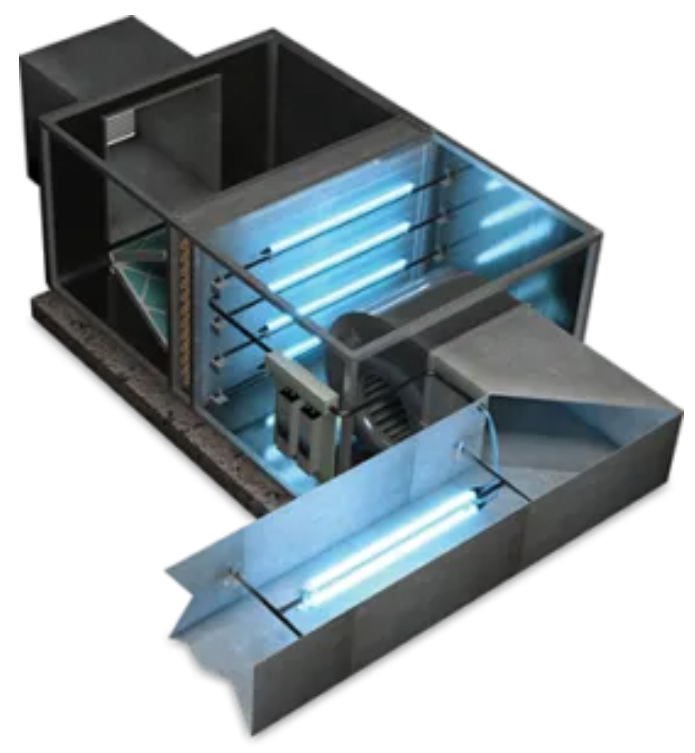
Lawrence-based Tech-UV: Ultraviolet Germicidal Systems — Ogle’s pandemic-founded startup spun out of a 25-year career in HVAC maintenance — builds on a family-owned business that’s been offering installation of UVC lights in systems for decades.
But until recently, the technology has seen little interest, he said.
“It was very few and far between. You could only sell it if there was already a situation in the building — like really dirty air, if there was high humidity with a high occupancy, or moldy ductwork,” he explained.
As COVID-19 crept in, so did opportunity, Ogle added.
“[There are four types of ultraviolet light]. The really potent UVC — which is 250 to 260 nanometers in wavelength — that’s the really harsh stuff. That’s the kind of stuff that will burn your skin, burn the cornea of your eyes. It’s lethal,” he explained, noting that by hiding the powerful light inside air ducts it creates a safe barrier that can’t harm humans and annihilates airborne pathogens pushed through the air in a way that’s chemical-free.
“We found that Coronavirus is really easy to kill. In fact — over a square meter — if you do a one-second pass through of a lighting rack with one-second exposure time, Coronavirus 99.9 percent of the time is dead with about 40 Watts of UV,” Ogle explained, adding such a success rate with a low wattage makes the virus no match for a second pass.
“It will not survive it. Boom.”
Click here to read more about how Tech-UV works.
In recent months, more than 60 businesses and office buildings have bought into the promise of Tech-UV, including the Charles Curtis State Office Building in Topeka — home of the Kansas Department of Health and Environment.
“Isn’t that ironic?” Ogle asked, amused by the ties and how his months-old startup could ultimately prove to be the necessary solution that gets state workers back into the office.
“The Curtis Building will be the single largest project we’ve ever taken on, without a doubt,” he said of the project — which came to Tech-UV as part of a partnership with P1 Group, the Lenexa-based facility maintenance and construction company.
“The air handlers inside their building are absolutely massive and they’re moving a crazy amount of air. There’s five floors total and each floor is moving 57,000 cubic feet per minute,” he said, noting more than 5,800 watts of UV will be installed in the air ducts on each floor.
Project contractors and decision makers in Topeka were immediately impressed by the Tech-UV data and couldn’t say no to taking a chance on the emerging disinfecting method, Ogle said.
“We see doing every state, county, and city building in the State of Kansas without a doubt,” he said. “And we will have the data from the Curtis Building after the install and can show everyone, ‘Hey, this is real and it works.’”
Even without data, customers are lining up to try the cost effective solution as they entertain reopening facilities, Ogle said.
“It’s not that expensive. We bid [a dental clinic] at like $4,600 and the bulb change out is less than 300 bucks a year,” he said. “We’ve got office buildings between Wichita, Kansas City, Lawrence and Topeka lined up. … The demand is going to be so large.”
Featured Business

2020 Startups to Watch
stats here
Related Posts on Startland News
André’s planted its flag in KC 70 years ago; chocolatier says that’s just a taste of what’s to come
Nearly 5,000 miles from Switzerland, a small group toured the inner sanctum of an iconic 70-year-old Kansas City company — a family-run brand that helped redefine accessible luxury in the Midwest, one Swiss chocolate-covered almond at a time. “What people get excited about André’s is the legacy, that we take a lot of pride in…
Here’s how ULAH’s new boutique model aims to rack success for local brands, not inventory debt
The new KC Collective consignment-based program for local brands at ULAH is a win for both the Westwood boutique and Kansas City creatives, said Joey Mendez and Buck Wimberly, announcing a fresh model to help the struggling store stay open and financially stable. “We’ve always had local brands,” said Mendez, co-founder of ULAH, explaining the…
Tiki Taco ticks up giving alongside expansion; CEO owns up to taco shop’s neighborhood impact model
A month-long campaign in the popular Kansas City-based chain offers easy add-on: joining KC GIFT’s network of donors Restaurant executive Eric Knott wants Tiki Taco’s operators to own the neighborhoods into which the popular taco shop expands, he said, but that doesn’t just mean dominating the fast-casual market in each pocket of Kansas City. “Our…