
T-shirt printer GOEX hopes to clad workers in dignity
October 4, 2017 | Tommy Felts

A Kansas City T-shirt screen printer has a lofty mission: Turn local purchases into global impact.
“Your dollar has value in how it’s treating others across the world,” said Ryan Hudnall, engagement director at the Global Orphan Project.
Tucked away near Wyandotte and 31st streets, GOEX serves as an offshoot of the Global Orphan Project, a non-denominational international orphan care ministry. The nonprofit operation launched GOEX as an apparel industry startup in 2015 with the intent of feeding dollars from wholesale and retail sales back into residential care and orphan prevention efforts in Haiti, East Africa, India and the Middle East, Hudnall said.
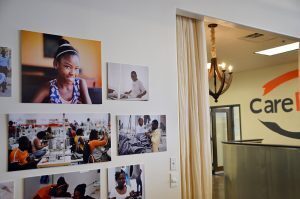
Global Orphan Project
As part of its global vision, GOEX’s production chain sends fabric from the United States to a warehouse in Haiti that the nonprofit helps control as a minority owner and key investor. There, seamstresses sew the T-shirts before they are returned to Kansas City for screen printing and distribution, Hudnall said.
“We own the whole vertical chain, allowing us to control the payment to the workers — to ensure they’re receiving a living wage — the quality of the working conditions and the relationships to our customers here,” he said.
Workers at the Haiti warehouse are paid twice the local minimum wage, he added, which GOEX considers a living wage.
“All of it is about the dignity of the worker,” Hudnall said.
It’s important to look beyond the preconceived notions of poverty and crime that Americans might imagine about the island country, he added.
“If you were to go with us on a trip to Haiti, you would encounter beauty in the most incredible places. You would see these children with nothing in the world, but they have joy. It overwhelms you,” he said.
GOEX’s focus also extends to its Kansas City employees, Hudnall said.
“We advocate for the quality of pay and working conditions for our workers in Haiti, but also for our workers here,” he said. “We hope — and we’re not there yet — but we hope to be a job engine here in Kansas City as well.”
“Employing someone is incredibly special,” he added. “To have the ability to invest in someone’s life through a job — that’s a gift.”
Finding an identity
It started with pajamas, then an online marketplace for women in impoverished areas to sell their wares. Finally, the operation evolved into a T-shirt printing venture. The facility on Wyandotte Street followed in November 2016.

GOEX, Global Orphan Project
“We know who we are at our core, but we’re still trying to attract customers who buy into our mission,” Hudnall said, noting the higher price point of GOEX’s goods because of the nonprofit’s commitment to higher wages for workers. “We’re still struggling with some of the same challenges all entrepreneurs face: breaking into new markets, identifying our ideal customer base.”
While GOEX features an online retail store for direct-to-consumer sales, most business comes through the wholesale screen printing operation, which can accommodate orders from 24 T-shirts to the thousands, Hudnall said. Most local bulk purchases have been from schools, churches, breweries and coffee roasters, he added.
“We have noticed a trend in Kansas City toward caring about purchases, and the workers behind the purchase. So we’re excited that Kansas City is our hub and our home,” Hudnall said, noting Kansas City serves as the headquarters of the Global Orphan Project, its founders and executive team.
GOEX hopes worthwhile sentiments like “Buy American” and “Buy Local” can be adapted to a consumer consciousness that considers an even broader range of purchase-based social and human effects, he said.
“The idea of the consumer attaching some value to how or where a product is made is not new. But it’s a new world now,” Hudnall said. “We are so interconnected. Through social media, the internet, there is a platform for us to understand how others in the world are living.”
CarePortal
At home, children are struggling too, Hudnall acknowledged.
In addition to its international orphan care ministry, the Global Orphan Project launched a tech-based domestic effort, called CarePortal, in March 2015. Using technology created, in part, through key contributions from volunteers, the portal connects the needs of struggling children with those who are in a position to help, he said. The effort aims to address issues related to foster care, adoption and transition.

CarePortal metro coverage area
“CarePortal is built on the idea of collaboration. It’s trying to leverage technology to innovate in the child welfare system,” Hudnall said.
Using the platform, social workers enter the need of a child into the portal. It then is distributed to all those enrolled to help (typically churches), followed by real-time aid.
One recent example came from Rice County, Kansas, where $400 was requested through the portal to purchase a sleeper sofa to help preserve the kinship placement of four children, ages 6-13, who were sent by foster care to live with their grandparents.
“You have all these social workers who have identified the need, but are just treading water trying to identify resources. You have local churches, carrying the mandate to care for the vulnerable, but unaware of the need,” he said.
The greatest outcome is to produce a situation in which families can stay together, Hudnall said.
“Instead of saying, ‘We need foster parents.’ Well, what if you could stabilize the family so that the child never has to go into the foster care system?” he asked.
CarePortal passed the milestone of impacting 15,000 children in early September, Hudnall said.
“We want to help families in real time. It’s our responsibility,” he said. “We’re not looking to maintain the status quo. We want to transform the child welfare system. And technology is a big piece of that.”
While the nonprofit piloted the program in Austin, Texas, its second market was Kansas City — now the most thriving when it comes to impact, Hudnall said.
“We are concerned about the state of the children and families in our hometown, whether it’s through jobs or the child welfare system,” he said.

2017 Startups to Watch
stats here
Related Posts on Startland News
André’s planted its flag in KC 70 years ago; chocolatier says that’s just a taste of what’s to come
Nearly 5,000 miles from Switzerland, a small group toured the inner sanctum of an iconic 70-year-old Kansas City company — a family-run brand that helped redefine accessible luxury in the Midwest, one Swiss chocolate-covered almond at a time. “What people get excited about André’s is the legacy, that we take a lot of pride in…
Here’s how ULAH’s new boutique model aims to rack success for local brands, not inventory debt
The new KC Collective consignment-based program for local brands at ULAH is a win for both the Westwood boutique and Kansas City creatives, said Joey Mendez and Buck Wimberly, announcing a fresh model to help the struggling store stay open and financially stable. “We’ve always had local brands,” said Mendez, co-founder of ULAH, explaining the…
Tiki Taco ticks up giving alongside expansion; CEO owns up to taco shop’s neighborhood impact model
A month-long campaign in the popular Kansas City-based chain offers easy add-on: joining KC GIFT’s network of donors Restaurant executive Eric Knott wants Tiki Taco’s operators to own the neighborhoods into which the popular taco shop expands, he said, but that doesn’t just mean dominating the fast-casual market in each pocket of Kansas City. “Our…