
His portable lab can detect COVID in saliva within minutes; how this former Navy SEAL’s startup is expanding its target
April 13, 2022 | Channa Steinmetz

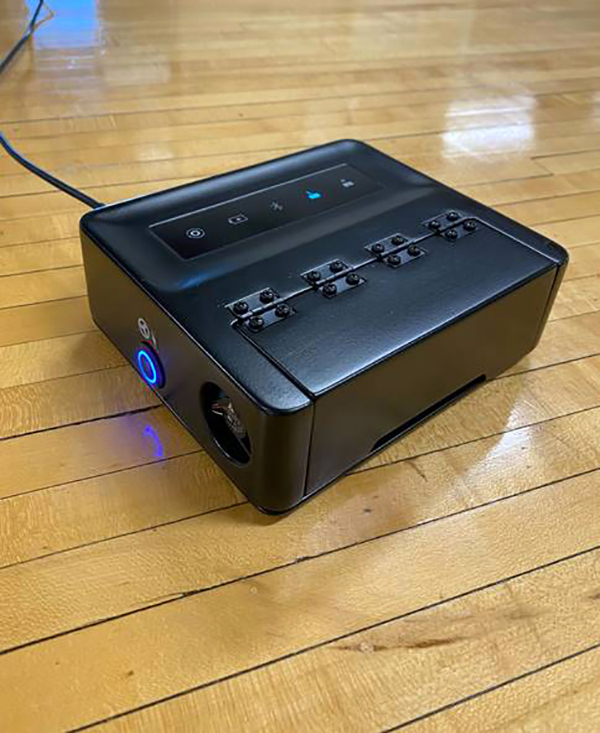
Foothold Labs is on a mission to develop a next-generation, portable diagnostics system that can not only rapidly detect infectious diseases in saliva within five-to-eight minutes, but also indicate deadly contaminants in other common substances, shared Sean McIntosh.
“To get equivalent results to our technology, someone would need to submit a sample to a professional lab, which would take two-to-six hours depending on what they’re testing,” explained McIntosh, the CEO and founder of Olathe-based biotech startup Foothold Labs.
Click here to check out Foothold Labs’ technology.
McIntosh first sparked an interest in lab-on-the-chip technology, specifically diagnostic technology, when he joined the military in 1999, he recalled. After 14 years as a Navy SEAL, McIntosh moved back home to Kansas City to begin his entrepreneurial journey.
“[My time in the military] gave me a lot of technical background; for the last year and a half, I was a technical product manager,” McIntosh said. “I managed several sensor programs, and that gave me the confidence to work on technology and to work with engineers.”
Along with technical knowledge, McIntosh’s experience in the military gave him the perseverance he needed to become an entrepreneur in Kansas City, he added.
Foothold Labs was founded in 2018 with the goal to build a device that utilizes lab-on-the-chip technology that would have 80 percent of the capabilities of machinery in a professional lab, McIntosh said — noting how this technology (known as the NanoRev System) would make testing more accessible to entire communities.
“It only takes about four hour of training to use our system effectively, versus laboratory equipment that takes multiple years and a master’s degree in some cases,” McIntosh said.
In human saliva, the Foothold Labs’ technology is currently able to identify COVID-19 virus, stress and fatigue biomarkers and tobacco. In other solvents, like water and alcohol, the technology can recognize pesticide residue, lead and heavy metal and gunpowder residue.
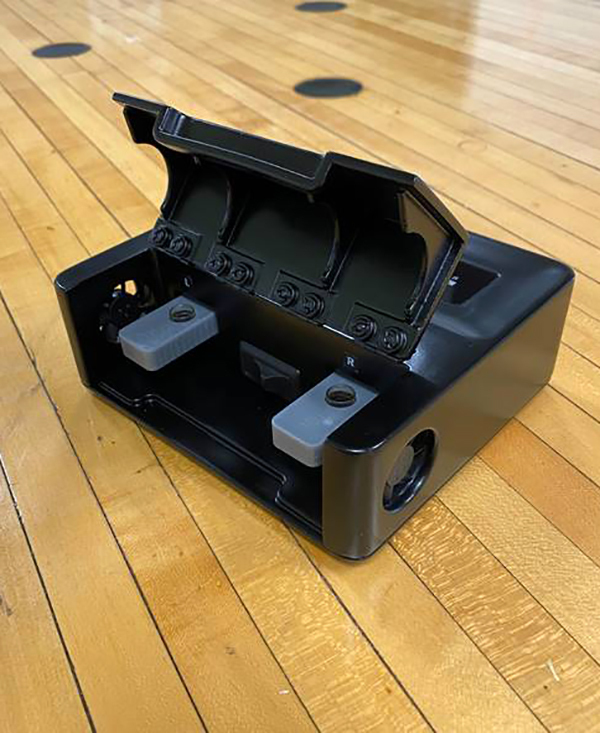
“One of our challenges is that we can only test for one target per chip as of now; so we couldn’t test for COVID and influenza A and B at the same time,” McIntosh noted. “But we are looking to expand to a cartridge that can detect four targets at once.”
Fundraising challenges and successes
Although Foothold Labs is working with technology that could quantitatively detect COVID-19 in a matter of minutes, McIntosh still found it difficult to raise local funds throughout the pandemic, he admitted.
“It’s been frustrating because the State of Kansas redirected a lot of funding that was supposed to go to small businesses,” he said. “There just hasn’t been the funding that we thought would be available, especially with the pandemic revealing the need for new diagnostic technology.”
A majority of funders for Foothold Labs are located along the coasts, McIntosh said.
“Investors in the Midwest won’t even bring us in; they won’t even let us pitch,” he noted.
“… I would encourage KC investors to educate themselves on what’s out there. Even if they’re primarily focused on saftward, the software revolution with cloud computing and cheaper processors enables a new revolution in hardware,” McIntosh continued, referring to Foothold Labs’ NanoRev System.
The startup was able to secure some Kansas City-based funding through Digital Sandbox KC — a proof-of-concept program that significantly and rapidly moves early-stage entrepreneurs from concept to commercialization.
“[Digital Sandbox] will allow us to produce more data for our current projects and produce it more quickly,” McIntosh said. “This will be key to holding labor costs down when running larger pilot projects and developing the data necessary to train our machine learning based software.”
Foothold Labs previously was awarded a $1.5 million Small Business Innovation Research (SBRI) grant from the Air Force’s AFWERX program in October 2020 — the startup’s primary funding source. It also allowed the team to connect with other areas of the military, McIntosh noted.
“They gave us a phase one SBIR to explore using our technology to detect chemical threats like chlorine gas or chloride,” McIntosh explained. “Because our technology is so cheap and portable, it could screen for these threats very easily.”
Advancing in the animal health corridor
As well as military interest, the animal health corridor has taken significant interest in Foothold Labs, McIntosh revealed.
“We have a funded pilot project with a top animal health company for veterinary point of care diagnostics,” he teased, noting that the animal health company is currently undisclosed. “They are interested in using our technology to basically help sell more of their current products and eventually new products. The idea is — if a veterinarian can show a pet owner that your dog has ‘X’ amount of bacteria within five minutes of testing, and quantitatively, that data will drive action.”
The technology would decrease the number of trips a pet owner has to take their animal to the veterinarian, leading to less stress on the animal — as well as provide a dependable diagnostic, he continued.
Eventually, McIntosh plans to get an iteration of the NanoRev System into the human health corridor, he shared, noting that it has been more of a challenge because of the regulations involved.
“Our goal is to get one of these in everyone’s bathroom,” McIntosh said. “If you want to track your human performance biomarkers, like glucose or DHEA, you could just take a test at home. Or, you could use it as a COVID test. It has the potential to be for lots of different use cases.”
[divide]

This story is possible thanks to support from the Ewing Marion Kauffman Foundation, a private, nonpartisan foundation that works together with communities in education and entrepreneurship to create uncommon solutions and empower people to shape their futures and be successful.
For more information, visit www.kauffman.org and connect at www.twitter.com/kauffmanfdn and www.facebook.com/kauffmanfdn

2022 Startups to Watch
stats here
Related Posts on Startland News
A St. Joe CEO handed him a franchise after graduation; two years later, the risk is paying off
Spencer Engelman’s expectations for his post-college career were shredded by an offer he couldn’t refuse. The Northwest Missouri State University graduate was awarded a business of his own — minus the franchise fee — by a veteran entrepreneur who had visited one of his classes. “It’s a crazy opportunity,” said Engelman, who now operates a DocuLock…
What a catch: Kansas City fandom creates custom appeal for taco-loving cartoonist vibe
Drawing from Kansas City’s spotlight moments — whether trendy and new or iconic and timeless — W. Dave Keith balances a quirky aesthetic with a practical focus on what will actually sell. “I’ve slowly learned that if I want to make money off this business, I need to make stuff that people want to buy,”…
Power through purpose: How a winding journey led this eco devo steward to deep-rooted impact
Editor’s note: The following story was written and first published by the Economic Development Corporation of Kansas City, Missouri (EDCKC). Click here to read the original story. [divide] Going behind the scenes of CCED with the people who make it happen Some people are drawn to city-building because of the bricks and steel, the architecture, the skyline, the…
Missouri’s weapon in the AI race with China: KC tech companies, says GOP lawmaker
As artificial intelligence reshapes the way Kansas City works, civic and elected leaders want to ensure small businesses and the region’s tech community have seats at the table. Federal regulation could help, said Eric Schmitt. “For me, [it’s about] making sure that the big tech companies don’t block out a lot of the innovators, say…