
Royals preview ballpark of the future: Now they need to decide where to put it
August 22, 2023 | Celisa Calacal

Editor’s note: The following story was published by KCUR, Kansas City’s NPR member station, and a fellow member of the KC Media Collective. Click here to read the original story or here to sign up for KCUR’s email newsletter.
[divide]
The Royals are choosing between a stadium and entertainment district in Kansas City’s East Village or in North Kansas City.
The Kansas City Royals unveiled two designs for a ballpark entertainment district on Tuesday, even as the owners have not yet decided exactly where to put it.
The Royals are waffling between two locations for a stadium entertainment district that the team says are “on equal footing”: North Kansas City or the East Village in downtown Kansas City. The team says it plans to pick a location by the end of next month.
The project is expected to cost more than $2 billion, with Royals ownership contributing more than $1 billion toward the cost. It’s still unclear where the additional money will come from, or how much taxpayers will be on the hook for.
The Royals said in a press kit that a new stadium district “will not be possible without public investment.”
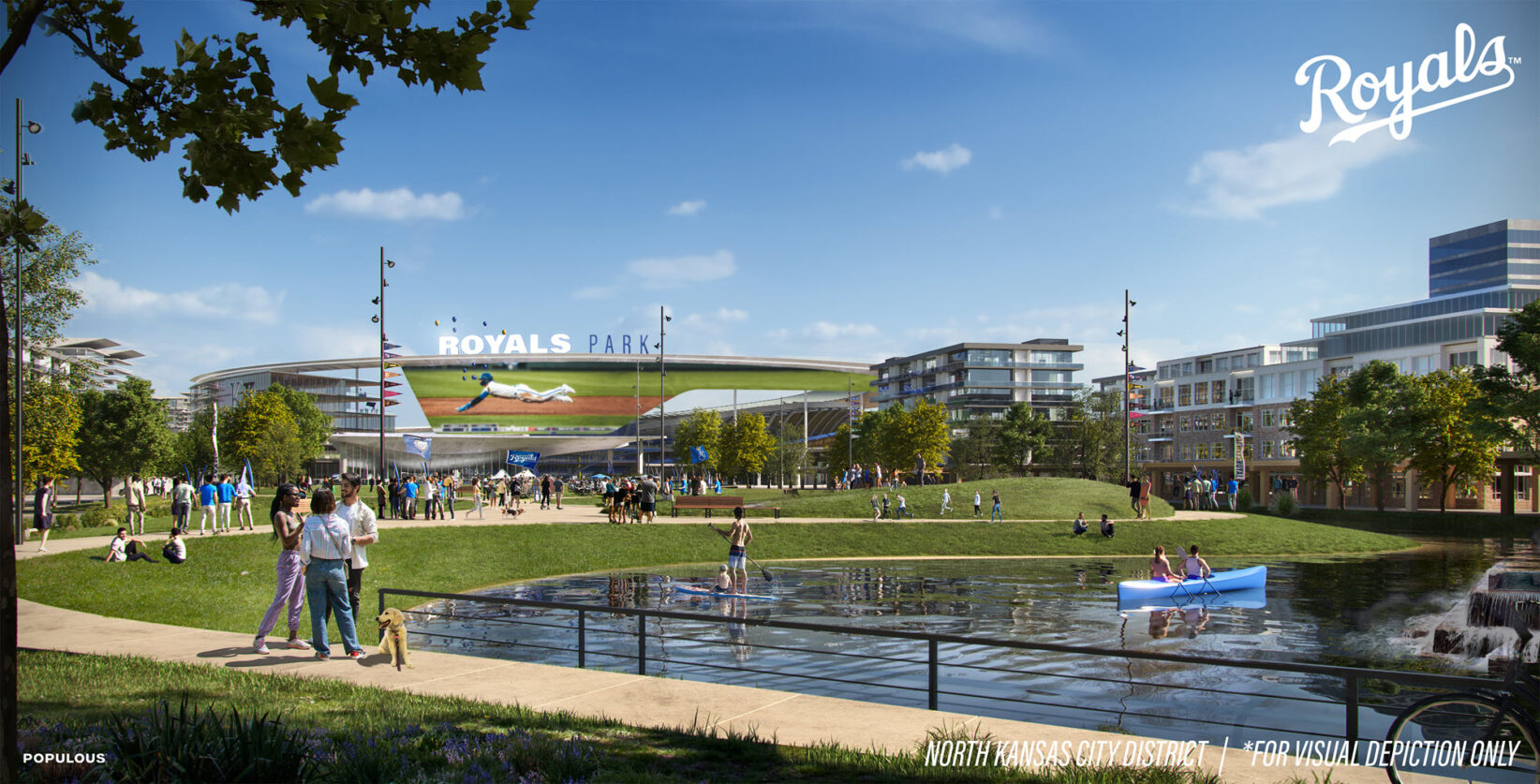
In North Kansas City, the Royals are proposing a park alongside a new baseball stadium as part of the entertainment district; rendering courtesy of the Kansas City Royals, Populous
Team representatives said the owners are speaking to elected officials in Clay County and Jackson County, including Kansas City Mayor Quinton Lucas.
If the owners choose the East Village, they want to extend the current three-eighths cent Jackson County sales tax currently used to maintain Kauffman Stadium and Arrowhead Stadium. The Royals’ share of the tax funds is estimated at between $300 million and $350 million.
Royals owner John Sherman told The Kansas City Star this week that if the Royals choose the East Village site, the team would want renewal of the three-eighths cent sales tax on the April ballot next year.
It’s currently set to expire in January 2031, the same time the Royals’ lease on Kauffman Stadium is up.
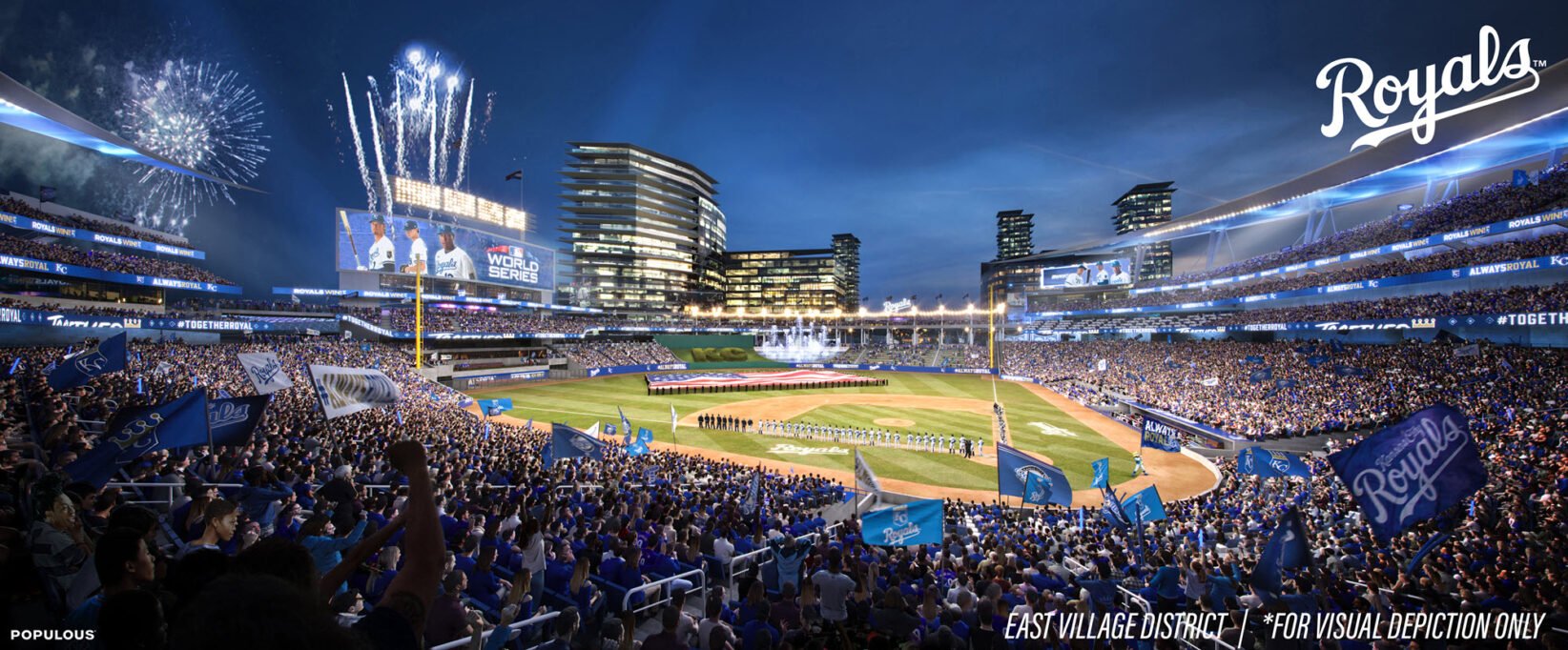
This rendering shows what a new Royals baseball stadium would look like in Kansas City’s East Village; rendering courtesy of the Kansas City Royals, Populous
If the Royals choose North Kansas City, the team says it would seek a similar tax. A recent survey conducted by a Washington firm found that 70% of respondents in Clay County were opposed to a sales tax to fund a new ballpark and entertainment district.
Sarah Tourville, Executive Vice President, Chief Commercial and Community Impact Officer for the Royals, said the team was made aware of the poll Tuesday.
“We’ve assembled a team of local and national experts with sophisticated polling experience,” Tourville said. “That polling data has been very constructive and we see a path to victory in both counties.”
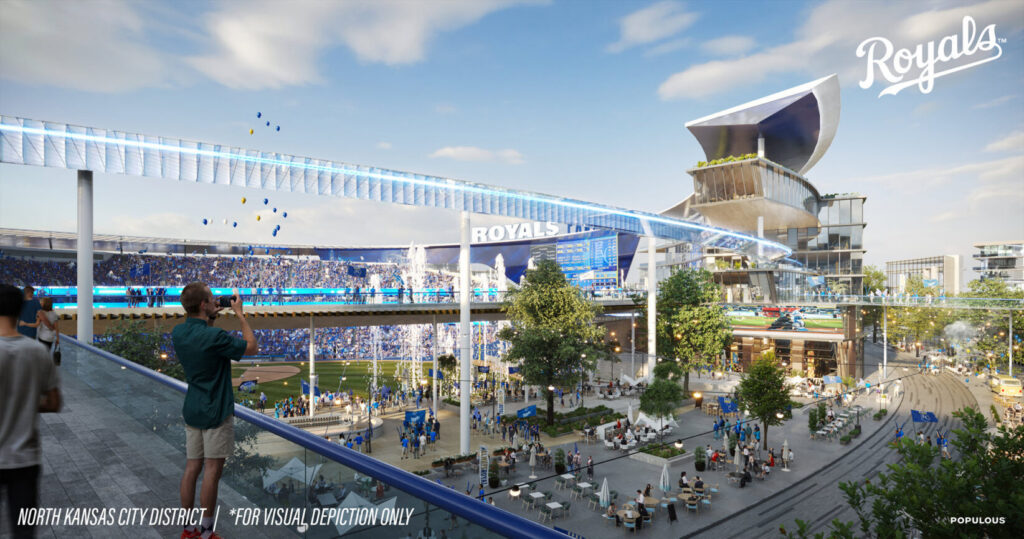
This rendering shows what the Royals ballpark and entertainment district would look like in North Kansas City; rendering courtesy of the Kansas City Royals, Populous
The two sites
A proposed stadium entertainment district in the East Village would cover 27 acres, from 8th Street in the north to 12th Street in the south, and Charlotte Street in the east to Cherry Street in the west.
Team representatives on Tuesday emphasized that the East Village site would focus more on attracting local businesses and restaurants to create an entertainment district that operates year-round.
The stadium will seat 35,000 people. The site rendering includes a pedestrian bridge above the highway to funnel people from Paseo Boulevard to the stadium, a hotel and conference venue and an event plaza.
The team also wants to create a “Cherry Street experience” made up of retail development and local restaurants.
“It’s intended to harmonize with the Power and Light district and with the existing downtown developments,” said Earl Santee, global chair and founder of the architecture firm Populous.

This rendering shows what the Royals ballpark and entertainment district would look like in North Kansas City, complete with a park; rendering courtesy of the Kansas City Royals, Populous
The North Kansas City location would be less dense and cover 90 acres, from Armour Road south to 16th Street and I-29 east to Erie Street. That project would include more housing than the East Village site. The project would also include a hotel, a performance venue along Armour Road, retail and a park called North Kansas City Central Park.
“We’re trying to create a district by giving it place and giving substance to its development,” Santee said. “It’s community focused and the idea is to bring people — a lot of people — into North Kansas City that would love to work and live there.”
The team wants to build new parking structures in either location to supplement existing parking. The proposal in the East Village includes about 4,000 parking spaces.
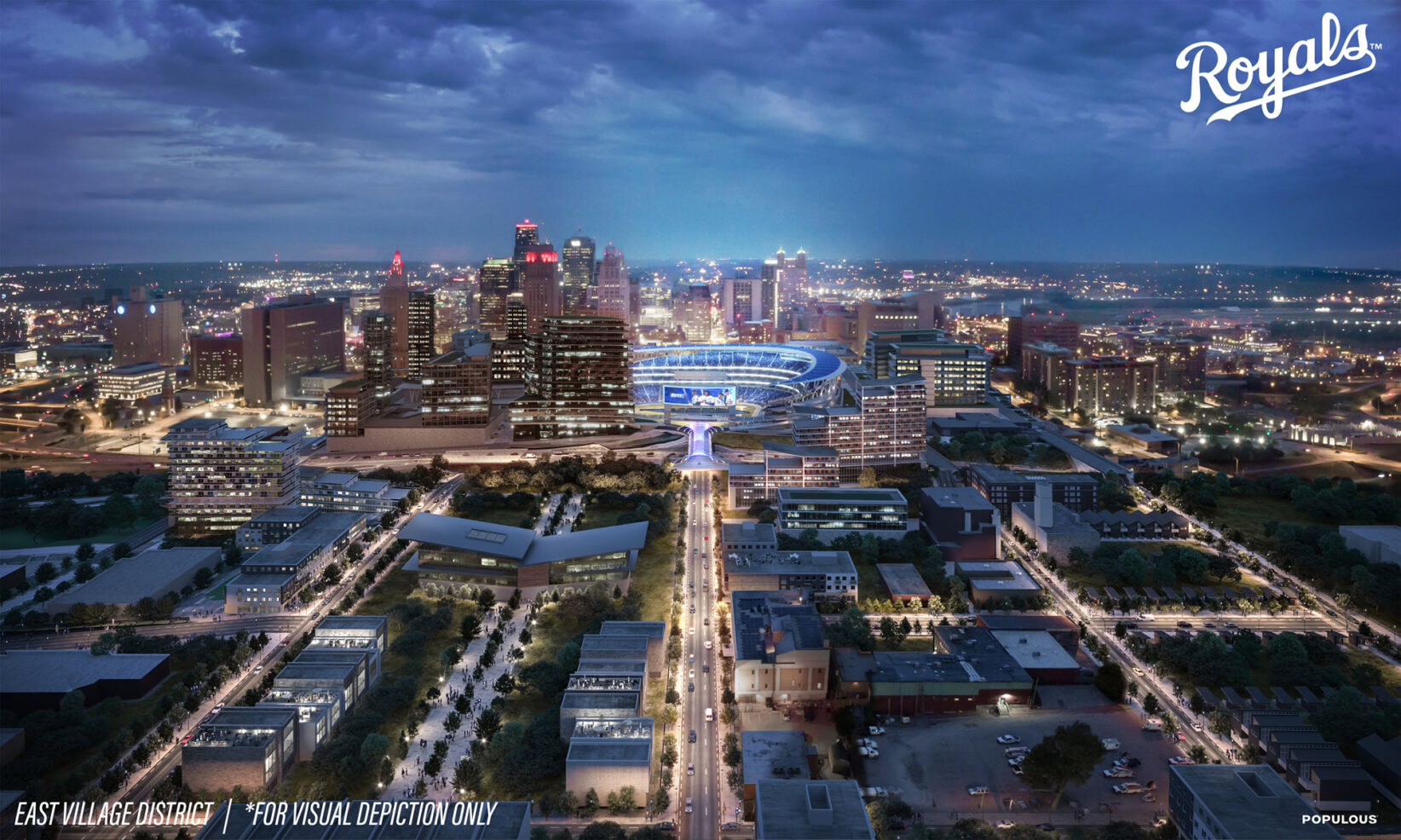
This rendering shows the outside of a proposed Royals baseball stadium if it were located in Kansas City’s East Village; rendering courtesy of the Kansas City Royals, Populous
The Royals claim a new ballpark entertainment district would be an economic boon for the region, predicting the project would create 20,000 jobs and produce $185 million in new regional economic output. But economists agree that sports stadiums don’t bring the long-term benefits to the cities that teams say they will.
The Royals want a new stadium in time to welcome fans on Major League Baseball’s Opening Day in 2028. The team’s current lease at Kauffman Stadium ends in 2031; Sherman and other team representatives said the team would not break its lease.
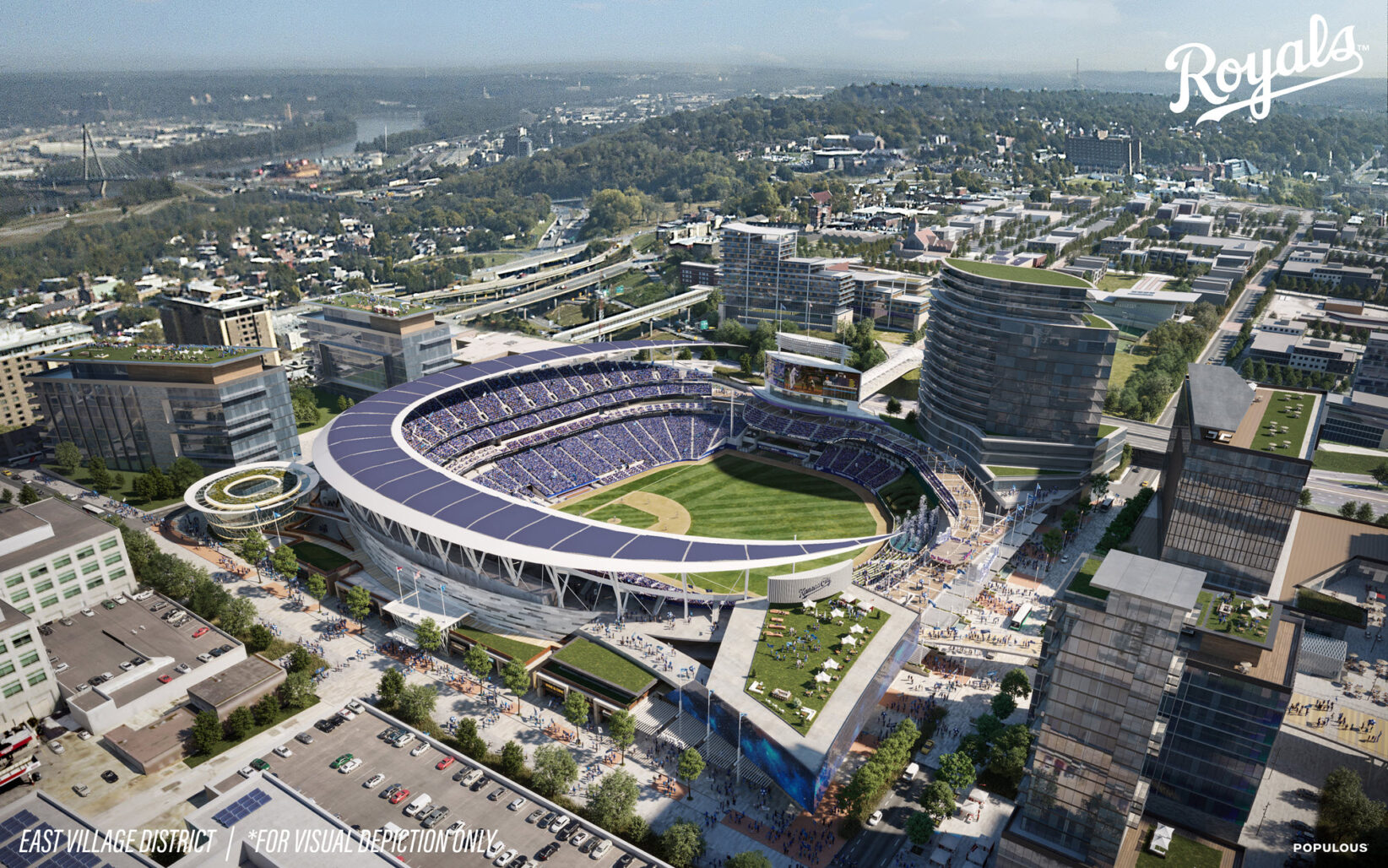
This rendering shows an aerial view of a proposed Royals baseball stadium if it were located in Kansas City’s East Village; rendering courtesy of the Kansas City Royals, Populous
Community benefits agreement
Team representatives said Tuesday the team is still committed to a community benefits agreement for the new stadium.
The local group Stand Up KC is advocating for an agreement that would raise the wage floor, pay stadium and entertainment workers a living wage and require the team to hire workers from areas hit hardest by unemployment.
“We deserve to have a seat at the table to negotiate a Community Benefits Agreement that ensures poor and working people will have concrete benefits from a generational project like this,’ said Stand Up KC leader and fast food worker Terrence Wise. “Without that, we are being left behind in our own community.”
[divide]
Celisa Calacal is KCUR’s Missouri politics and government reporter.

2023 Startups to Watch
stats here
Related Posts on Startland News
Video: KC women in tech talk challenges, engagement
While Kansas City ranks as a top locale for ladies in technology, there’s still work to be done to create more gender diversity in the industry. This video — created in collaboration with Kansas City Public Television and videographer Brad Austin — explores some of the challenges that women face in a male-dominated field and how to engage more women…
3 local businessmen named EY’s Entrepreneur of the Year
Three Kansas City area businesspeople recently snagged one of the most prestigious awards for entrepreneurs. EY announced Monday the winners of the Entrepreneur of the Year 2015 for the central Midwest, which included three businessmen from the Kansas City metro area. Those receiving the commendation included: Jody Brazil, CEO of FireMon; Matthew Perry, President of…
Women flex their tech muscles at KC conference
Framed by a LEGO guitar and robotic vehicle, Rheanne Walton and Emma Howard anxiously review notes at their podium as dozens of technology experts await their pitch. The middle-school students are visiting the Kansas City Developers Conference to share the story of their all-girl robotics team, MindSTEM, and how it competes in the FIRST LEGO…
New lab hopes to boost digital inclusion in Kansas City
A new computer lab in Northeast Kansas City hopes to serve as a tech oasis in a digital desert among low-income households. Google donated and opened the new lab Monday in Chouteau Court, furthering the company’s mission to help bridge the area’s digital divide through education about computers and Internet use. Rachel Hack Merlo, Google…