

The red carpet, garageband and laboratory of funding models
April 22, 2016 | Larissa Uredi

Editor’s note: The opinions expressed in this commentary are the author’s alone.
“Funding! Funding! Funding!”
It’s the warrior’s cry of the startup community.
In the world of entrepreneurship, there’s an incredible amount of pressure to run a startup that can be described as “disruptive,” “innovative” and “scalable.” Those descriptions come with a hefty price tag, however. So, what’s a startup to do? It depends.
Like most things, startups run on money. To solve the money question, you ultimately have three paths to consider, which I’ll refer to as the red carpet, garageband and laboratory methods.
Venture Capital: the red carpet of funding
Venture capital steals the spotlight as the “best” route to becoming an all-star startup. Raising capital through VC has the perception of being the red-carpet route to success, fame and fortune, because it says people with the big bucks think you’re brilliant.
To have a chance at walking that carpet, you, the entrepreneur, take the time to build the idea, the team and to gain proof-of-concept traction. You take the work you’ve done and present it to a group of people with more money and experience than you. You show them that your company is a great fit for their portfolio because your idea fits those descriptions of “disruptive,” “innovative” and “scalable.”
It’s a tough approach to win, especially in Kansas City. The local venture capital market is extremely conservative, and although things are looking up, we’re a long ways away from Silicon Valley.
Then, if you do gain entrance to the red carpet by raising a bunch of capital, you’re no longer completely your own boss. Your investors want a return on their investment, which sometimes means changing your vision, approach and product to fit someone else’s goals.
The takeaway: Pursuing venture capital funding is a great way to find the money you need to aggressively scale your company. The downside is that you run the risk of your business morphing into someone else’s vision while joining an aggressive playing field.
Play in a garageband with bootstrapping
Bootstrapping is often pigeonholed as “what you do until you can get funding.” It’s the option entrepreneurs hold onto when they can’t raise capital and are still unwilling to give up their dream.
Bootstrappers fund their business ideas themselves and work like a fiend until they’re profitable. They don’t borrow excess money and don’t compromise their venture or vision because an investor tells them it’s a bad idea. They don’t pivot their business every time they lose a sale. They have the ability to scale their business at their own pace and have the time to avoid common — and dangerous — growing pains.
The takeaway: If you have the savings and the guts to put your money where your business idea is, this is a great route to go. You call the shots and run the business you want to run. The downside is that all of the risk is yours and the safety net is small or nonexistent.
A lean startup model is the startup laboratory
If your startup doesn’t fit the VC model or you hate the idea of answering to investors, the lean startup model may be for you.
Instead of building a complete idea, the lean startup team builds parts of the whole. They test those parts by drumming up as many sales as possible and then use the proceeds to restart the cycle. The idea, per serial entrepreneur Eric Ries, is to constantly adapt your business to fit the needs of your customers, and when something doesn’t work for them, get rid of it.
It’s worth noting, however, that lean startup methodology can be implemented within both the bootstrapping and venture capital model. It’s not so much a funding model, as much as a method to quickly and inexpensively test ideas.
The takeaway: For those of us with a restless entrepreneurial spirit, the lean startup is a great way to decide what kind of business to run. You have virtually no costs to get started and you get a quick sense of market demand. The flipside? Without a solid plan in place and a roadmap to follow, it’s easy to get off track and end up in an endless pivot loop where you never quite nail down your business model or goals.
While the choices on how to run your business are difficult, how you choose to fund your business can define the success of your company. It’s one of the biggest decisions you will make. Choose carefully, while keeping an eye on the kind of business you want to run and the amount of control you want to have.
Larissa Uredi is the marketing and sales director for The DeviceShop, a small business accelerator out of Shawnee, Kan. that offers office space, workshops, and manufacturing and prototyping services. The DeviceShop considers itself to be a community of innovators aiming to develop successful and profitable entrepreneurs. Uredi is also the business developer for No-Where Consultants.

Featured Business


2016 Startups to Watch
stats here
Related Posts on Startland News

The WTF Series: Big data
On a daily basis, Ben Kittrell translates the jargon-filled world of technology for clients of his tech consultancy. The Words that Frustrate (WTF) series aims to offer readers some clarity in an industry dominated by techies’ confusing argot. I don’t remember if I had heard the term “Big Data” before 2012 but after attending South-by-Southwest that year…

Roberts: 5 things the world can learn from KC entrepreneurs
This week, entrepreneurship is king in Kansas City. As we welcome the world to our burgeoning tech hub during Techweek, it’s tempting to think that Kansas City’s startup community is a new phenomenon. But in fact, the names of the city fathers (and mothers) — the Kauffmans, Kempers, Blochs and Helzbergs — that adorn almost…

After new regulations, Uber opens KC office
Uber is spreading deeper roots in the Kansas City metro after new regulations have allowed the ride-sharing giant to operate legally in Kansas and Missouri. The San Francisco-based company is currently renovating a new Kansas City office on McGee Street near the Power and Light District, said Andy Hung, general manager of Uber Kansas City.…
Kansas City receives new tech-focused jobs board
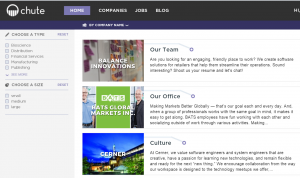
Businesses both big and small looking to fill technology positions in their companies have a new outlet to find talent: KCnext’s new job board. In conjunction with Kansas City’s inaugural Techweek, the KCnext team announced Chute Wednesday to help area businesses in their recruiting efforts — whether they’re members of the tech council or not. Millennials have shed light on…