
Sleep tech designed to combat night sweats moves toward consumer market with KS bedfellows
November 28, 2023 | Sidney Steele

A Leawood company’s bed-based sleep technology — designed to reduce night sweats and help people better regulate their temperatures while they sleep — is headed to market in early 2024 with backing from the Kansas angel tax credits program and a swelling pre-seed round, said Win Hansen.
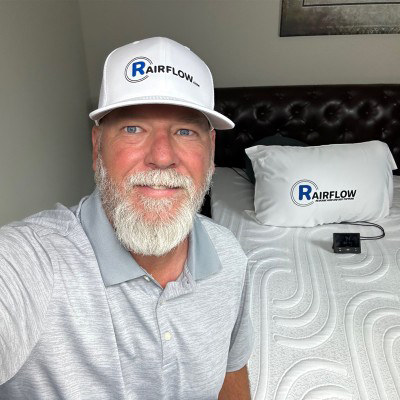
Win Hansen, Rairflow
Rairflow, Inc., which designed and developed prototypes for its reverse airflow control units in Kansas, recently announced the funding milestones as it works to earn backing from the Kansas Department of Commerce, according to Hansen, president and CEO of the company.
With $116,000 in Kansas angel investor tax credits lined up and now $200,000 toward its opening investor round, Rairflow also is collaborating with the Kansas State University Technology Development Institute (TDI) to finalize designs of the control unit for its reverse airflow bed toppers, he added.
Product-market fit efforts have already proven successful, Hansen said, leaning into the mattress topper’s Kansas roots as a key catalyst for traction so far.
“The companies that I’m working with are the ones that make the mattresses for major retail brands, and they’re the OEM (original equipment manufacturers) that are behind the retailers,” he said.” So, it’s phenomenal that I’m not sending this to China or Mexico to get this designed and developed; we’re doing the final tech spec within the state of Kansas.”

Rairflow mattress
Home-state support
Keeping the product development close to home comes through the support of K-State’s TDI and encouragement from the State of Kansas, Hansen emphasized.
Rairflow received an Innovation Fund grant from the Kansas Innovation and Technology Enterprise (KITE), which provides companies with funding to make their ideas a reality, as well as the angel investor tax credits, which provide an economic incentive for investors to support businesses in the state of Kansas.
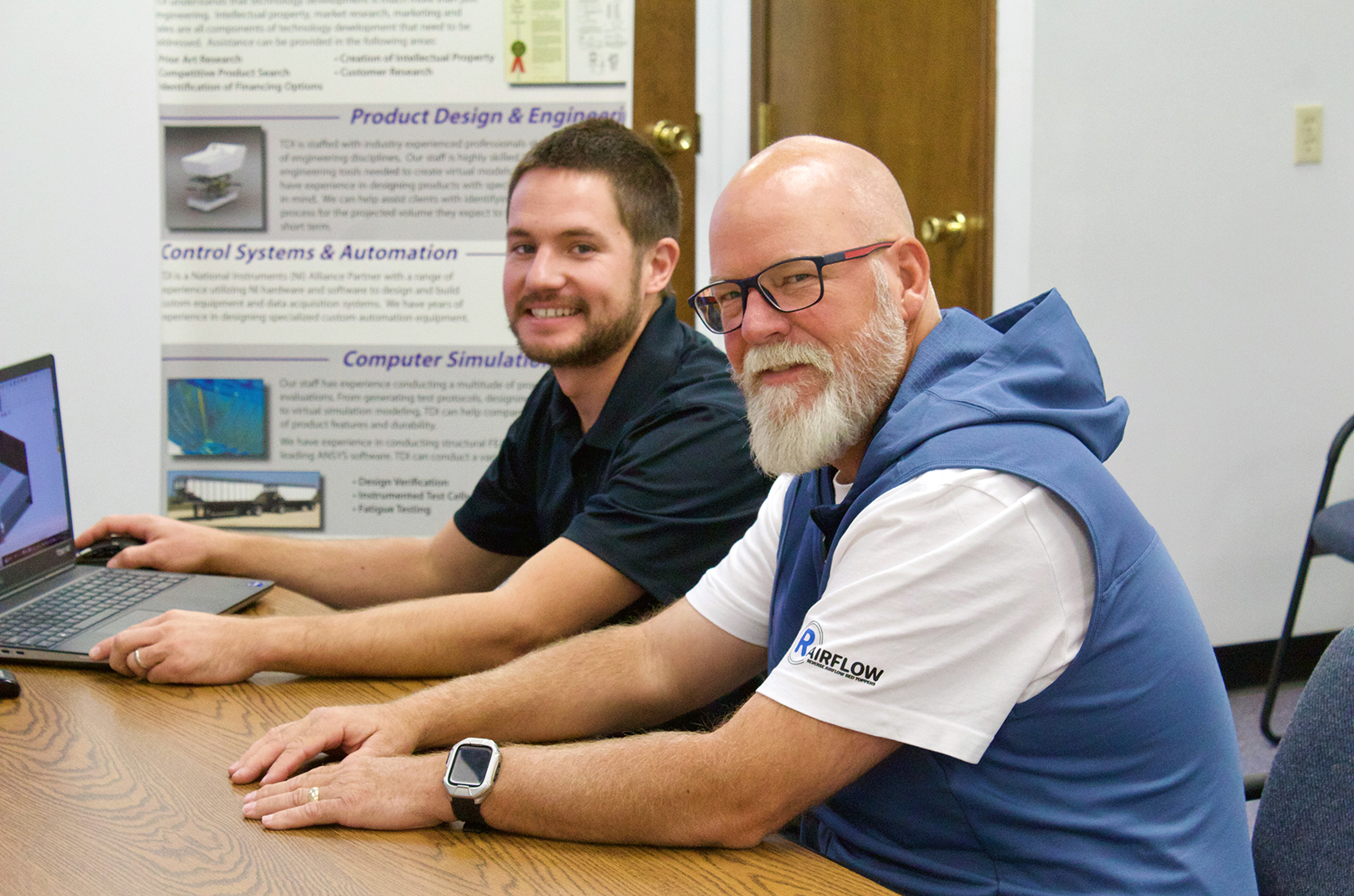
Quinton Berggren, senior engineer at the Kansas State University Technology Development Institute (TDI), and Win Hansen, president and CEO of Rairflow
“[Innovation Fund grants are] for individuals like Win who are trying to develop new products and find funding for the initial proof of concept if they’ve worked with one of the commerce partner organizations,” said Bret Lanz, commercialization director for TDI.
Rairflow has also applied through the TDI for the state’s proof-of-concept grants program, which aims to enable promising technology to advance to a stage where it is capable of attracting licensees, seed investment or generating revenues, according to the Kansas Department of Commerce. It provides funding for Kansas-based companies to connect with product designers and researchers in Kansas, helping to foster technological development and innovation within the state.
The TDI employs 11 full-time employees with expertise in product design and engineering. It is home to a 3D printing lab and a full-scale machining shop.
“In our facility, we’re able to do the engineering design work, but we can also produce it once we’re ready to go,” Lanz said. “So, that’s the unique aspect that we bring to the table for not only Win, but for all types of manufacturers and entrepreneurs.”
Hansen is thrilled an institution like TDI supported Rairflow’s development in Kansas, he said.
“I can call these guys up who know what I’m trying to do. They understand the technology. They’re going to not only help me design this, but they have a working shop where they are going to poly print,” Hansen said. “These prototypes are going to allow me to cut down time and money. And at the end of the day, I’m going to have a working prototype in the U.S. built in Kansas much quicker than I could through a process of doing it globally.”
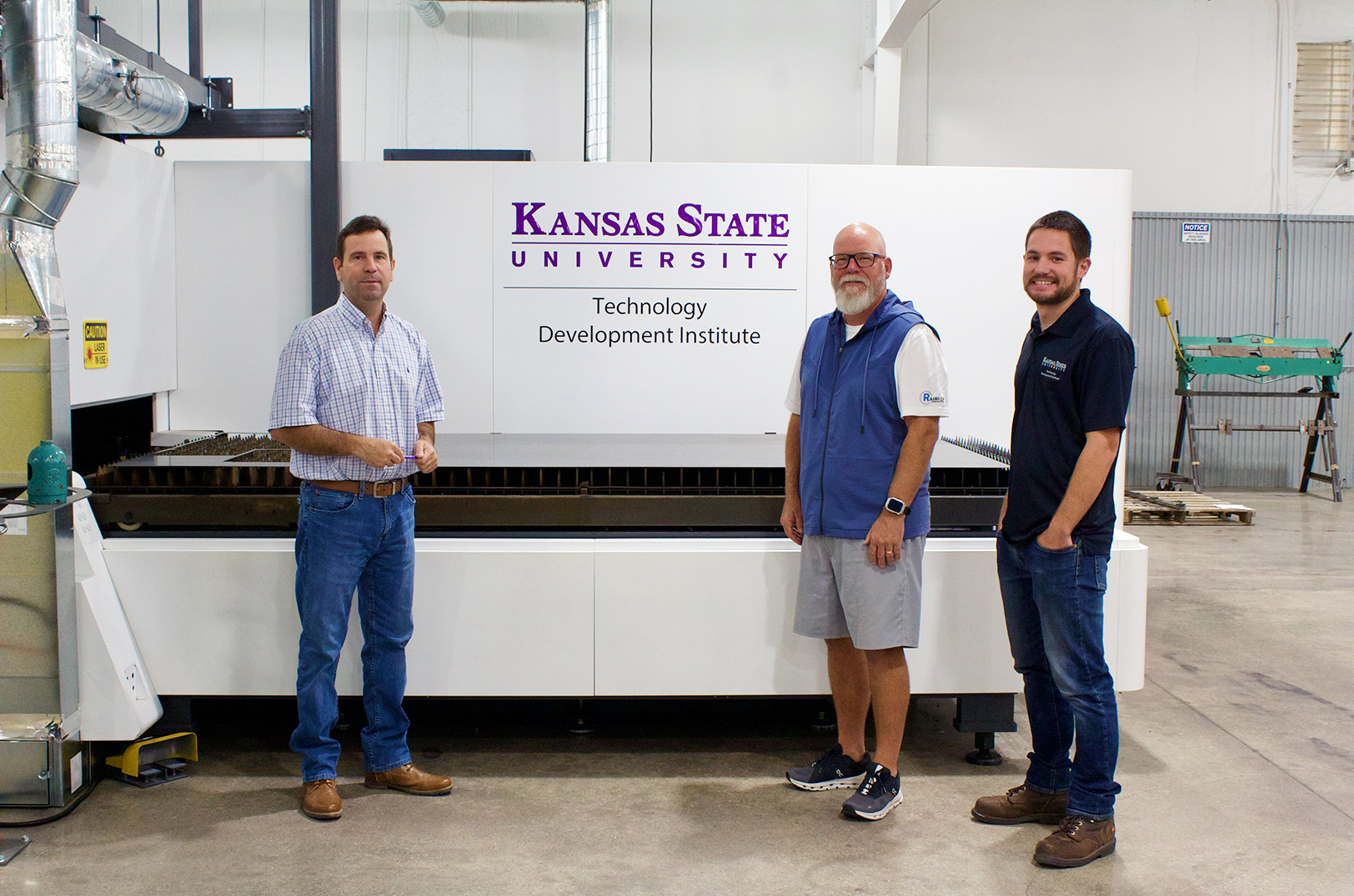
Bret Lanz, commercialization director at the Kansas State University Technology Development Institute (TDI), Win Hansen, president and CEO of Rairflow, and Quinton Berggren, senior engineer at TDI
Organizations like TDI help small businesses and entrepreneurs scale their products with a lower barrier to entry by providing support, expertise, and equipment business owners otherwise might not be able to access. TDI is able to offset production costs for the businesses it works with through grants, like the proof-of-concept funding Hansen received, and through the K-State 105 Initiative. Through the latter effort, Kansas State University is supporting all 105 counties in the state of Kansas using their research and extension network to make economic resources available to all Kansans.
Through the K-State 105 initiative, Lanz explained, TDI is able to offset up to 50 percent of costs for development projects like Rairflow’s mattress topper product.
“If they’re Kansas-based companies, we do have funding to help them,” Lanz said. “So, we’re really trying to make the most of it.”
Inside the technology
Night sweats are a common symptom of a multitude of medical issues, with experts noting ties to menopause, anxiety disorders, increased bodyweight, sleep disorders, and the use of medicines like antihistamines and selective serotonin reuptake inhibitors (SSRIs).
One medical study found that 41 percent of participating patients experienced night sweats. As many as 97 million women struggle with sleep trouble due to hot flashes and subsequent night sweats, according to the Sleep Foundation. Even more, the economic cost of sleep deprivation in the United States is estimated to be between $280 billion and $411 billion each year, according to a study from the RAND Corporation.
The consumer bedding market is full of products intended to help cool sleepers, Hansen acknowledged, from products that blow air from the foot of the bed under the comforter to gel mattress toppers that claim to have cooling materials.
The Rairflow mattress topper works differently — using reverse air flow technology to pull air from around the sleeper through the bed chamber to draw out heat and humidity. Once released, it will be the first product on the market to identify and measure the frequency and duration of night sweating events, Hansen said.
While he believes there’s nothing like Rairflow available in the consumer market, Hansen said reverse airflow technology has been used in healthcare for more than 10 years, primarily to improve the comfort of hospital patients dealing with ulcers.
Hansen was working for a global medical company when this technology hit the healthcare market in 2011, he said. At the time, his wife was going through chemotherapy and struggled to regulate her body temperature while she slept, Hansen recalled. She was having night sweats that made her uncomfortable and disrupted her sleep. Because Hansen had access to the medical mattress topper, he brought one home for his wife to use.
“I took it home and put it under my wife, and she did phenomenally well,” he said. “I was fascinated by it, and I took it to the president of our division and said that I think we are missing out on an opportunity. What this technology is really suited for is the commercial bedding market, where people are hot and sweaty and not sleeping well, not just in managing the microclimate of a small number of people in hospitals.”
The wife of Hansen’s colleague was going through menopause at the time, and experiencing vasomotor symptoms commonly known as hot flashes, he detailed. She loved the idea, so Hansen and his colleague conducted a poll of 1,000 women in various stages of menopause, asking if they would like this technology to help them better manage their sleep. The results came back overwhelmingly positive, he said.
But before Hansen was able to launch the product, his company was bought out in 2012.
“The company I worked with was put up for sale, so that shut down this project,” Hansen said. “They didn’t want anything to do with the consumer bedding market at the time they had bought us. So, they tabled it, and it sat collecting dust until I revived it about a year and a half ago.”
By 2021, Hansen had exited the medical device industry.
“I was looking for the next thing that I wanted to do that would have more of my fingerprint on it, my ownership,” Hansen said. “And this project came to mind.”
Hansen started seeking out the company’s leadership in Sweden to figure out who he could talk to in order to get licensing to the patents that they own.
After six months of negotiation with his former company’s leadership in Sweden, Hansen said, he won exclusive licensing to 10 patents to develop reverse airflow bedding products — setting the stage for Rairflow’s local development and debut.
The company is set to launch a Kickstarter campaign for Rairflow in February, Hansen said. Right now, interested customers can pay a $1 reservation fee to lock in a mattress topper at the lowest price at launch.
Click here for more information about pricing and the Rairflow mattress topper.

2023 Startups to Watch
stats here
Related Posts on Startland News
KC’s first innovation officer reflects on work, city’s tech future
After more than two years of service, Ashley Hand is leaving the driver’s seat of Kansas City’s innovation efforts. Hand, who soon will be departing as Kansas City’s chief innovation officer, was tasked with implementing innovative strategies to improve how city government can better serve Kansas Citians. The city will be accepting applications for the…
Welcome to Startland News
Scrappy. Determined. Gritty. Those often were the words attributed to the Kansas City Royals as the team unexpectedly surged into the 2014 World Series and captured the national spotlight. Those very words are apt for this city, which has been built on the grit and determination of successful entrepreneurs like Ewing Kauffman, Joyce Hall, Henry…
Kansas budget woes render uncertainty for angel tax credits
As state budgetary concerns loom in the background, early-stage firms in Kansas are hoping a bill to extend the Sunflower State’s Angel Investor Tax Credit program will become a priority for legislators. Scheduled to sunset after the 2016 fiscal year, the program annually allocates $6 million in credits to entice investments in early-stage, growth-oriented companies…
KC virtual reality firm partners with KU, NFL coaches
A Kansas City-based virtual reality company hopes some marquee partnerships will plug it into a market projected to reach $150 billion in five years. Founded in 2013, Eon Sports VR recently landed the University of Kansas football team as a client for its mobile virtual reality platform to help players train without the risk of…