
Q&A: Founder Jy Maze on the industry that runs the world (and delivers the toilet paper)
June 24, 2019 | Rashi Shrivastava

Everything has to ship, said Jy Maze. From the microphone in her hand to the stool where she sat to the shoes on the Maze Freight Solutions founder’s feet, it all comes with mileage and a cost, she said.
Her woman-owned, Overland Park-based, third-party freight logistics startup itself was packed in 2017 when Maze decided to quit her job as a freight broker at Freightquote.com and tap into the boundless opportunities offered by the transportation industry, she said. Maze also wanted to help diversify a male-dominated industry, she said.
One of three panelists Thursday at Startland’s Innovation Exchange — presented by Idle Smart and hosted at Fishtech Group — Maze joined founders Bek Abdullayev, CEO of Super Dispatch and Ben Jackson, co-founder of Bungii, in a conversation about Kansas City’s auto and mobility tech companies and their roles in accelerating innovation in the city.
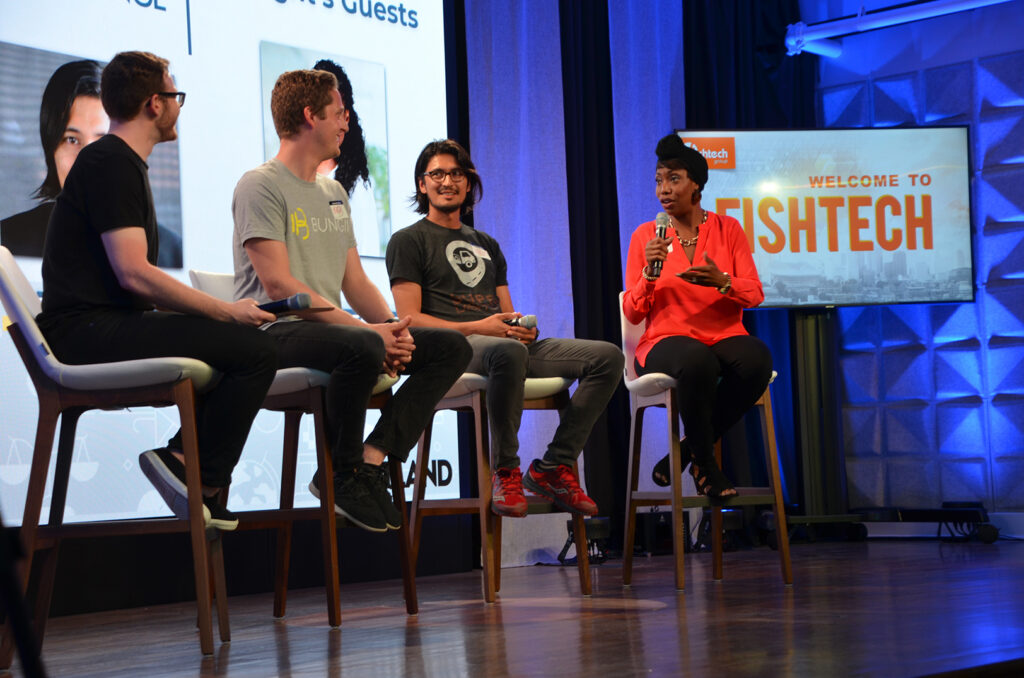
Austin Barnes, Startland News; Bek Abdullayev, Super Dispatch; Ben Jackson, Bungii; and Jy Maze, Maze Freight Solutions; Startland’s Innovation Exchange
Startland and Missouri Business Alert sat down with Maze after the event for a one-on-one Q&A on challenges that face auto tech startups and the road that lies ahead for the trillion-dollar industry.
Click here to listen to a Missouri Business Alert podcast featuring Maze.
[divide]
SLN/MBA: How did you get your feet wet in the transportation industry, specifically in freight logistics?
Jy Maze: I got into transportation over a decade ago. I was a freight broker for a prominent award-winning company and I was in the top 10 of 700 reps. When I got into the niche of truckload freight, it intrigued me to the point where I said, “You know, there’s a lot of money in this industry.” And there’s a lot of good that we can do. And as a woman-owned business, it was uncharted waters.
SLN/MBA: What inspired you to take the leap into transportation?
Transportation is one thing that I’m addicted to. A lot of people say, “She’s good at freight.” I am. I love freight — everything about it, from the supplier to the manufacturer to the time it has to be picked up to the time it is delivered. I am very intrigued about it because it runs the entire world. The world cannot run without transportation and freight. I mean, if the toilet paper didn’t get around, what would you have? Even in times of distress, when FEMA called upon us to deliver water to places where hurricanes had destroyed cities, you know, you look at the distress and you see a city go down and you see, “Oh, my goodness, this city has to be rebuilt. The only way to rebuild it is to import goods and products to build the city again.” And that’s why transportation has to thrive.
SLN/MBA: You spoke about how the auto tech sector has been male-dominated and male-driven for years. How do you see yourself and your company changing that narrative?
JM: Well, we are opening up for diversity. Men aren’t the only ones who drive cars; women drive too. And so women know what they like, as well. So it’s always good to get a human perspective on how things are supposed to be run. You are able to put yourself in the consumer shoes. This opens up opportunity for diversity for women to actually say, “You know what? I know about that supply chain. I know about automation. And I think that my opinions and my ideals could be heard.” And that’s why I’m glad that we are able to pave the way to open up the doors for that.
SLN/MBA: Maze Freight Solutions has existed since 2017. And you’ve been in this profession for more than 10 years. What are some of the biggest challenges that the freight industry has had to face or is facing right now?
JM: We need more truck drivers — people to actually jump in the truck and to drive the freight. … I mean, Millennials aren’t trying to jump in the truck anymore. The Baby Boomers are dying off so if we can fix that problem, the entire nation can thrive from transportation.
SLN/MBA: You also mentioned that the trade war with China has impacted sales at your company. How does policy at the national and international level interfere with the automotive industry’s growth?
Maze: As with a lot of outside influencers, politics play a part. We did see a decrease in sales when the steel tariffs went up. A lot of manufacturers that we deal with had to shut down, like Harley Davidson had to move their production overseas. America is the No. 1 manufacturer and we work with imports and exports. If we don’t have allies that are providing the things that we need, it will cause a big problem. And a lot of transportation depends on importing and exporting. We lost about $30,000 a month when the steel industry shut down. Yes, we were moving a lot of steel.
SLN/MBA: The panel discussion explored how the industry is headed into a time where driverless cars and drones become a reality. What do you think the future of freight looks like?
JM: Tech is here to stay, for sure. I have empathy and I have hope. Empathy because tech is going to eliminate a lot of jobs for people; it’s going to cut down on labor. That’s what tech does. Now you can walk in and buy a driverless car. Well, I think that’s going to make a lot of people lazy. That’s just my opinion on it, you know, there’s no more labor; there’s no more having to think. I mean, we’ve got Google Maps, but who reads a map anymore? I have hope because it’s going to be a long time before drones are moving hefty goods from one place to another.
SLN/MBA: What role do you think Kansas City plays in the growth of the automotive industry?
JM: Kansas City is right in the middle. We’re the Midwest, so everything has to either go through or around us. So we’re the key player. If it doesn’t trickle down here, then it’s not going to go anywhere. Kansas City is a base place. It’s not too fast. It’s not too slow. It’s it’s the right pace. And there’s a lot of ideas and a lot of innovators here; they’re just too scared or don’t think that they have the support to open up their creative minds. If we can get more investors involved and more people to look into Kansas City, they would know that Kansas City is uncharted waters.
[divide]
This story was produced through a collaboration between Missouri Business Alert and Startland News.
Featured Business

2019 Startups to Watch
stats here
Related Posts on Startland News
1MC recap: program traces roots, features The Swapping Co., OneDayKC
Kansas City’s 1 Million Cups tried something new today. And by new, it was actually old. The event met in its original venue, Kauffman Labs, which served as an intimate setting for attendees. Entrepreneurs and community members gathered around desks and viewed presentations projected onto a white board. “The venue change happened today because our…
Coming UMKC innovation center to serve students, entrepreneurs
With funding shored up from private and public donors, the University of Missouri-Kansas City is planning to move ahead with its plan to build the Robert W. Plaster Free Enterprise Center to support students and entrepreneurs. Missouri Gov. Jay Nixon announced Tuesday that the state is allocating $7.4 million to the center, which represents half…
Security firm Nodal nabs $100K, ramps up hiring
Good news is stacking up for Kansas City-based Nodal Industries. The security hardware tech company recently snagged $100,000 in seed funding as part of an opportunity to participate in the 500 Startup accelerator program, based in Mountain View, Calif. The funding will allow Nodal to hire up to eight people, as well as ramp up production…
Play-It Health lands in top-ranked digital health accelerator
As with many successful startups, the idea for Play-It Health was born out of personal experience with an unsolved industry need. Kim Gandy, a former clinician and now the founder and CEO of Play-It Health, recognized that patients were having trouble engaging and adhering to their medical regimen. In the worst cases, this led to…