
Midwest crypto platform Normal aims to bring blockchain ‘banking’ to the mainstream
September 4, 2024 | Haines Eason

Cryptocurrencies are poised to radically disrupt and transform monetary systems across the globe, said Joshua Blew, noting the coming financial freedom offered by such developments is closely tied to individuals’ access to the best tools and ownership of the right assets.
But connecting to them in a world of banking behemoths and entrenched financial institutions can be a challenge, the Rayton native said.

Blew’s startup, Normal — a Chicago-based cryptocurrency trading platform with an ETF (exchange traded funds) feel — aims to revolutionize a rapidly marketplace on the blockchain, he said.
Since he began building it about three years ago, his emerging business has already helped more than 100 investors from seven countries diversify $200,000 into crypto while saving them more than $5,000 in trading fees, Blew said.
A core strategy is keeping the investor in control, he detailed.
As traditional financial giants like BlackRock slowly begin to include crypto in their offerings, they’re using a model where neither they nor the investor own the actual coins, but the investor owns the financial institution’s product — shares in an ETF, for instance.
In such situations, larger firms offer investors access to only a few cryptocurrencies, ones like Bitcoin, Ethereum, etc. that are seen as more stable than others, Blew explained.
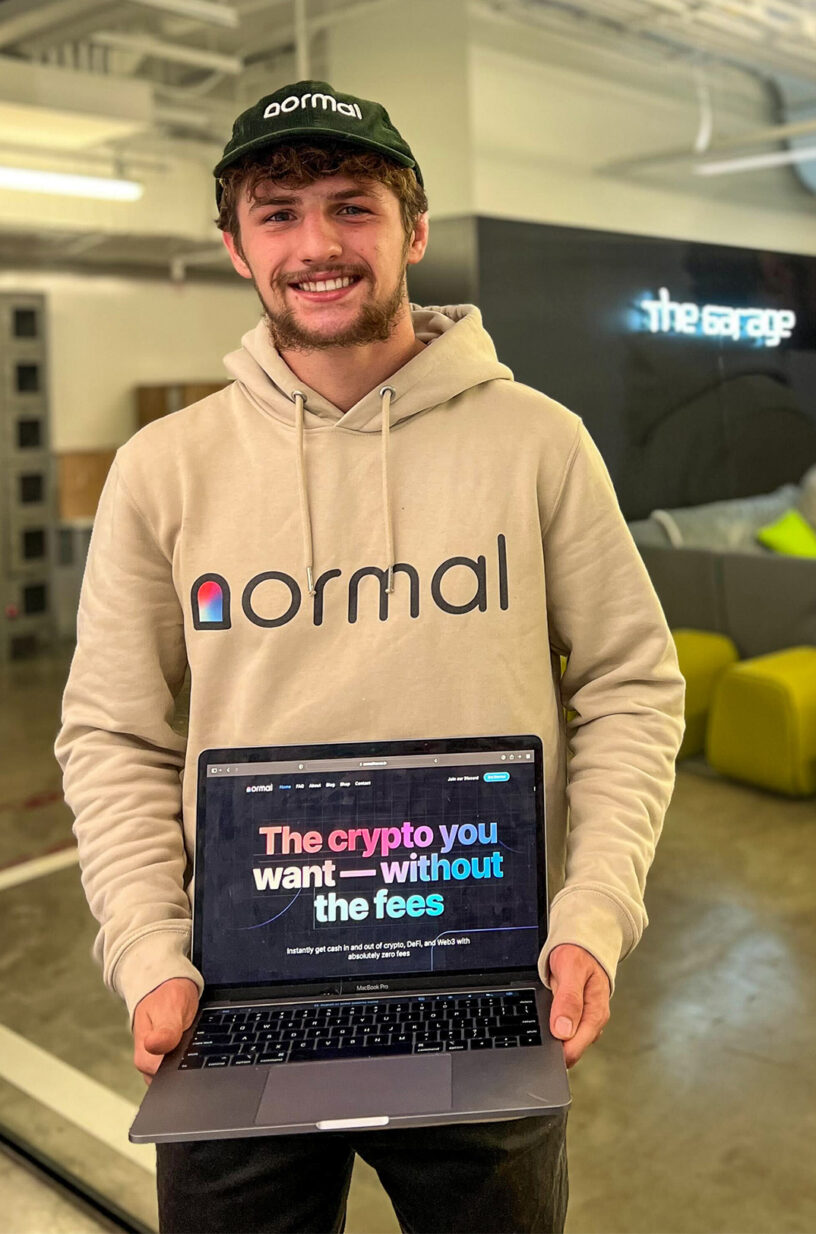
Justin Benjamin, co-founder and chief operations officer at Normal
Normal keeps coin ownership with the investor and instead helps them diversify their holdings across coins of their choice, he said. That allows Normal to provide investors access to a much wider array of coins — more than 200, he added.
The startup’s structure also opens its services to global investors, Blew noted, allowing its platform to sidestep “the millions of dollars in legal fees and years it takes to come up with those indexes that someone like a BlackRock would have to do.”
Normal’s approach to asset ownership also sets it apart, he said.
Typically, institutional crypto ETFs don’t hold cryptocurrency for their investors. Instead, they partner with a custodian, typically a coinbase or Gemini, Blew explained.
“The custodian actually owns your assets,” he said. “But with our model, you are actually self custodying, it’s kind of called. And so, with self custody, it does two big things for you.
“No. 1, it increases your security, so you’re actually able to move that crypto into a wallet or ownership structure of your choice that you can really tailor to your needs,” Blew said. “You can also trade your assets 24/7 — you’re not limited to the kind of traditional stock market hours of Monday through Friday nine to five.”
Normal also is building out its platform to revolutionize dividend creation, he added.
“You can lend out your crypto to lending networks on the blockchain, or you can stake it — but they’re basically just interest generating opportunities that you can use to earn passive income on your assets,” he said, noting the startup’s interest-earning offers should be live in the next few weeks.
Next up: earning Normal’s status as an RIA, or registered investment advisor — a key indicator of strength in transparency.
Right skills from the beginning
By the age of 16, Blew was teaching himself to code and trading penny stocks. By 2020 — before he’d even graduated from DePaul University — he was working full time as a lead software engineer with Kansas City-based banking UX startup Finotta, building APIs and frontend interfaces.
Trading penny stocks, coding and working adjacent to the financial industry ultimately introduced Blew to Bitcoin and crypto, he said.

Joshua Blew, Normal
Tom Woodward, a former teacher of Blew at Summit Technology Academy, knew from the beginning that Normal’s founder was special.
“Josh, he came to me one day and he had written a program to try to guess the stock prices,” Woodward said. “It just went straight over my head, but I was like, wow, this kid’s something special.”
Woodward corroborated Blew’s early interest in both investing and computer science, saying he rarely saw students who were interested in both.
“I was actually teaching a finance and fintech program,” Woodward said, “and he was one of the few students interested in both sides of that.”
Woodward recalls including a Warren Buffett quote in his email signature line when he worked as an educator, the famous “three qualities” quote:
“Somebody once said that in looking for people to hire, you look for three qualities: integrity, intelligence, and energy. And if you don’t have the first, the other two will kill you.”
“Josh has the energy, definitely has the intelligence, but he has a fantastic moral compass,” Woodward said, adding that the drama in the crypto space the last few years led Blew to pivot Normal “a couple of times in light of people that didn’t have that integrity piece.”
Citing the Sam Bankman-Fried scandal — involving a high-profile cryptocurrency fraud scheme — Woodward said Blew “has remained nimble and stayed true to himself.”
A Normal future as the new normal
Startups founded by individuals like Blew have the potential to reshape the economy in areas where their more traditional predecessors have failed to evolve for the better — especially not the betterment of normal people, said Dr. Alex Cahana.
“I don’t think that BlackRock is a company that shares the same values or the same vision of the world that I do,” said Cahana, a venture partner with “enterprise escalator” Impact Rooms.
“And so the reason that they’re using crypto is because it’s a peer-to-peer technology. It saves them a lot of money; it saves them a lot of overhead; it increases their margins… But the fundamental issue is that they are not interested in my wellbeing. They might say it, but that’s not how it’s translated in their everyday work.”
Cahana is an advocate for decentralization — decentralization of finance, healthcare and other key industries. Within cryptocurrency and finance, he’s a supporter of a future in which individuals are their own banks. In this scenario, what banks would become is more of a platform — a facilitator of connections between individuals.
The key to that vision, however, is an individual being willing to do their due diligence, he added.
“What is hard in crypto … is the DYOR. You need to do your own research,” Cahana said. “What is confusing and what you need to be careful of, or alert your readers to, is all about the branding.
“It’s like when you go to the supermarket, how do you know that what you’re going to buy is unhealthy? It says on it ‘healthy, natural, organic,’ all that… And if you look at the ingredients, you see that there are 70 ingredients in it. And so you know that that’s not healthy.”
The same goes for cryptocurrency, he said.
“There just has to be ingredients that you understand. And that’s the tough part,” Cahana continued. “If you don’t understand, read the code, go to GitHub and read the code. And that’s what people don’t do.”
Crypto indexes like Normal “are probably the closest it comes to being on your own. And that’s why it’s a good choice because they’re using an index, they’re creating ETFs, they’re personalizing it,” he said. “You understand the mechanisms of it, and the fees are low compared to others and traditional finance.”

2024 Startups to Watch
stats here
Related Posts on Startland News
KC’s first innovation officer reflects on work, city’s tech future
After more than two years of service, Ashley Hand is leaving the driver’s seat of Kansas City’s innovation efforts. Hand, who soon will be departing as Kansas City’s chief innovation officer, was tasked with implementing innovative strategies to improve how city government can better serve Kansas Citians. The city will be accepting applications for the…
Welcome to Startland News
Scrappy. Determined. Gritty. Those often were the words attributed to the Kansas City Royals as the team unexpectedly surged into the 2014 World Series and captured the national spotlight. Those very words are apt for this city, which has been built on the grit and determination of successful entrepreneurs like Ewing Kauffman, Joyce Hall, Henry…
Kansas budget woes render uncertainty for angel tax credits
As state budgetary concerns loom in the background, early-stage firms in Kansas are hoping a bill to extend the Sunflower State’s Angel Investor Tax Credit program will become a priority for legislators. Scheduled to sunset after the 2016 fiscal year, the program annually allocates $6 million in credits to entice investments in early-stage, growth-oriented companies…
KC virtual reality firm partners with KU, NFL coaches
A Kansas City-based virtual reality company hopes some marquee partnerships will plug it into a market projected to reach $150 billion in five years. Founded in 2013, Eon Sports VR recently landed the University of Kansas football team as a client for its mobile virtual reality platform to help players train without the risk of…