

Nile Valley Aquaponics grand opening brings sustainability, hope to community
March 29, 2017 | Meghan LeVota
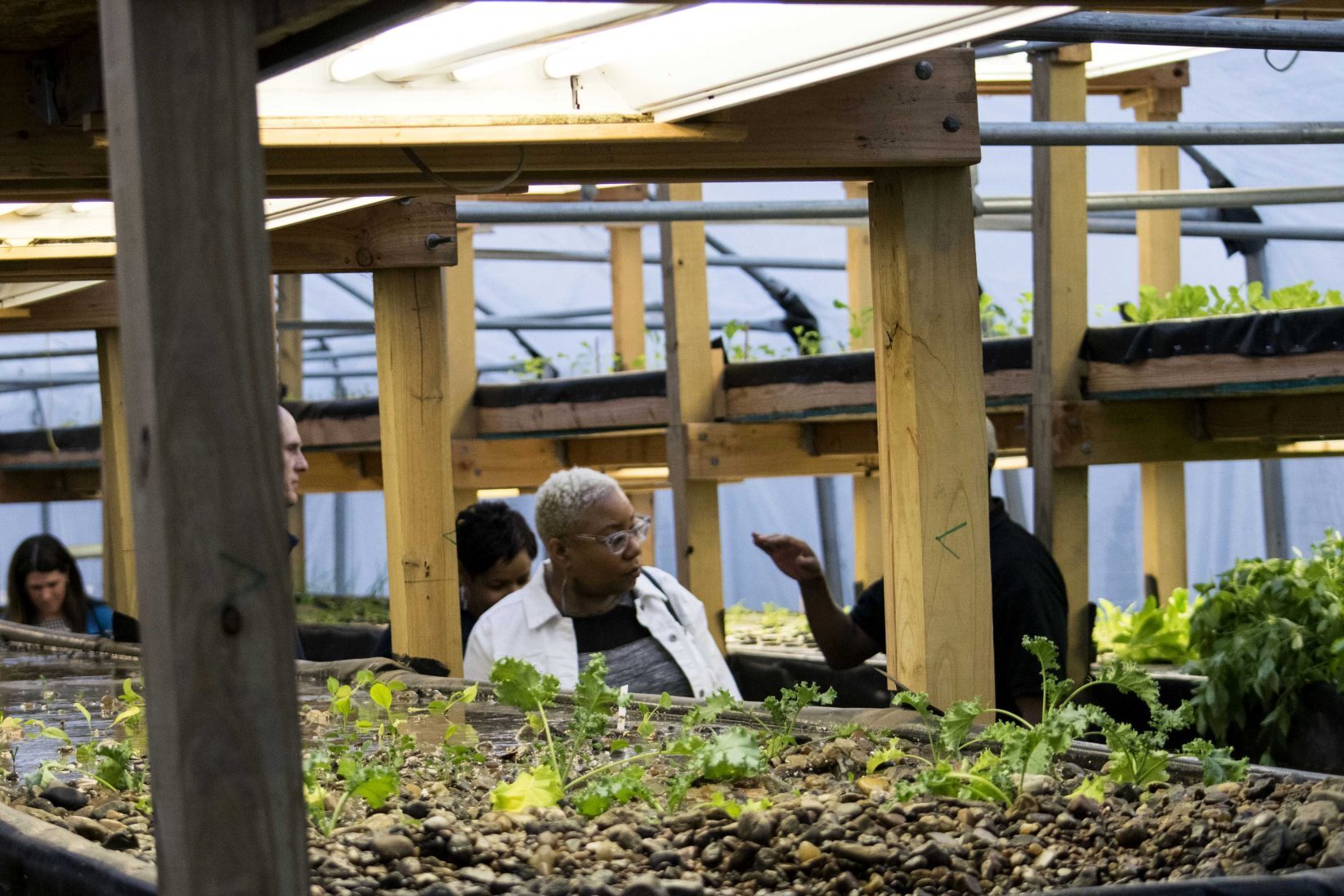
A sustainable greenhouse with the aim to empower one of Kansas City’s most underserved communities launched on Friday after two years of raising funds and preparation.
With partners such as the City of Kansas City, Mo., Kansas City Power and Light, Barkley and HOK, Nile Valley Aquaponics celebrated with an open house at the site at 29th Street and Wabash Avenue, a block west of Prospect. The two-day event attracted more than 300 community members, from both east and west of Troost.
Founder Dre Taylor expects Nile Valley to attract 1,500 volunteers and produce over 100,000 pounds of food — vegetables and fish — this year. This is especially notable because it is location in the heart of a food desert, a part of town where affordable and healthy food is hard to obtain especially for those without a vehicle.
“I’m excited for the community,” Taylor said. “Everyone’s been waiting for it and I think it’ll be good for it. There’s a lot of places we could have built this, but on the east side it’s most needed.”
Aquaponics is a gardening technique in which fish and plants grow together, imitating a natural ecosystem and using 10 percent less water than traditional soil growing methods. Waste from the fish feeds the plants. Nutrients from the plants filter into the water and return to the fish tank. The system can easily produce organic food by avoiding the use of any chemical fertilizers, pesticides or mercury.
The goal of most greenhouses is to resemble a natural ecosystem as much as possible which can be a difficult — and costly — task.
Through much research and planning, Taylor figured out how to cut costs by roughly 40 percent, as compared to a typical aquaponics system. Most notably, by raising his own insects to feed the fish, he saves on food purchases.
For the most part, Taylor can step back and observe his creation without extensive human intervention, in a zero-waste fashion.
“It’s raising fish, vegetables and other produce in a closed system,” Taylor said. “The fish waste supplies nutrients to the vegetables, allowing the vegetables to be able to grow.”
This makes Nile Valley Aquaponics one of the first closed-loop ecosystems to exist in the world. Even in the natural world, closed-loop ecosystems traditionally can’t exist.
“The insects that we are breeding is an essential part of what we’re doing and it removes food waste,” Taylor said. “It’s the future of sustainability.”
Nile Valley Aquaponics will raise several species of fish, including tilapia, and will grow leafy greens, lettuce, tomatoes, cucumbers and several herbs, such as basil and dill. In addition to these products being for sale, Taylor said he will host quarterly community workshops on composting, gardening and fishing.
Taylor’s efforts to improve the community do not stop with farming. His aquaponics project operates as part of Males to Men, a mentorship program he founded in 2013. The program shows African American boys ages seven to 16 how to be self-sufficient, grow their own food and strengthen their community. Thanks to Males to Men, over 600 people volunteered over the last year to get Nile Valley up and running.
“We teach the boys entrepreneurship and we teach them who they are,” Taylor said. “How to work out, exercise, learn about current events and put them in a good position in life.”
In addition to sustainably providing healthy food in an area with few other options, Taylor hopes the project will help alleviate crime and inspire the community. A message he recently shared at the social entrepreneurship conference Conquer for Good.
“It’s sure not the money,” Taylor said. “It’s about being an example and showing you can build something. It’s about having an idea and making it come to fruition.”
To see the system in action, watch the video below.



2017 Startups to Watch
stats here
Related Posts on Startland News
5 takeaways from most entrepreneurial city report
A report analyzing progress on Kansas City’s goal to become America’s most entrepreneurial city highlighted a trove of information on the area’s early-stage business community. KCSourceLink’s second-annual “We Create KC” report dissects the metro’s entrepreneurial ecosystem, including its headway toward realizing a challenge to become the nation’s most entrepreneurial city. Expounding on such metrics as…

KC lands federal ‘Smart Cities Initiative’ grant
The White House announced a new ‘Smart Cities Initiative’ this week that will bolster the Kansas City tech community. The $160 million grant has a slew of moving parts, but one portion includes a $6 million grant from the National Science Foundation that 15 communities, including Kansas City, will benefit from. The exact amount each…

Pipeline accepting applications, heading abroad
Pipeline Entrepreneurs is welcoming applicants for its 10th fellowship class, which is now gearing up for a lively year of entrepreneurial education. Pipeline, an organization of powerful Midwestern entrepreneurs that conducts a fellowship each year, will be holding its development courses in Kansas City, St. Louis, Nebraska and Ireland. Pipeline CEO Joni Cobb said the…

Postmates launches on-demand delivery service in KC
Postmates is coming to Kansas City. Well, technically the San Francisco-based company is already here. The Kansas City area is one of 10 metros the on-demand delivery service is officially launching in on Sept. 17, but for those who have heard of Postmates and downloaded the app, the service is live. Similar to Uber, Postmates is organized through…