
Scared away from networking events? Anti-social introverts can turn to tech
November 15, 2017 | Tommy Felts

Networking strength comes in numbers — even for anti-social introverts, Jeremy A. Smith told a crowd Tuesday at Global Entrepreneurship Week.
“Anti-social people, myself included, hate events,” he said.
But like all other entrepreneurs, such introverts still must build and maintain actionable professional networks from which they can request and receive value, Smith said. In-person networking events are the answer for some people, he admitted, but others like him struggle through the awkward encounters.
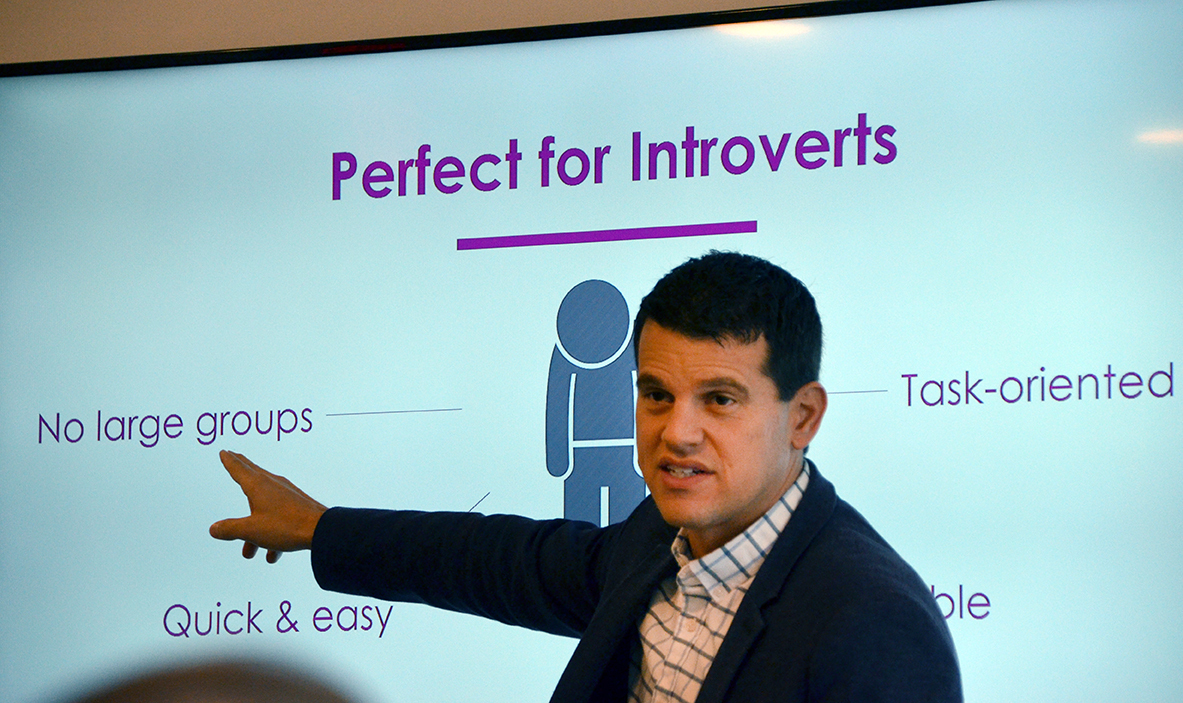
Jeremy Smith, Anti-social Networking, GEW
“Extroverts are energized by crowds, parties, networking events, things like that. Introverts are drained by them,” he said. “And that’s exactly how I felt.”
Smith, a practice leader for Kansas City-based MarksNelson’s accounting services department, described the experience of a typical networking event, from his perspective.
Walking in, you see crowds of people who aren’t even free-roaming, he said, they’ve already clustered together into groups.
“So first you’ve got to figure out ‘How the hell do I break into that circle?’ Like physically. ‘How do I get into this circle so I can then insert myself into this conversation?’” Smith said.
That takes you two Uncomfortable Moment No. 2, he added.
“You’re barging into a circle of people who have already established a relationship and then start talking about something that hopefully they might care about and you don’t look like an idiot,” Smith said. “And what do I do with my hands when I’m talking?
“And then I peel off with somebody, and that’s great, and we’re talking,” he added. “But two things usually happen: I don’t know how the hell to get out of that conversation. It’s like a one-hour networking event and I don’t know to get out of this thing that I tried so desperately to get into.
“Then I have an uncanny skill — I’m probably the world’s best person — at networking with the wrong people,” he continued. “I can’t tell you how many times I’ve spent like 25 minutes talking to a guy, and then I’m like ‘What do you do?’ And he’s like ‘Oh, I’m just the janitor here.’ Twenty-five minutes well spent. Thank you. He’s a nice man, but networking is not to meet those people, it’s to build your actionable network.”
Fortunately for introverts, Smith has developed an anti-social networking system that allows them to skip such interactions altogether, he said. It’s quick and easy, no large groups are involved, it’s scalable, and it flips networking from a social obligation to a task-oriented effort, he said.
Warning: Conversation is required. At least initially.
Start with coffees, Smith said. Or if you don’t like coffee, try alcohol.
“It’s easy to talk one-on-one with someone. It’s targeted. You know you’re talking to someone who can be an actionable part of your network, and you’ll actually be able to have a meaningful conversation,” he said. “That’s good for you and it’s good for them.”
Here’s where it gets tricky … the follow-up.
“Establishing those initial contacts is fantastic and you can’t build an actionable network without it, but here’s the thing: You can’t just have one coffee and then reach out when you need them 19 months from now. That’s not how human beings work,” he said. “You have to stay engaged with them. You have to keep them warm over the entirety of your professional career.”
In Smith’s system, he returns from a coffee, sits down at his computer and sets up a Google alert to notify him of news related to the company or organization of the person with which he just met. If he’s alerted to some development, he can respond with an email to the new contact.
Next, he advocates using a paid Gmail plugin called Boomerang to schedule reminders to send the new contact a templated email — written generically enough to be applicable to all recipients, but personal enough to feel human — each quarter.
“One person in 10 seconds. It’s not a social obligation. It’s a task. It’s a structure. It’s a system,” Smith said. “Keep it simple. Don’t add layers. Once you do, you’ll stop using your system and you won’t be able to build that actionable network.”
Featured Business

2017 Startups to Watch
stats here
Related Posts on Startland News
Gallery: Sprint Accelerator Demo Day
The Sprint Mobile Health Accelerator held its Demo Day event Thursday at the Kauffman Center for the Performing Arts. Ten startups that specialize in mobile health technology graduated from the Techstars-led accelerator, which conducts a three-month, mentor-led program designed to quickly advance businesses. Check out photos from the event by scrolling below.
UMKC, Digital Sandbox KC partnership to maximize resources, create jobs
The University of Missouri-Kansas City’s E-Scholars program has partnered with a business incubator program to provide resources and capital to student entrepreneurs. The program has partnered with Digital Sandbox KC to offer inroads to students to further develop their business projects with additional funding. “The UMKC Entrepreneurship Scholars program has a very specific goal –…
KC smart city ‘an invitation’ to innovators, entrepreneurs
The City of Kansas City, Mo., has signed an agreement with Sprint and Cisco to create the largest smart city in North America in the City of Fountains. Sprint will be building a network of connectivity worth up to $7 million dollars while Cisco will be providing smart city infrastructure worth upwards of $5 million. The…