
Hemp acres shrink across Midwest; USDA data shows farmers turning away from CBD
May 16, 2024 | Elizabeth Rembert

Editor’s note: The following story was published by Harvest Public Media and KCUR, Kansas City’s NPR member station, and a fellow member of the KC Media Collective. Click here to read the original story or here to sign up for KCUR’s email newsletter.
[divide]
Fewer farmers are planting hemp across the Midwest and Great Plains; The decline is most acute in hemp grown for its oils, like CBD, but experts say there’s greater opportunity in industrial hemp
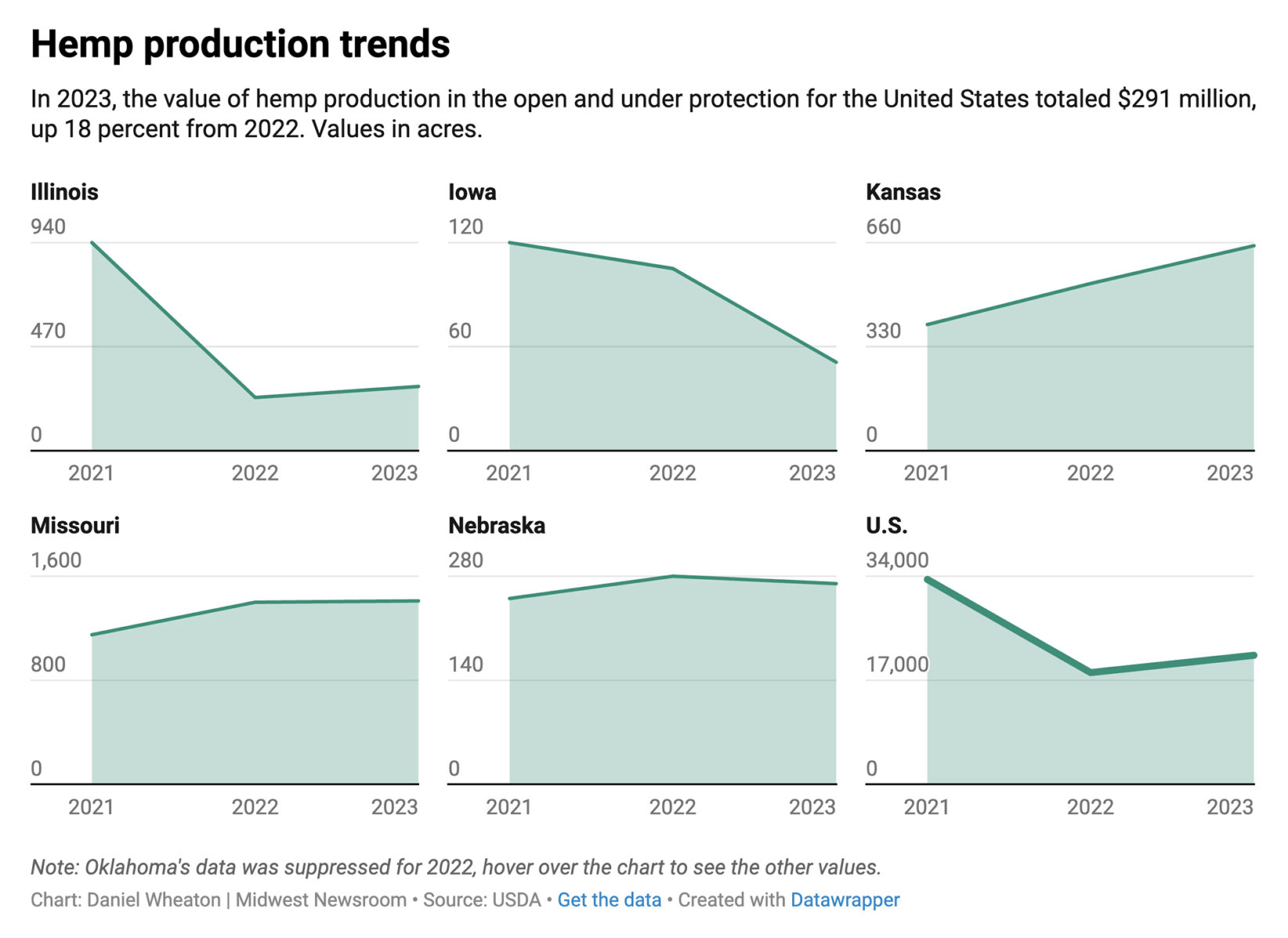
Farmers in the Midwest and Great Plains are planting much less hemp than they were two years ago, according to the most recent report from the U.S. Department of Agriculture.
But to David Lakeman – who leads the hemp and cannabis program at the Illinois Department of Agriculture – the smaller numbers may be a good thing.
He said there was a large surge of interest after the 2018 Farm Bill allowed farmers to grow cannabis plants with low levels of THC, the psychoactive agent found in marijuana.
“That excitement was real, but perhaps it outran infrastructure,” Lakeman said. “We have to build a whole industry of transportation, processing and markets. Now I think we’re starting to see a stabilization and what I hope is the beginning of a recovery for this industry.”
Sarah Stephens, who raises and processes hemp in Kansas, predicts the stabilization will lead to a tipping point for hemp growers. She’s seen improvements in seed breeding and growing techniques like row spacing, planting depth and machinery usage.

Sarah Stephens, Midwest Hemp Technology
“We’ve gone through the trial and error and now we’re slowly headed in the right direction,” she said. “We’re headed toward an upward tipping point that will take us to a million acres of hemp in the not too distant future.”
Stephens grows industrial hemp through her company Tallgrass Hemp & Cannabis. Industrial hemp is used for grain and fiber production and processed into things like high protein food, animal bedding and building materials.
Unlike in other Midwestern states like Illinois and Iowa, Kansas saw a rise in harvested hemp since the USDA started keeping track in 2021. Stephens said Kansas hemp farmers can be confident someone will buy their crop with three processors in the state.
She said industrial hemp is a better fit for farmers in the Midwest and Great Plains than floral hemp, which is typically raised in greenhouses for its essential oils like CBD.
“If you’re a farmer that’s normally planting corn or soybeans, CBD is probably not right for you,” Stephens said. “The whole production is very different from row crop farming. But with industrial hemp, you plant it with a planter and harvest it with a combine.”
Stephens’ insights play out in the USDA data, which shows farmers in the region are moving away from their initial focus on raising floral hemp for CBD production.
“It’s been followed by a shift toward more industrial hemp for manufactured goods,” Lakeman said. “That’s less likely to generate profits at the percentage those CBD products did initially, but is more likely to see steady, relatively level returns on investment.”
In Iowa, farmers harvested just 51 acres of hemp in 2023, according to the most recent data. That’s down from 120 in 2021.
Scott Booher wasn’t surprised to see the decrease. He and his wife Megan grow just under an acre of hemp to make medicinal products for their company Four Winds Farm in Amana, Iowa.
“We knew three other people who started growing hemp just because we were,” Booher said. “A lot of the hemp farmers around here thought there was going to be somebody who was just going to buy all the hemp.”
While Booher raises floral hemp mostly for its oils, he said he’d like to see more industrial hemp products used to replace plastic. He said that will help farmers see the opportunity in the crop.
“Farmers aren’t going to switch over from corn and soybeans until there’s something legitimate on the buying end,” he said. “I’d love to see more hemp raised for fiber. I think that’s what’s going to help the Midwest really flourish.”
Marijuana reclassification
The hemp industry also may be indirectly helped by President Joe Biden’s recent announcement that he plans to loosen restrictions on marijuana. Cannabis is classified as a Schedule 1 drug and regulated along with heroin and LSD. Biden plans to move it to Schedule 3, putting it into the ranks of Tylenol with codeine and testosterone.
Erica Stark leads the National Hemp Association and said while the news is a step in the right direction, it will likely have just an indirect benefit on the hemp industry.
“It could provide consumers some protections,” Stark said. “Let’s say they bought some hemp flower and it’s accidentally a bit high on THC. Now that’s not carrying Schedule 1 penalties.”
The downgrade could also help bankers and insurance agents feel more comfortable working with hemp growers and sellers, Stark said.
[divide]
This story was produced in partnership with Harvest Public Media, a collaboration of public media newsrooms in the Midwest. It reports on food systems, agriculture and rural issues.

2024 Startups to Watch
stats here
Related Posts on Startland News
Local weight lifting tech firm Rack Performance lands $250K
A Lenexa-based tech company is racking up investment capital to further develop its weight room management software. Rack Performance recently raised $250,000 from local, private investors that will help the company advance the second version of its software. Rack Performance built a web-based, weight room and group fitness platform to help coaches and trainers efficiently…
Kansas City startup ‘walks the talk,’ bungee jumps
Sara Davidson doesn’t lightly espouse a message of fearlessness in business. And that’s why Davidson, the founder of Hello Fearless, is live broadcasting her jump off a cable car in Switzerland. Davidson is hoping to inspire other women around the world to conquer their fears not only with a live-streamed bungee jump — out of a…