
This Blue Valley teen uses AI to research cancer; Trump’s budget cuts could halt his work
July 2, 2025 | Jodi Fortino

Editor’s note: The following story was published by KCUR, Kansas City’s NPR member station, and a fellow member of the KC Media Collective. Click here to read the original story or here to sign up for KCUR’s email newsletter.
[divide]
An Overland Park high schooler traveled to Washington, D.C., to advocate for cancer research funding after the Trump administration proposed slashing the National Institutes of Health budget
Matthew Chen, a senior at Blue Valley North High School, knows the importance of cancer research firsthand — he’s been working with the University of Kansas Cancer Center for two years to look into the disease.
He also joined cancer survivors and medical experts with the American Cancer Society Cancer Action Network last month in Washington, D.C., to advocate for cancer research funding following the threat of federal budget cuts.
The Trump administration has proposed slashing billions of dollars from the National Institutes of Health budget for 2026 and cutting nearly 40% of the National Cancer Institute’s funding.
At a time when more than 2 million new cancer cases will be diagnosed this year and more than 600,000 people will die from the disease, Chen said lawmakers should be putting more into the agency’s budget and not cutting back.
“These numbers are extremely high, and now, more than ever, we need increased efforts on cancer research for better treatments in cancer prevention,” Chen said. “Because cancer can affect anybody.”
Chen, 16, got his start with the KU Cancer Center by volunteering at cancer screening events, eventually moving into cancer research.
At first, Chen spent time experimenting with artificial intelligence and coding in different programming languages. That would later become his focus to help predict patient outcomes, side effects and quality of life from cancer treatment.
After studying existing research, he began writing code, training computer models and spending hours collecting data on patient outcomes. One of his projects looked at where people live and how that impacts their ability to afford cancer treatment.
Another AI model he built tracks lymphocytes, a type of white blood cell, in patients across their treatment.
“It helps doctors to sort of tailor the treatment that patients receive based on what side effects, or the severity of the reaction that they’re predicted to have,” Chen said.
In Washington, D.C.
Chen attended a U.S. Senate Appropriations subcommittee hearing last month during which lawmakers reviewed Trump’s budget request to shrink NIH funding. He said he was relieved to hear bipartisan support from legislators, including from U.S. Sen. Jerry Moran of Kansas, to whom he spoke after the event.
“It was great to feel like I personally am making a difference, and to let Sen. Moran know that his constituents care a lot about this issue,” Chen said.
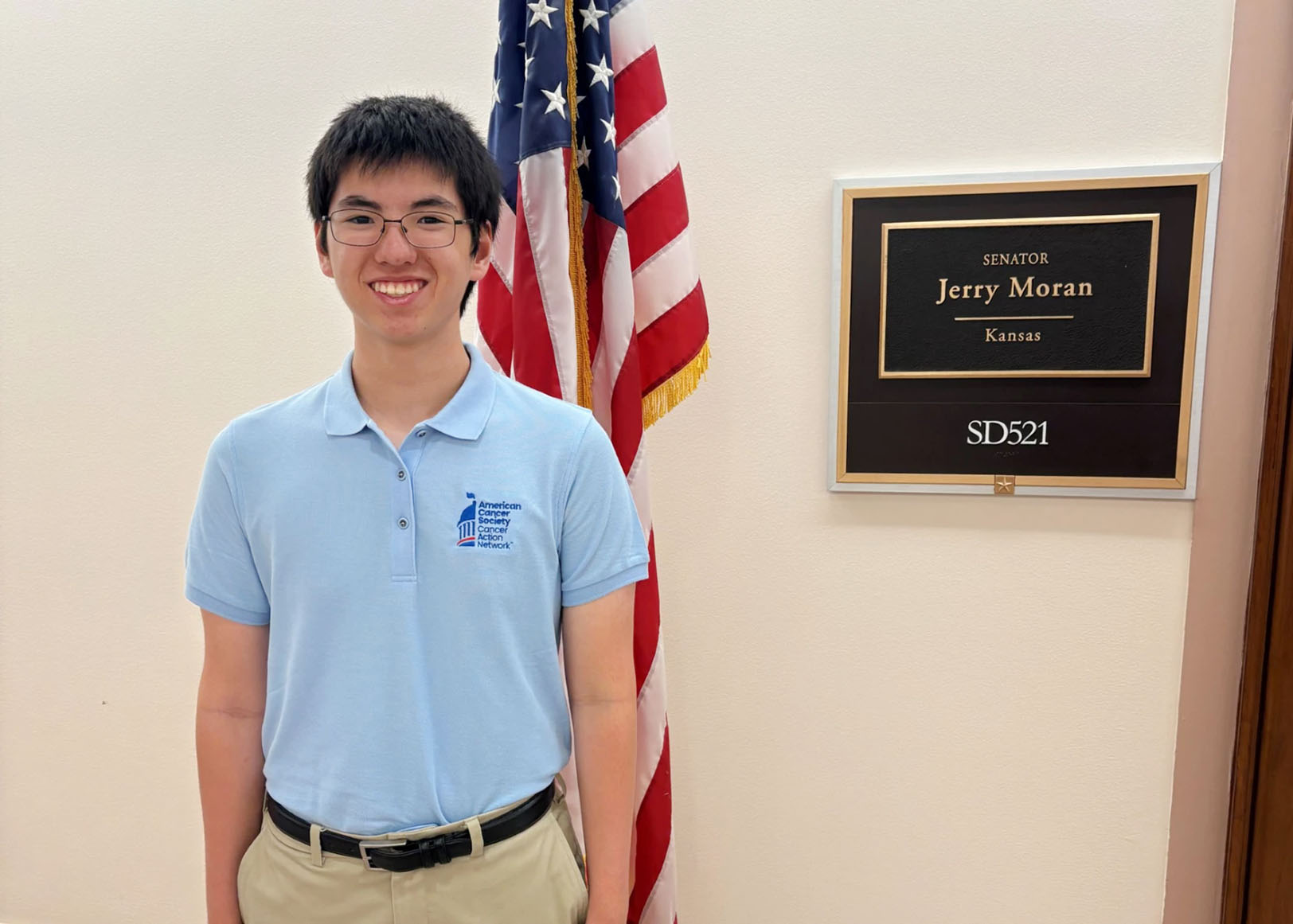
Matthew Chen, a senior at Blue Valley North High School, spoke with U.S. Sen. Jerry Moran of Kansas after a Senate Appropriations subcommittee hearing in June to review Trump’s budget request to shrink NIH funding; photo courtesy of Matthew Chen
National cuts to cancer research could directly impact Kansans, Chen said. The KU Cancer Center is the state’s only NCI-designated cancer center, and it provides residents with access to clinical trials and education on cancer prevention and detection, he said.
Megan Word, the government relations director for ACS CAN in Kansas and Nebraska, said the cancer center also gives patients access to newer treatments and more specialists who treat specific cancers.
The American Cancer Society also has a Hope Lodge in Kansas City, where Word said people who travel more than 50 miles for treatment can stay free of charge.
Word said Kansans are lucky to have those resources, and the group is working to ensure the whole state can access them.
“We can’t do that without research funding. We can’t do that without early detection, prevention screening programs,” Word said. “To look and try to estimate how we’re going to keep that support system in place if we’re looking at a reduction as large as the president has proposed, it’s really unbelievable.”
Funding cuts
Additional federal cuts could impact other cancer prevention efforts across the state.
Trump proposed cutting $4 billion from the Centers for Disease Control and Prevention, which funds the Kansas registry that tracks how often residents are diagnosed with cancer, what type they have and their survival outcomes.
Word said some of the state’s cancer prevention programs have already been impacted by earlier cuts and layoffs.
The Department of Health and Human Services closed the CDC’s Office on Smoking and Health, which Word said shutters funding that went toward states’ work on tobacco cessation and prevention education.
Word said more cuts to the CDC under Trump’s budget proposal could threaten the state’s program to detect breast and cervical cancer.
“The current actions that have frozen funding, slash staffing and talk of future funding cuts for lifesaving cancer research is unacceptable. These cuts will have life-threatening consequences,” Word said. “That means fewer people will have access to clinical trials. Researchers on the cusp of new discoveries will be forced to shut off the lights.”
For now, Chen said he’s grateful for the opportunity to get hands-on experience in the biomedical field and to learn firsthand the importance of that work.
Chen said he’s been so inspired by his work that he hopes cancer research will be part of whatever job he pursues in the future.
“If there are these severe cuts, that might not be an option for future generations, and I want to ensure that it is because it’s such a great opportunity, and it helps not only high schoolers, but it helps cancer patients as well,” Chen said.

2025 Startups to Watch
stats here
Related Posts on Startland News
Harvesting KCMO’s urban-to-rural development wins means taking down silos, EDCKC leader says
Editor’s note: The following is part of an ongoing feature series exploring impacts of initiatives within the Economic Development Corporation of Kansas City through a paid partnership with EDCKC. [divide] Kansas City’s growth isn’t just shaped by skyline-changing projects, said Heather Brown, describing a simple formula — and delicate balance — that keeps the region building upon its…
Roo-Up with pulled pork or bite into Big Salvy: Ding Dong Dogs debuts at KC Streetcar’s mouthwatering last stop
Matt McLain longed for the hot dogs he grew up eating as a young baseball fan in Chicago. His just-off-the-roller, quick-serve hot dog restaurant near UMKC and the extended KC Streetcar line squirts a dinger of nostalgia in an emerging destination known for elevated fare. It’s an opportunity McLain relishes, the Ding Dong Dogs owner…
Beach volleyball heavyweights, Olympians hitting KC sand for George Brett showdown
Serial entrepreneur Lance Windholz hopes a high-profile weekend beach volleyball tournament — showcasing 24 professional players, including seven Olympians — will encourage more Kansas City athletes and enthusiasts to dig the sport he loves. The George Brett 4v4 Volleyball Showdown arrives Saturday, Sept. 13, at Shawnee Mission Beach Volleyball. Two amateur teams are set to compete…
KC-built AI command center helps businesses gain superpowers without losing their tech stack
First envisioned as an AI-powered agent built to streamline operations at Kansas City-based Plexpod’s coworking spaces, Intuidy has evolved into its own operating system; one that is transforming the way companies operate, co-founder Grayson Smith said. Vantage — Intuidy’s flagship platform launched in early 2024 with the help of Smith’s brother, Gentry — is a…