
This Blue Valley teen uses AI to research cancer; Trump’s budget cuts could halt his work
July 2, 2025 | Jodi Fortino

Editor’s note: The following story was published by KCUR, Kansas City’s NPR member station, and a fellow member of the KC Media Collective. Click here to read the original story or here to sign up for KCUR’s email newsletter.
[divide]
An Overland Park high schooler traveled to Washington, D.C., to advocate for cancer research funding after the Trump administration proposed slashing the National Institutes of Health budget
Matthew Chen, a senior at Blue Valley North High School, knows the importance of cancer research firsthand — he’s been working with the University of Kansas Cancer Center for two years to look into the disease.
He also joined cancer survivors and medical experts with the American Cancer Society Cancer Action Network last month in Washington, D.C., to advocate for cancer research funding following the threat of federal budget cuts.
The Trump administration has proposed slashing billions of dollars from the National Institutes of Health budget for 2026 and cutting nearly 40% of the National Cancer Institute’s funding.
At a time when more than 2 million new cancer cases will be diagnosed this year and more than 600,000 people will die from the disease, Chen said lawmakers should be putting more into the agency’s budget and not cutting back.
“These numbers are extremely high, and now, more than ever, we need increased efforts on cancer research for better treatments in cancer prevention,” Chen said. “Because cancer can affect anybody.”
Chen, 16, got his start with the KU Cancer Center by volunteering at cancer screening events, eventually moving into cancer research.
At first, Chen spent time experimenting with artificial intelligence and coding in different programming languages. That would later become his focus to help predict patient outcomes, side effects and quality of life from cancer treatment.
After studying existing research, he began writing code, training computer models and spending hours collecting data on patient outcomes. One of his projects looked at where people live and how that impacts their ability to afford cancer treatment.
Another AI model he built tracks lymphocytes, a type of white blood cell, in patients across their treatment.
“It helps doctors to sort of tailor the treatment that patients receive based on what side effects, or the severity of the reaction that they’re predicted to have,” Chen said.
In Washington, D.C.
Chen attended a U.S. Senate Appropriations subcommittee hearing last month during which lawmakers reviewed Trump’s budget request to shrink NIH funding. He said he was relieved to hear bipartisan support from legislators, including from U.S. Sen. Jerry Moran of Kansas, to whom he spoke after the event.
“It was great to feel like I personally am making a difference, and to let Sen. Moran know that his constituents care a lot about this issue,” Chen said.
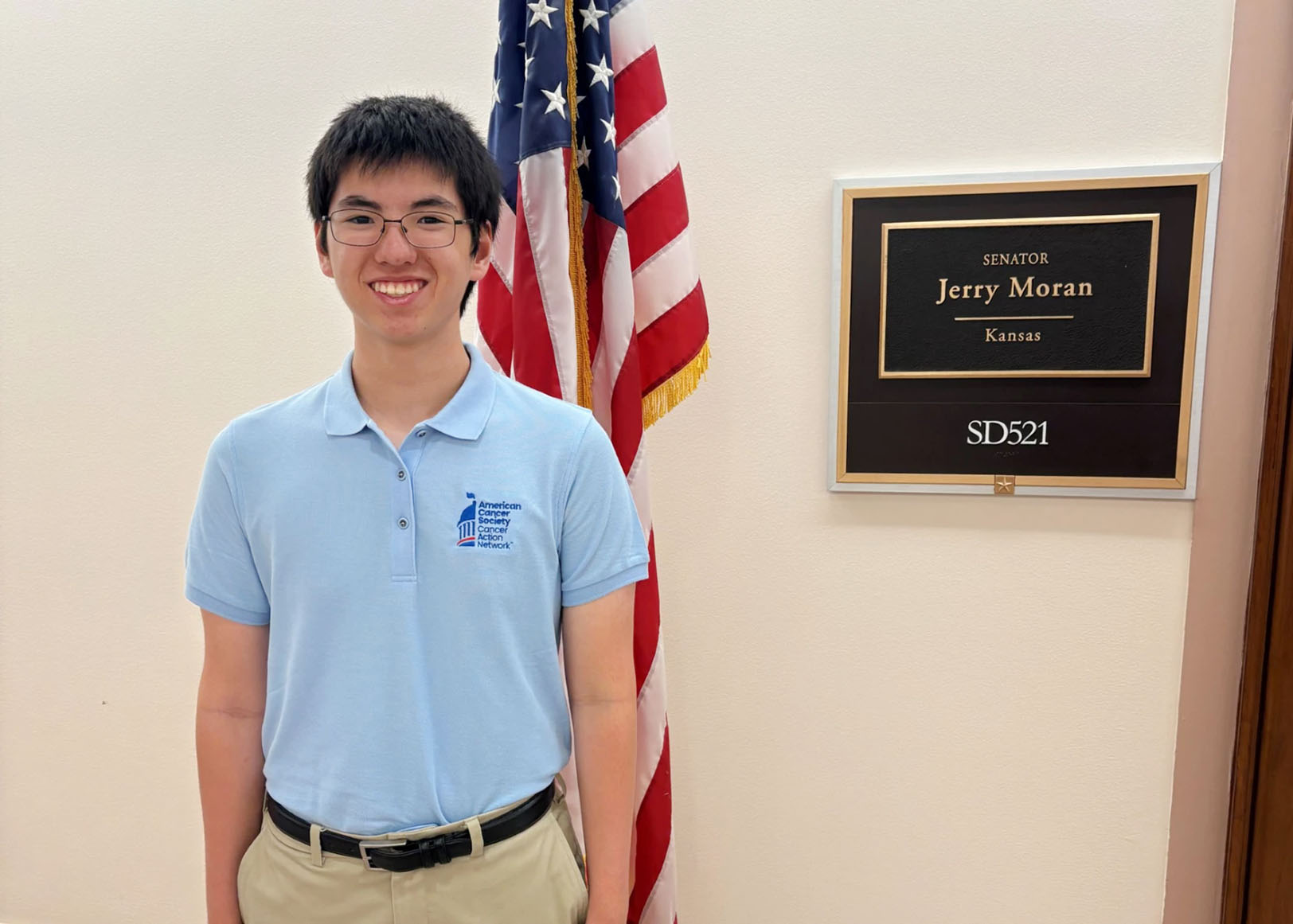
Matthew Chen, a senior at Blue Valley North High School, spoke with U.S. Sen. Jerry Moran of Kansas after a Senate Appropriations subcommittee hearing in June to review Trump’s budget request to shrink NIH funding; photo courtesy of Matthew Chen
National cuts to cancer research could directly impact Kansans, Chen said. The KU Cancer Center is the state’s only NCI-designated cancer center, and it provides residents with access to clinical trials and education on cancer prevention and detection, he said.
Megan Word, the government relations director for ACS CAN in Kansas and Nebraska, said the cancer center also gives patients access to newer treatments and more specialists who treat specific cancers.
The American Cancer Society also has a Hope Lodge in Kansas City, where Word said people who travel more than 50 miles for treatment can stay free of charge.
Word said Kansans are lucky to have those resources, and the group is working to ensure the whole state can access them.
“We can’t do that without research funding. We can’t do that without early detection, prevention screening programs,” Word said. “To look and try to estimate how we’re going to keep that support system in place if we’re looking at a reduction as large as the president has proposed, it’s really unbelievable.”
Funding cuts
Additional federal cuts could impact other cancer prevention efforts across the state.
Trump proposed cutting $4 billion from the Centers for Disease Control and Prevention, which funds the Kansas registry that tracks how often residents are diagnosed with cancer, what type they have and their survival outcomes.
Word said some of the state’s cancer prevention programs have already been impacted by earlier cuts and layoffs.
The Department of Health and Human Services closed the CDC’s Office on Smoking and Health, which Word said shutters funding that went toward states’ work on tobacco cessation and prevention education.
Word said more cuts to the CDC under Trump’s budget proposal could threaten the state’s program to detect breast and cervical cancer.
“The current actions that have frozen funding, slash staffing and talk of future funding cuts for lifesaving cancer research is unacceptable. These cuts will have life-threatening consequences,” Word said. “That means fewer people will have access to clinical trials. Researchers on the cusp of new discoveries will be forced to shut off the lights.”
For now, Chen said he’s grateful for the opportunity to get hands-on experience in the biomedical field and to learn firsthand the importance of that work.
Chen said he’s been so inspired by his work that he hopes cancer research will be part of whatever job he pursues in the future.
“If there are these severe cuts, that might not be an option for future generations, and I want to ensure that it is because it’s such a great opportunity, and it helps not only high schoolers, but it helps cancer patients as well,” Chen said.

2025 Startups to Watch
stats here
Related Posts on Startland News
She scored music on Netflix and LA’s star-studded stages; now BodaciousThang is getting vulnerable in KC
When Cheyenne Jolene steps on stage in the shoes of her alter ego, the singer-songwriter’s voice carries both raw emotion and unapologetic truth. Performing as BodaciousThang, Jolene blends R&B, hip hop, rock, and soul into what she describes as “genre bending” music. Her songs are steeped in authenticity and storytelling, offering listeners intimate glimpses into…
SNAP cuts are ‘worse than they look on paper’: Food access advocates warn shelves could go bare overnight
Chef Shanita McAfee-Bryant doesn’t mince words about perceptions of the hungry Kansas Citians she serves daily through her award-winning culinary social venture. “These are the people who — if you listen to the rhetoric — are deemed ‘lazy,’” the founder of The Prospect KC’s NourishKC Community Kitchen told Startland News. “We know the narratives being…
LISTEN: Fermenting a clean future through products from meat alternatives to skin creams and baby formula
On this episode of Startland News’ Plug and Play Topeka founder podcast series, we chat with Francesca Gallucci of Natáur, a Baltimore-based biotech company that’s reimagining how essential nutrients are made. Combining synthetic biology, metabolic engineering, and eco-friendly fermentation, they’re producing bio-based taurine (and other naturally occurring sulfur compounds) without relying on petroleum. Gallucci takes…
KCMO slashes fees for outdoor dining permits, launches dining trail for grant winning projects
Kansas City has officially eliminated outdoor dining permit fees, reducing the cost from $850 to zero, thanks to the momentum created by a city-led initiative to encourage investment in outdoor dining experiences, city leaders announced this week, unveiling new plans to promote funded businesses and their projects. Launched in 2024, the Outdoor Dining Enhancement Program…