
The future is local: How masks helped neighbors look each other in the eyes again
December 27, 2021 | Keith Bradley

Editor’s note: The opinions expressed in this commentary are the author’s alone. Keith Bradley is co-owner of Made in KC, a brick-and-mortar and online retailer of locally made goods with neighborhood, marketplace and cafe locations downtown, on the Country Club Plaza, in Lee’s Summit, Lenexa, and across the metro.
[divide]
As we wind down our second holiday season of the COVID-19 pandemic and look to a brighter new year, reflection is all but inevitable. Remember when toilet paper, flour and other essentials were in short supply? When Zoom felt new? Or when masks felt novel?
How about when our favorite neighborhood restaurant was about to close — or closed for good? Or what about when our everyday grocery store clerks and UPS drivers, who were always deserving of our respect and attention, became our heroes?
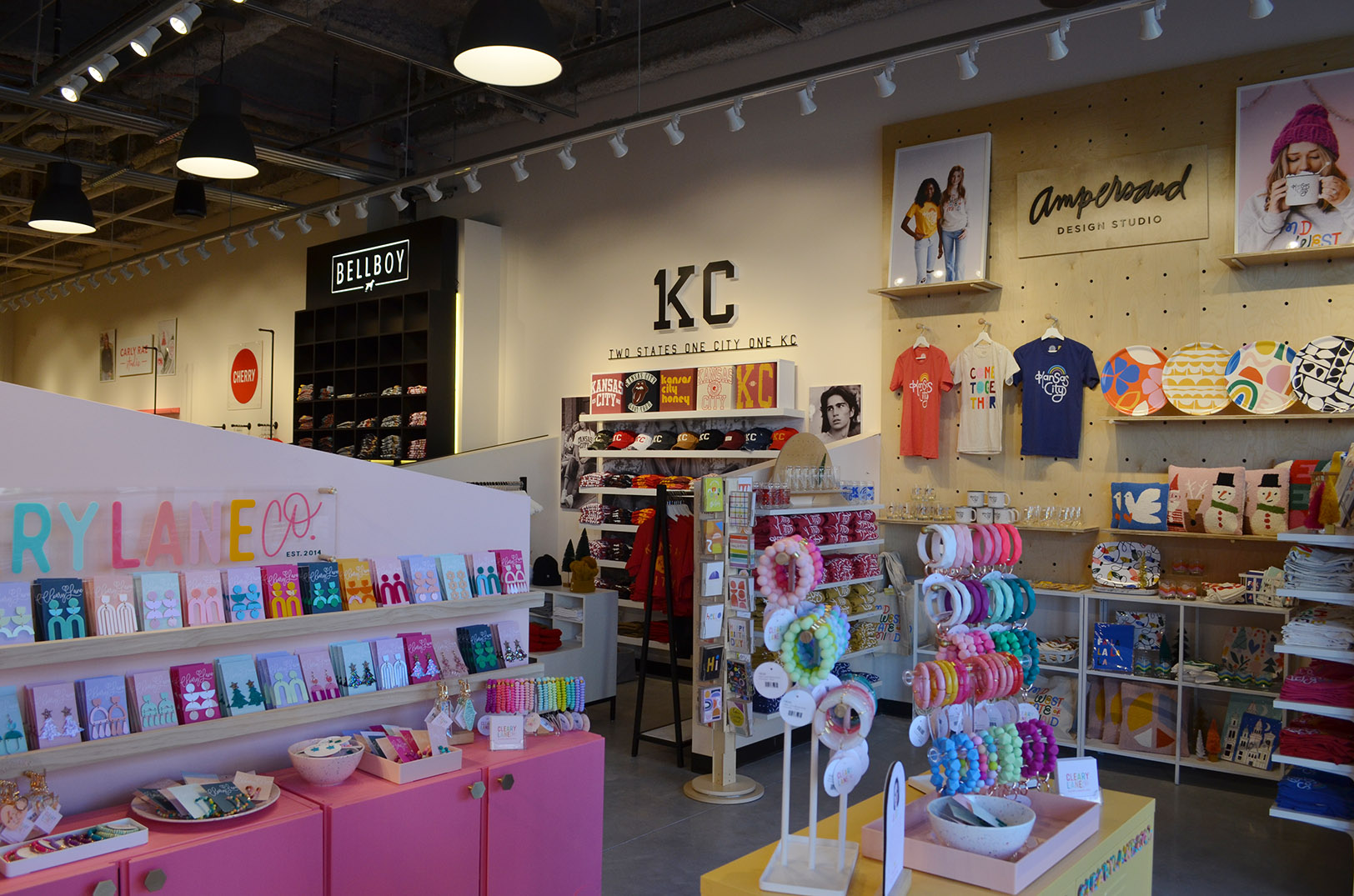
Made in KC marketplace at Lenexa City Center
As I reflect on the past two holiday seasons, I’m instantly reminded of the global and local environments we all live in and how for the past half century or longer we’ve made investments and tradeoffs to achieve an inter-connected, fast-paced global economy often at the expense of our local economies and communities.
Low-cost items delivered to your door-step in a matter of days if not hours. The same chain restaurants are available on nearly every continent. Instant video, chat, and communication with anyone, anywhere. The same big box stores in every major city. Fly to other countries for business or pleasure at a moment’s notice.
All the while, our local communities take the hit. The big box store takes more money away from the neighborhood it is in than it gives. The local cafe can’t compete with the marketing prowess of the chain cafe and so on.
Not only did our local neighborhoods take a hit, but we did as well. We turned shopping, once a communal experience, into a private and impersonal experience. A couple clicks, at my door, as if by magic, as if no other person was involved.
We turned communication, once both a communal and personal experience, into something that can be done anonymously behind an avatar. We became impatient and hurried and less connected.
Then the pandemic arrived. Things changed, things slowed. Shopping became communal and less private, more deeply personal again. If I got out, I needed to wear my mask to protect the grocery store clerk and the grocery store clerk needed to wear a mask to protect me.
Through plexiglass and through masks, we saw each other more clearly and what were previous impersonal interactions of goods for money became something more. And when the internet failed to deliver essentials, the local grocery store was ready and there for us like it has always been. (My local grocery store never ran out of a thing we really needed, did yours?)
When we communicated with others online, we wanted to see each other face to face, however fuzzy, as if we were in the same place. And when the UPS driver came, we no longer wished for them to arrive and go as quickly as possible, but wanted to see them albeit briefly and from a distance just to waive and say hi.
When our vacations were put on hold, our local parks and streets became new again. And we rushed to our local neighborhood restaurants as if we were putting out a fire.
I’m not decrying globalization.
It is a feat of human achievement to be celebrated and will not be undone. We need each other in the deepest meaning of the phrase; and global problems, like a pandemic, require global interconnect solutions. Our world needs to be more connected, not less.
But what we’ve lost in the process — one purchase, one exchange, one anonymous tweet, one play for convenience and thrift over value and sustainability at a time — is the recognition that we need to care for and build our local communities and economies in order to care for and build our global community and economy.
Through our purchases, we’ve divested money away from our local communities. Through our endless streaming and posting and online chatting, we’ve neglected our neighbors on our block. Through our desire for lower-cost food, we’ve neglected our local farmers who provided healthier and sustainable options. Through our desire to be like this city or that city, we’ve left our city open to be just like this city or that city in both good ways and bad. Through our desire to escape our community we’ve forgotten all that is in our own backyard.
As we look to the new year — in which the pandemic will still be dominant across the globe and supply chains will remain constrained — l challenge you as I regularly challenge myself to resolve in big ways and in small ways to support and care for our local communities.
Through supporting local businesses and restaurants, through talking with our neighbors, through waiting just a couple days longer for that next purchase, through continuing to visit your local park as if it were a national park.
So to my neighbors on 69th Terrace, my neighbors at the grocery store, my delivery driver neighbors and my hat making neighbors, my pit master neighbors, and my candle pouring neighbors, my touch down-throwing neighbors and my home run-hitting neighbors, my T-shirt designing neighbors and my tax accountant neighbors, to my homebound neighbors and my dog-walking neighbors, to my Northland neighbors and my East Side neighbors, and to my all my neighbors locally and globally: I wish you a happy, healthy and more local new year.
[divide]
Keith Bradley is co-owner of Made in KC.

2021 Startups to Watch
stats here
Related Posts on Startland News
Open Doors: Here’s how KCMO plans to turn empty storefronts into a World Cup stage for local talent
Applications are now open for grants of up to $10,000 for businesses and artists who want to activate underutilized or vacant commercial spaces in the downtown area during the coming FIFA World Cup to showcase Kansas City’s entrepreneurial spirit. Funds awarded through the just-detailed Open Doors! Program — crafted through a partnership between the City…
He took over a house-trained side hustle; meow it’s time scale the gourmet catnip brand
Adam Larson might be severely allergic to cats, but he’s following his own advice — pawing away at a gourmet catnip side hustle and toying with the best market fit for the business (and his life). Larson — who also is a network convener for MOSourceLink, the founder Decimal Projects, and a former program coordinator at…
How Main Street Summit is putting homegrown small business on stage with Tim Tebow
COLUMBIA, Missouri — Small businesses don’t stay small on purpose, said Colby Kraus, echoing a mantra popular among organizers of the Main Street Summit — an immersive downtown experience rich with enough Americana capital for entrepreneurs and community builders from all walks of life. Approaching its third year, Main Street Summit is set to return Nov.…
ICYMI: MTC says it’s moving forward with select entrepreneur programs despite steep state funding cuts
Editor’s note: This story was originally published by Missouri Business Alert, a member of the Kansas City Media Collective, which also includes Startland News, KCUR 89.3, American Public Square, Kansas City PBS/Flatland, and The Kansas City Beacon. Click here to read the original story. [divide] The Missouri Technology Corp. has released its annual implementation plan, announcing which programs…