
KC Fed: We can fix the digital divide (and solutions come without a high cost)
September 10, 2019 | Jeremy Hegle

Editor’s note: The opinions expressed in this commentary are the author’s alone. Jeremy Hegle is senior community development advisor at Federal Reserve Bank of Kansas City.

Jeremy Hegle, Federal Reserve Bank of Kansas City
Some issues affecting the digital divide are complex — expanding availability of affordable broadband, for example, requires government policy, technology, and lots of money. It can seem daunting and a bit abstract to think how an innovative Startland News reader can affect that. There are, however, actionable ways you can help narrow the divide.
Over the past few years, we heard growing concern that those at the middle and lower end of the income spectrum were at an increasing technological disadvantage. Just 53 percent of adults with incomes less than $30,000 have broadband at home. Applying for even minimum-wage jobs often requires using the internet. Securing what’s considered a “living wage” job almost always requires possessing digital job skills, as even “baseline” digital skill jobs pay 17 percent more. So where does this put the millions of Americans that don’t have broadband at home, or the relevant computers and skills to utilize it?
In early 2018, based on input from the Kansas City Fed’s Community Development Advisory Council, we launched an investigation into this digital divide. We had two goals:
- Identify key challenges and opportunities to narrow the digital divide, and communicate the findings broadly.
- Identify what, if any, additional role the Bank could serve to narrow the divide.
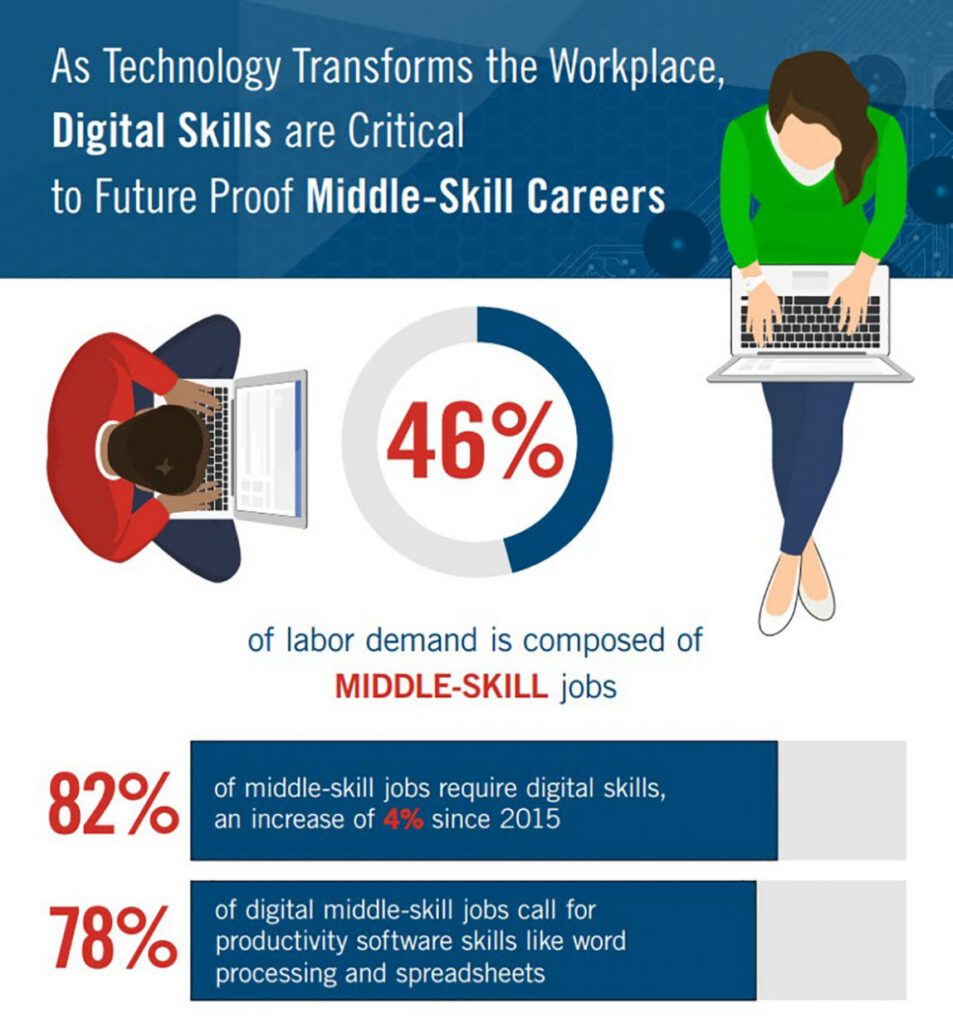
Image courtesy of Burning Glass Technologies
The first step: Listen and learn
Through a series of roundtable discussions, one-on-one interviews, and an online survey, more than 160 practitioners weighed in. They shared perspectives on what’s working to narrow the digital divide and what isn’t, which programs they admire, and what they wished the broader community understood.
This feedback identified seven common themes. The KC Fed’s community development team then sought related research, policy and innovative practices to complement the report’s findings. Results were recently released in a report, ”Disconnected, Seven lessons on fixing the digital divide.” Some of the lessons focus on policy and infrastructure. Another speaks to the need for ongoing collaboration — something the KC region, with the KC Digital Inclusion Coalition, excels at.
The following two lessons for fixing the digital divide require a bit of innovation, yet (relatively) little funding.
Donate your used (but functional) computers to community organizations
Our region is home to countless community organizations providing digital literacy, education and workforce development training to youth and adults alike. These organizations often work on shoestring budgets, and purchasing new computers isn’t cheap. At the same time, businesses typically replace their computers in three year cycles, often selling them to refurbishers for just pennies on the dollar. Donating gently-used computers to local nonprofits can be a low-cost, high — impact catalyst to the economic prospects of their clients.
As a demonstration project, in 2018 the Kansas City Fed donated 25 surplus laptops to Connecting for Good, a nonprofit computer refurbisher. The laptops were given new operating systems before starting a new life at Operation Breakthrough, which provides a wide-range of education, child care and family support services for low-income families. After just six months at Operation Breakthrough the laptops had:
- Helped students learn how to code and compete in robotics competitions;
- Allowed three parents to continue their education; and
- Increased the digital skills capability of teachers in classroom.
Reevaluate hiring and training programs for your employees
The skyrocketing cost of college education is putting a four-year degree out of reach for many, making it challenging to obtain a decent job. And, with record-low unemployment, many companies struggle to find qualified workers. To address this, some companies are reevaluating their hiring requirements and training programs. Apprenticeship programs have expanded beyond the traditional trades to computer programming, systems analysts and information technologies, among others. Companies like SnapIT Solutions now work with coding boot camp programs to source new employees. New hires receive on-the-job training to increase their coding know-how.
Click here to learn more about SnapIT Solutions’ job training effort.
Visit KansasCityFed.Org to learn more innovative ways communities are working to close the digital divide.
[divide]
Jeremy Hegle is senior community development advisor at Federal Reserve Bank of Kansas City.
Featured Business

2019 Startups to Watch
stats here
Related Posts on Startland News
Former Kauffman Foundation VP on how to scale via networking
With more than 25 years of leadership experience, Lesa Mitchell knows a thing or two about making — and fostering — valuable connections. Previously the vice president of innovation at the Ewing Marion Kauffman Foundation and a former executive at Marion Labs, Mitchell now is the founder of Networks for Scale, a company that works…