
KC’s Westside neighborhood awarded $1M from feds to reconnect community split by I-35
February 28, 2023 | Startland News Staff

A newly announced $1 million grant is expected to help reestablish a Kansas City neighborhood that was cut off from itself and opportunity thanks to past transportation infrastructure decisions — part of a $1 billion plan to right what many call a decades-long wrong largely perpetrated against historic communities of color.
In a first round of funding for the Reconnecting Communities Pilot Program — established by President Biden’s Bipartisan Infrastructure Law — the U.S. Transportation Department is awarding 39 planning grants and six capital construction grants, totalling $185 million in awards.
Among them: $1 million in funding to be used to study how to reconnect Kansas City’s Westside neighborhood with the rest of the city’s commercial and residential centers.
The Westside community was home to immigrants from Mexico, Central, and Latin America who created a rich and diverse neighborhood that was a mix of housing, restaurants, and businesses, according to the transportation department. That community is now separated by I-35, which was built in the late 1960s, and other rail systems.
The City of Kansas City, Missouri, will develop a comprehensive plan to increase mobility and connectivity, repair the community, and redress inequities and barriers to opportunity throughout the Westside of Kansas City, the department said.
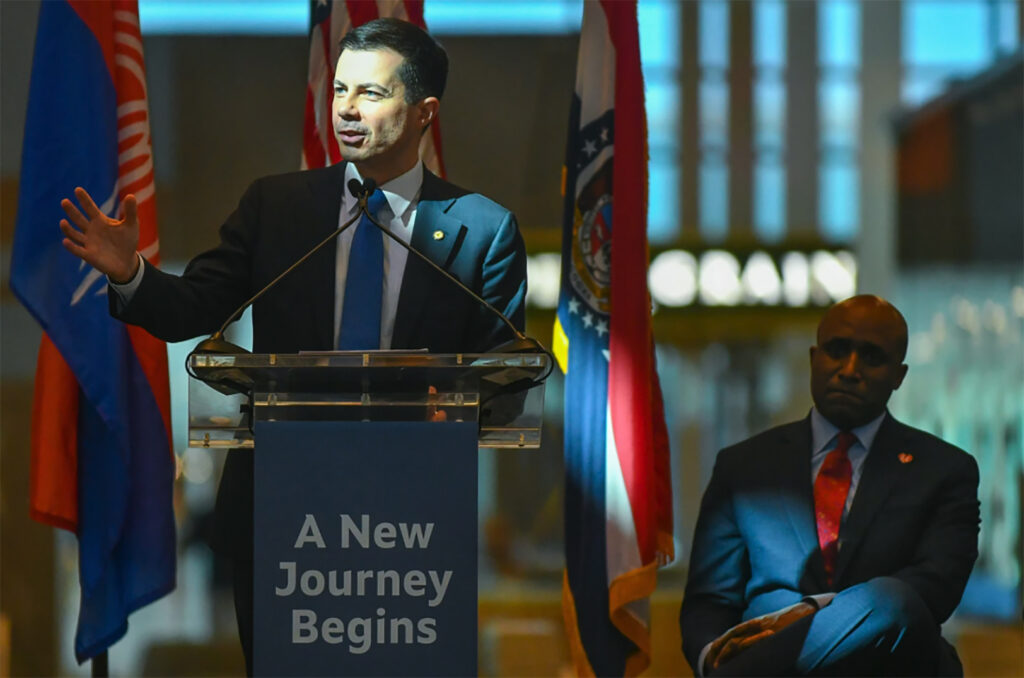
Pete Buttigieg, U.S. secretary of transportation, speaks at ribbon cutting ceremonies at the new terminal at Kansas City International Airport; photo by Carlos Moreno, KCUR
“Transportation should connect, not divide, people and communities,” said Pete Buttigieg, U.S. secretary of transportation, who was in Kansas City Monday for the opening of region’s new airport terminal. “We are proud to announce the first grantees of our Reconnecting Communities Program, which will unite neighborhoods, ensure the future is better than the past, and provide Americans with better access to jobs, health care, groceries and other essentials.”
Click here for an overview of the Reconnecting Communities Program.
Sixty-one percent of residents in the northern section of Westside and 47 percent of residents in the southern section now live below the poverty level, according to the transportation department. The I-35 viaduct has passed its projected life span and will need to be replaced in the coming years.
The Kansas City project proposes changes to the viaduct (structure or underpass), Beardsley Road, and West Pennway, and to improve transit access to address the barrier.
Check out a map of the Westside neighborhood below, then keep reading.
As with the Westside initiative in Kansas City, the first round of grants through the program is intended to fund construction and planning for transformative community-led solutions, including capping interstates with parks, filling in sunken highways to reclaim the land for housing, converting inhospitable transportation facilities to tree-lined Complete Streets, and creating new crossings through public transportation, bridges, tunnels and trails. These projects are expected to help revitalize communities, provide access to jobs and opportunity, and reduce pollution.
RELATED: H&R Block contributes $10M to South Loop Link plan; cost now $200M
Kansas City is one of 45 communities nationwide to first secure funding through the Reconnecting Communities Pilot Program, a first-of-its-kind initiative to reconnect communities cut off from opportunity and burdened by past transportation infrastructure decisions. pic.twitter.com/IAKZTc1m9T
— Kansas City (@KansasCity) March 3, 2023
[pullquote]
The Bipartisan Infrastructure Law is the largest long-term investment in U.S. infrastructure and economy in the nation’s history. It provides $550 billion over fiscal years 2022 through 2026 in new Federal investment in infrastructure, including in roads, bridges, and mass transit, water infrastructure, resilience, and broadband.
U.S. Reps. Cori Bush and Emanuel Cleaver, D-Missouri, and U.S. Rep. Sharice Davids, D-Kansas, were joined by U.S. Sen. Roy Blunt, R-Missouri, in supporting and voting for the Bipartisan Infrastructure Law in August 2021.
All other Republican members of both the Missouri (Graves, Hartzler, Long, Luetkemeyer, Smith, and Wagner) and Kansas (Estes, LaTurner, and Mann) Congressional delegations in the U.S. House and U.S. Senate voted against the infrastructure bill.
[/pullquote]
A new Reconnecting Communities Institute has been established to provide technical assistance to grant recipients, prioritizing those that serve economically disadvantaged communities.
Click here to see the full list of Reconnecting Communities program awards, including another $1 million grant to for Wichita’s 21st Street Corridor, which also has been impacted by I-35.
“Transportation infrastructure should help people get where they need to be, but, too often in our nation’s history, transportation infrastructure has done the opposite by dividing neighborhoods and cutting off communities from opportunity,” the department of transportation said in a press release. “For example, highways and rail lines can be physical barriers, preventing residents from easy access to social and economic opportunities. This burden is often felt most by communities of color.”
President Biden last week issued a new executive order directing agencies to further advance racial equity and support for underserved communities, including through federal actions that strengthen urban equitable development and expand economic opportunity in rural communities.
“Restoring communities like these helps give everyone a fair chance at accessing jobs and essential services such as healthcare services, grocery stores, and places of worship,” according to the transportation department.
Click here for historical context highlighted by the U.S. Transportation Department to indicate the need for the Reconnecting Communities Pilot Program.
President Biden’s Inflation Reduction Act also established a new, $3 billion program called the Neighborhood Access and Equity Grant Program which can also fund projects that reconnect communities. USDOT anticipates launching this program later this spring.
Buttigieg previously announced $48.2 million in federal funds for five Kansas City projects through the Rebuilding American Infrastructure with Sustainability and Equity (RAISE) program — also funded through Biden’s Bipartisan Infrastructure Law.
Two of those projects focused on reconnecting east-west communities in the metro.
Featured Business

2023 Startups to Watch
stats here
Related Posts on Startland News
Women flex their tech muscles at KC conference
Framed by a LEGO guitar and robotic vehicle, Rheanne Walton and Emma Howard anxiously review notes at their podium as dozens of technology experts await their pitch. The middle-school students are visiting the Kansas City Developers Conference to share the story of their all-girl robotics team, MindSTEM, and how it competes in the FIRST LEGO…
New lab hopes to boost digital inclusion in Kansas City
A new computer lab in Northeast Kansas City hopes to serve as a tech oasis in a digital desert among low-income households. Google donated and opened the new lab Monday in Chouteau Court, furthering the company’s mission to help bridge the area’s digital divide through education about computers and Internet use. Rachel Hack Merlo, Google…
Lantern scores big with Sporting Kansas City deal
Tech firm Lantern Software’s mobile app hit the right pitch with its hometown soccer team. The startup, located in Kansas City, Kan., recently partnered with Sporting Kansas City to offer its mobile concessions ordering platform. The deal, effective Saturday, will allow fans in Sporting KC’s Boulevard Members Club to order and pay for concessions on…
Scarcity of women, parents in startups offers research opportunity
It’s no secret that — like any business — an entrepreneurial ecosystem is disadvantaged without a diverse set of players. But hurdles such as late night meetings and male-dominated culture at startups create barriers to entry for two specific groups: women and parents. That’s why researchers at the Ewing Marion Kauffman Foundation are taking another…