
‘Troost is not scary’: Kansas City equity walk highlights Black business revival
August 13, 2025 | Thomas White

Editor’s note: This story was originally published by The Beacon, a member of the KC Media Collective, which also includes Startland News, KCUR 89.3, American Public Square, Kansas City PBS/Flatland, and Missouri Business Alert.
Click here to read the original story from The Beacon, an online news outlet focused on local, in-depth journalism in the public interest.
[divide]
Ron Evans used to walk with his grandmother — as she clutched her purse — past the intersection of Troost Avenue and Armour Boulevard because she didn’t feel safe walking to Save A Lot alone.
At that very same intersection, Urban Restaurant (formerly Urban Cafe) now hosts dinner guests as part of a pocket of redevelopment that includes several apartment complexes and a Chase Bank branch.
“The first time she came in here, she was blown away at how nice everything was,” says Evans, co-owner of Urban Restaurant. “When she walked back out on the street her first words were, ‘I almost forgot where I was.’”
For a woman who lived through decades when crossing Troost was effectively restricted for people of color, forgetting where she was illustrates just how much things have changed.
Brandon Calloway hopes to give more people a chance to see that transformation firsthand on Aug. 15. He has invited the public to join him for the Troost Equity Walk as he treks the length of Troost from Truman Road to Bannister Road.
“Troost is not scary,” says Calloway. “It is a hub for Black businesses.”
Calloway, co-founder of the nonprofit Kansas City G.I.F.T. (Generating Income for Tomorrow), will highlight 24 Black-owned businesses along the 10-mile stretch, including several that have seen grant funding or business support from his organization.
Economic scars starting to heal
Historically, Troost functioned as Kansas City’s racial dividing line. Redlining and racially discriminatory lending practices such as those outlined in Richard Rothstein’s bestselling book “The Color of Law,” contributed to systematically higher levels of poverty along and east of Troost, which in turn have contributed to the street’s reputation.
A 2018 NBC News analysis found that households one block east of Troost earn $20,000 less annually and residents live 15 years less on average than those one block west of Troost. A 2023 Mid-America Regional Council report showed that the historic discrimination in housing still impacts the region today and contributes to concentrated poverty and an unofficial but entrenched geographic racial divide.
However, some sections of the “Troost Wall” are finally starting to crumble. Millions of dollars have been invested along the corridor in recent years, bringing new businesses, housing and higher property values. According to data from Zillow, the 64131 and 64110 ZIP codes that run along and just east of Troost have respectively seen 146% and 137% increases in the average property value over the past five years.
Completed projects that have helped spur Troost’s recent redevelopment include:
- $78 million — Armour Corners mixed-use project by Mac Properties that renovated all four corners of the intersection on Armour and Troost.
- $26 million — Beacon Hill housing for University of Missouri-Kansas City students.
- $20 million — Marcato Apartments at 27th and Troost.
- $18 million — Wonder Shops & Flats, housing BikeWalkKC headquarters, The Combine and SAVE Inc., along with apartments and other businesses.
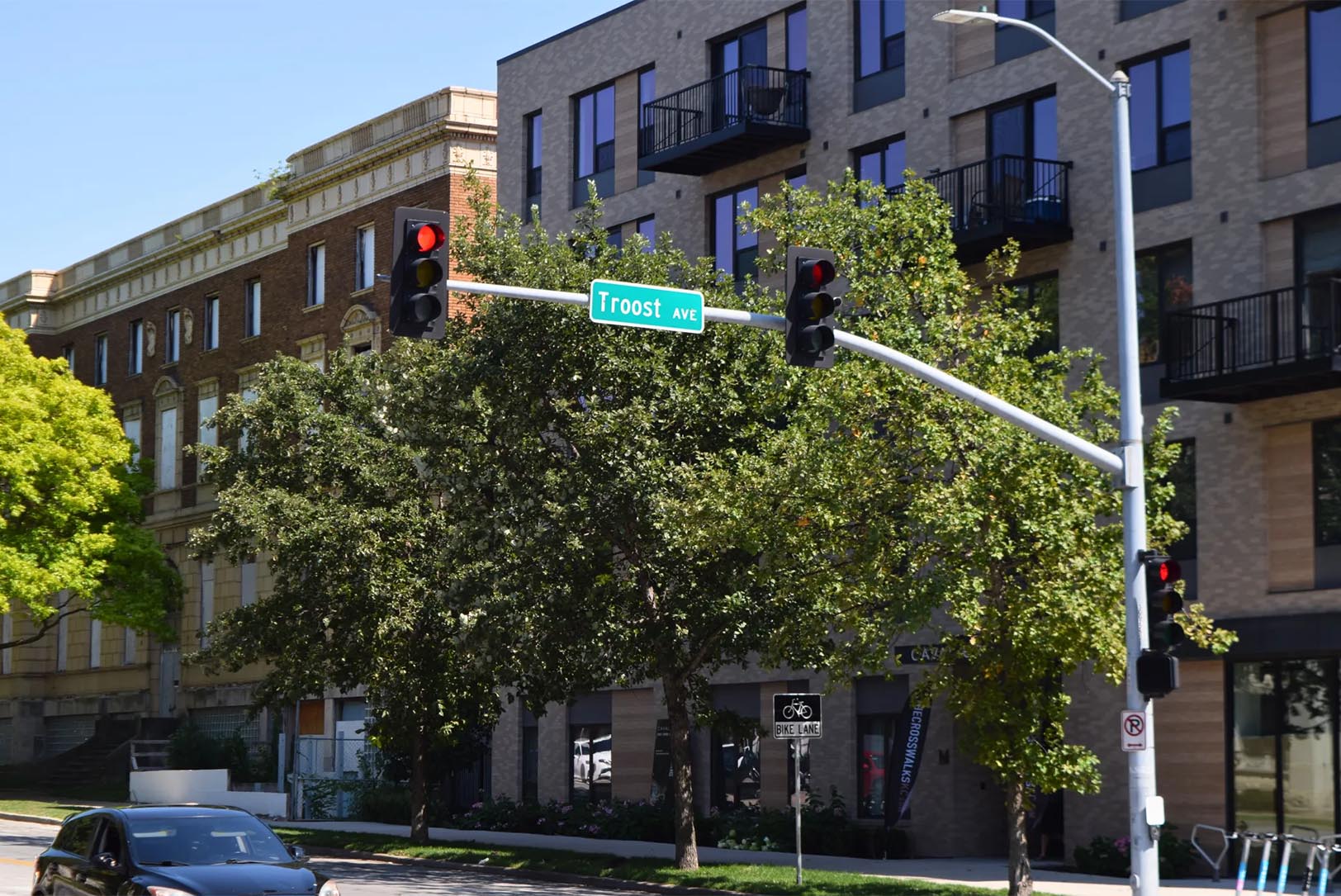
The corner of Troost Avenue and Armour Boulevard recently received a $78 million renovation; photo by Thomas White, The Beacon
Evans says that economic figures aside, he notices the changing Troost just by looking out Urban Restaurant’s windows.
“It’s crazy to me to see all kinds of people jogging and walking with their dogs,” says Evans. “With all the new buildings and everything around they just view it as regular.”
Evans says the new residents — largely young professionals or students — occupying the apartments surrounding his location don’t view Troost the same as past generations.
“They don’t really seem to carry that ‘Troost stigma’ in their minds,” says Evans.
ICYMI: Chef brings Urban concept back to Troost; $25K GIFT grant boosts fight against gentrification
Troost Equity Walk
Two months ago, Calloway was looking for a place for an Army-style “ruck walk” and decided to hike all the way down Troost to get an updated ground-level perspective of the street he grew up around.
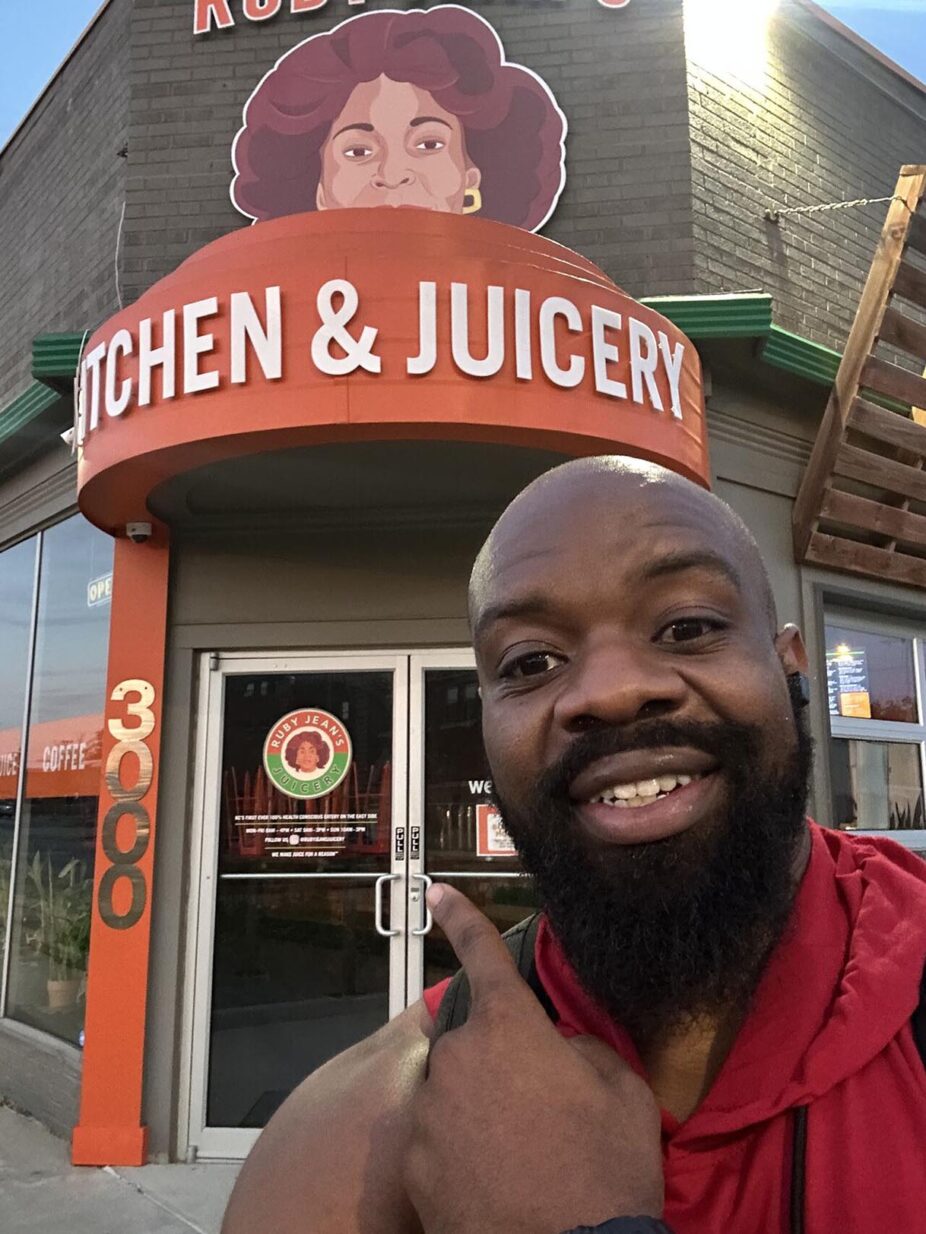
Brandon Calloway on his “Ruck Walk” outside Ruby Jean’s Kitchen & Juicery on Troost Avenue; photo courtesy of Brandon Calloway
“Remembering what Troost was like 15-20 years ago then seeing what it is today was a powerful experience,” says Calloway. “I felt proud of the progress the city and the street have made.”
Calloway posted photos of his walk on social media and got a response so big he decided to invite the public. Dozens of people, including Kansas City Mayor Quinton Lucas, have RSVP’d for the 10-mile walk, which starts at 6 a.m. Aug. 15 in hopes of beating the summer heat.
Those who take part in the Troost Equity Walk will note the street’s impressive but uneven redevelopment. The corridor features several gleaming new developments, but still has stretches of abandoned buildings and vacant lots — particularly south of 75th Street.
Development still favors areas west of Troost, but change is undeniably underway.
GIFT building momentum
KC G.I.F.T. emerged from a 2020 Facebook post about how if 15,000 people gave $10 a month, the collective community funding could spur Black-owned businesses’ growth east of Troost without waiting for outside institutional investment.
“Troost is the entry point,” says Calloway. “The biggest goal of G.I.F.T. is helping to facilitate the creation of significant employers on the East Side.”
The nonprofit has strategically funded 78 Black-owned businesses east of Troost since its inception. KC G.I.F.T. has invested $1.9 million in grants that have created 153 new jobs and generated an average revenue growth of 209% for grant-receiving businesses.
Urban Restaurant was awarded a $25,000 grant last year that helped them cover expenses in their crucial first year at Armour and Troost. The grant was applied directly toward rent payments, allowing them to invest in the restaurant’s long-term needs like hiring, marketing and expanding a patio.
That grant is already showing dividends as Urban was named best restaurant at the Kansas City People’s Choice Awards.
“Black-owned businesses aren’t better just because they are Black, but we’re saying they aren’t worse because they are Black,” says Calloway. “They are just like every other business, large or small scale and dealing with the same issues, but they’re often dealing with those issues with fewer resources.”
Calloway says that G.I.F.T. invests in businesses that are looking to grow, and points to another example in Equal Minded Cafe at 43rd and Troost. A G.I.F.T. grant helped the cafe expand from exclusively beverage service to being able to serve food.
When businesses receive grants — ranging from $10,000 to a new $100,000 grant launching this September — they also get a year of business coaching, bookkeeping services, marketing support from Crux KC and pro bono legal services.
“Our goal is the reduction of the racial wealth gap and poverty-related crime,” says Calloway. “We do that by creating jobs and growing dollars within the community.”
The organization, which recently received a project grant from the Ewing Marion Kauffman Foundation to support its work, also operates a business center at 50th Street and Prospect Avenue. The business center has booked more than 8,300 appointments with 2,650 people seeking business support, whether or not they receive grant funding.
Calloway says growing wealth across Troost is one of the only ways for Kansas City to fully realize its potential.
“We are only as strong as our weakest link,” says Calloway. “Even though we’ve done a lot on the East Side, there’s still more to do in order for us all to be able to say that we’re doing our part.”
Featured Business

2025 Startups to Watch
stats here
Related Posts on Startland News
1MC recap: program traces roots, features The Swapping Co., OneDayKC
Kansas City’s 1 Million Cups tried something new today. And by new, it was actually old. The event met in its original venue, Kauffman Labs, which served as an intimate setting for attendees. Entrepreneurs and community members gathered around desks and viewed presentations projected onto a white board. “The venue change happened today because our…
Coming UMKC innovation center to serve students, entrepreneurs
With funding shored up from private and public donors, the University of Missouri-Kansas City is planning to move ahead with its plan to build the Robert W. Plaster Free Enterprise Center to support students and entrepreneurs. Missouri Gov. Jay Nixon announced Tuesday that the state is allocating $7.4 million to the center, which represents half…
Security firm Nodal nabs $100K, ramps up hiring
Good news is stacking up for Kansas City-based Nodal Industries. The security hardware tech company recently snagged $100,000 in seed funding as part of an opportunity to participate in the 500 Startup accelerator program, based in Mountain View, Calif. The funding will allow Nodal to hire up to eight people, as well as ramp up production…
Play-It Health lands in top-ranked digital health accelerator
As with many successful startups, the idea for Play-It Health was born out of personal experience with an unsolved industry need. Kim Gandy, a former clinician and now the founder and CEO of Play-It Health, recognized that patients were having trouble engaging and adhering to their medical regimen. In the worst cases, this led to…