
Why Bay Area investors are shifting their gaze from tech to on-the-ground ag innovations
October 12, 2023 | Nikki Overfelt Chifalu

Agriculture innovation is at a capital-fueled crossroads, said Josh Svaty, describing a growing appetite from well-funded West Coast investors who are hungry for high-yield Midwest solutions.
Climate change — and the challenges it poses across industries — is seeding much of that interest, explained the Kansas farmer, former politician, and investor; speaking to Startland News before a recent Farm Voice panel on the future of ag innovation.
“Consumers are going to see a ton of ideas and new opportunities to purchase the next big thing that’s right for the planet. And they’re going to have to be really discerning,” said Svaty, noting Bay Area investors are pouring money into ag tech without having the same level of understanding of its nuances as Kansas City and Midwest investors.
More regional investors gravitate toward hard tech, while West Coast investors typically are drawn toward solutions rooted in software, continued Svaty, who owns and operates Free State Farms in Ellsworth and is the founder and principal of Perennial Prairie.
“We’re investing in something that’s going to be operating out in the fields,” he said. “For years the Bay Area has been looking for tech unicorns — that are software based — that can rapidly be worth billions of dollars just because of the number of people using them. When you get into the ag space, there’s some software but there’s a lot of hard tech.”
The next generation of ag innovations are going to be key in solving critical climate challenges like the diminished Ogallala Aquifer in Western Kansas, Svaty shared, emphasizing the importance of the largest repository of fossil water in North America — a source central to producing food outside of the heart of the Corn Belt of Iowa and Illinois.
“We have become significantly more efficient with the way we use the water, which is great,” he explained. “But it also presents Jevons paradox — which we saw with the 19th-century coal situation — that as you become more efficient with something, you actually don’t use less, you use more. So we are being more efficient with better technology, but we’re still just using it as fast as we possibly can. The next era of ag innovations — particularly with water — are going to have to address the question of: how do we actually use less? How do we leave some of it in the ground?”
And that’s not easy, Svaty added.
“I’m not even sure if our regulatory structures are set up to handle that,” he said. “These were real property rights given away in the 1940s and ’50s. And so backtracking on them, you can’t just do it with a regulatory hammer. It’s major.”
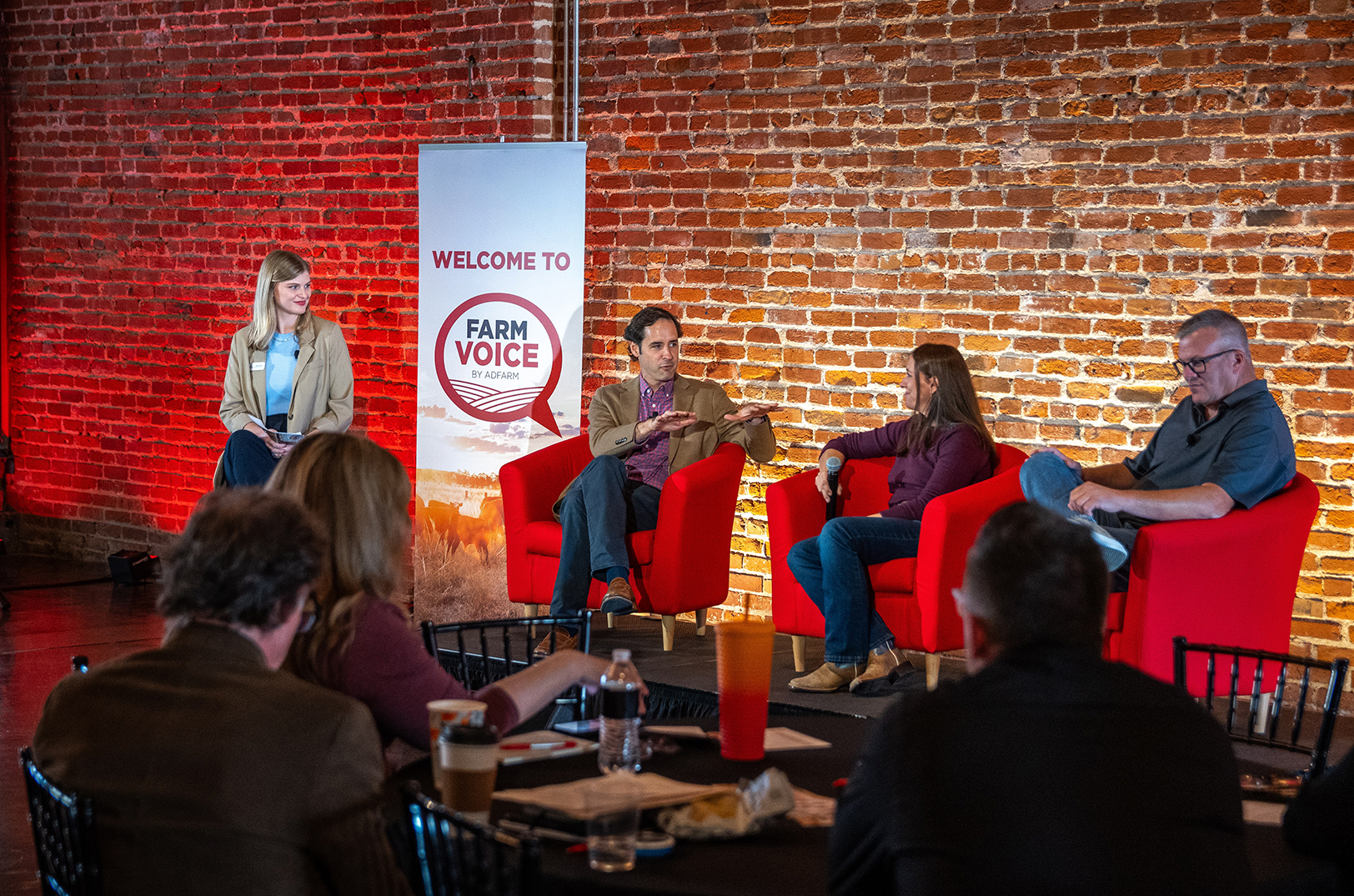
Josh Svaty speaks during a recent Farm Voice panel on the future of ag innovation at The Guild in Kansas City; photo courtesy of AdFarm
Fertilizer waste is also being addressed by the latest innovations, Svaty noted. He’s an investor in Nitricity, an electrified climate-smart fertilizer startup that participated in Black and Veatch’s IngiteX Climate Tech Accelerator in 2022.
“It is estimated — globally — that we waste upwards of 50 percent of the fertilizer we put on,” he explained. “So not only is that wasted money on the part of farmers, it’s the wasted back-end energy to produce that in the first place. And then it’s not simply wasted, it’s either volatilized into the atmosphere, which is bad, or it goes down the rivers, which is bad.”
Better fertilizers need to be produced and then applied as accurately as possible, Svaty said.
“Our technology in that world is improving,” he added. “But we still have a long way to go.”’
An investor in the energy space tipped him off to San Francisco-based Nitricity, which was launched in 2018 and produces nitrogen fertilizer from air, water and renewable electricity, Svaty said.
“I had been interested in fertilizer anyway,” he noted. “But this was prior to the huge run-up in the fertilizer debacle that we’ve had the last couple of years.”
After talking to co-founder and CEO Dr. Nicholas Pinkowski, Svaty recalled flying out to the Bay Area to check out the technology.
“I got really excited and saw what every farmer dreams of,” he continued. “We’re all subject to market forces that can move at any time, whether it’s fuel or selling our commodities on the back end. Fertilizer in particular is one where we frequently feel helpless and here’s a potential process that can be done on the farm — right where it’s needed — and you control it yourself. It’s hard not to get excited about that.”
Electing to return home
As a fifth-generation Kansan and farmer, raised outside Ellsworth, Svaty has grown up around renewable energy, he shared.
“We had one of the very earliest wind farms in the state (in our area),” he said. “I had always liked renewable energy when I was younger, but also you just never knew how fast it would happen. Not only did it start to happen fast, but it really was in my backyard, which was really exciting.”
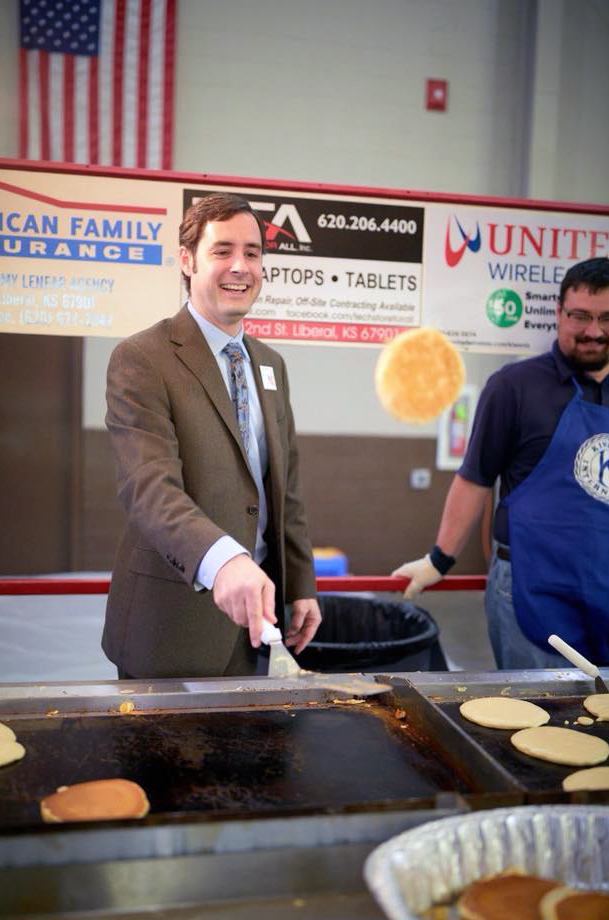
Josh Svaty, then a Democratic candidate for Kansas governor, flips pancakes on the campaign trail in Liberal; photo courtesy of Josh Svaty
Svaty took a break from the farm early in his career to pursue politics, elected to the Kansas House of Representatives at the age of 22 in 2002 before being appointed Kansas Secretary of of Agriculture in 2009. After that, he worked for the Environmental Protection Agency and the Kansas Land Institute before his 2018 bid to be Kansas Democrats’ gubernatorial candidate. (Svaty ultimately was defeated by Laura Kelly, who went on to win the general election in 2018 and 2022.)
“I made my run for governor, which I tell people is the most awesomest run for governor ever,” he joked. “But it was not successful. Now I spend my time in the world of agriculture and renewables and energy.”
He and his wife now own Free State Farms — a diversified cow-calf and grain operation — in the same area he grew up in and the same area he represented in the Kansas Legislature.
“Agriculture is just something I can’t let go of,” he added.
Svaty admits he’s had an uncommon career path.
“But it’s me,” he explained. “It’s been great. And I think that’s what anybody would hope for is that you look back at the arc of your professional career and it makes some degree of sense and you can point to having done something.”
Farming where the money grows
Post-politics, Svaty is immersing himself in ag innovation as an investor. And from his perspective, he shared, implementing innovation in Kansas can be less about politics and more about money.
“I know some of the most conservative and large dairies in southwest Kansas that are at the cutting edge of all things carbon related because they want access to that California market,” he explained. “Whether it’s ag or anything else, the consumer knows best. And if 39 million people in California want a better carbon-certified product and will pay for it, then the farmers in the Midwest are going to figure out a way to do it. It’s just a matter of whether or not the money works.”
Also, from his experience with Nitricity, he said it’s often the larger farms that take the leap first.
“This is one thing that I talk about — particularly in the Bay Area, where there’s a lot of people that still feel like that small farm is great,” he explained. “There’s a lot of benefit to small farms. But I always tell them, some of our best early adopters for the most cutting edge technology to apply fertilizers well, are not your small farms. They’re the 40,000-acre farmers that are out there really zeroing in on how to apply that fertilizer.”
Featured Business

2023 Startups to Watch
stats here
Related Posts on Startland News
Founder of defunct Symptomly shares lessons from failure
Failure is a touchy subject. But for Derek Bereit — the former CEO and co-founder of mobile asthma tracking company Symptomly — his company’s failure was an opportunity shrouded in a difficult situation. Rather than sulking, Bereit sat down with Startland News to discuss Symptomly’s demise, the lessons it provided him and the possibilities that…
Founders discuss tough decisions entrepreneurs face
Two founders took the stage at Kansas City’s chapter of 1 Million Cups to discuss the vast variety of tough decisions entrepreneurs face when starting and running a business. Stuart Ludlow, co-founder of RFP 365 and Sarah Shipley, co-founder of BikeWalkKC, offered insights and advice for those launching a business. Read about RFP365’s recent funding…
Lenexa studio joins national coworking relief effort for Nepal
Despite the nearly 8,000 miles between them, a Kansas City-area coworking studio is helping with relief efforts in Nepal after a 7.8 magnitude earthquake destroyed hundreds of buildings and claimed thousands of lives. Lenexa-based Plexpod has joined the international “Coworking for Nepal” movement that has attracted dozens of studios to encourage fundraising for Nepal relief…