
Early childhood isn’t a money maker, but can be a money breaker: ECJC initiative links lack of child care to business’ bottom lines
September 19, 2024 | Nikki Overfelt Chifalu

Access to safe and affordable child care is an issue that should concern everyone, Judy Bumpus acknowledged.
Research indicates the current capacity to provide child care within the Kansas City metro is only 45 percent, according to the director of client services for the Kansas City Women’s Business Center, with 80,000 children still needing childcare services.
“There is a need all around,” Bumpus said. “Child care is everybody’s business, and it’s really what we need to drive our economy.”
To tackle this issue, the Women’s Business Center (WBC) is leading the Johnson County Child Care Recovery Initiative — sparked by the county government — which is focusing on resources to assist child care providers in the highly-regulated and financially-complicated industry.
In Johnson County alone, there are 45,094 residents under the age of 6; 32,467 children with all parents in the labor force; and 14,343 child care slots needed — per the WBC, which operates as a program of the Enterprise Center of Johnson County but serves the entire metro area.
“There is now such a great need for early childhood educators,” explained Rose Munoz, an instructor for the initiative who has been working with child care providers for over 25 years. “But early childhood is not a money making system — and with parents needing to go to work — there are so many processes that have hindered providers to receive different needs and just to keep their doors open.”
The goal of the initiative, Bumpus noted, is to provide small business consultation services and training to help strengthen existing providers, assist current providers wanting to expand their business, and train those exploring their own entry into becoming licensed as a provider.
“We know financials are a big issue,” she said. “Having them think of themselves as entrepreneurs instead of providers can help change the mind set.”
“Comments that are consistent with the participants as they complete the classes are, ‘Where have you been?’ ‘Why weren’t you available when I first started?’ And ‘I didn’t know this,’” Munoz continued. “I think one of the gems of participants taking these classes is that the whole concept of running a business is now broken down into common language that makes it easier for them to understand.”
Since receiving funding for the initiative in fall 2023, Bumpus said, the program has helped to provide 1,368 new child care spaces in the county. That includes helping a Happy Campers Montessori School in west Shawnee expand to Desoto after the city’s only child care facility closed and the need increased dramatically because of the new Panasonic battery factory nearby. It also provided 6,103 counseling hours.
“We spend lots and lots of time working with providers individually, because each child care is very different,” Bumpus added.
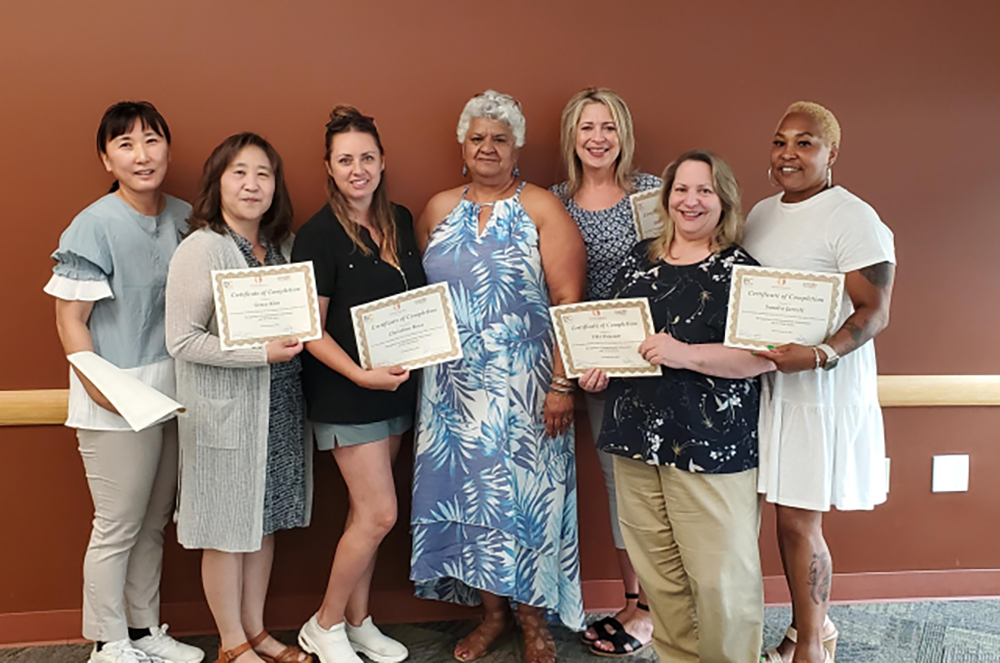
Judy Bumpus, director of client services for the Kansas City Women’s Business Center, center, poses with Spring 2023 graduates of the Johnson County Child Care Recovery Initiative; courtesy photo
Out of isolation
Services provided through the initiative include: business classes, growth mentors, access to a tax service with expertise in the child care industry, workshops, access to a certified temp staffing agency, and cash grants for everything from air conditioning units to architectural designs for fire marshals.
“There’s a lot of providers that come into the field and they have no idea what resources are out there that can help them support their program,” Munoz explained. “So we have established a lot of resources that are available that could help them sustain their business. It’s not just all focused on one area. We tried to provide them with a smorgasbord of knowledge, resources, and networking.”
Child care providers can often feel isolated, Bumpus and Munoz noted, the opportunity to network is key.
“Networking has become amazing because providers are now giving back to each other and supporting their programs as they’re growing,” Munoz added.
Despite being a provider in the area for over a decade, Heidi Petree — who owns Curiosity Kids Child Care in Overland Park — said she didn’t have an opportunity to interact with other providers before getting involved with the WBC classes.
“Everybody’s at home all day,” she explained. “It was nice to meet other people and bounce ideas off of them.”
Bumpus and the WBC helped Petree expand her in-home business into a center, she shared, increasing the number of spots from 12 to 34. They helped her build her website, connect with an accountant, write contracts, and access grant funds.
“Without all of that, I don’t know that I would have succeeded,” Petree added, “I’ve learned a lot.”
Next step: education
While the initiative is aimed at providing resources for child care providers, Bumpus noted that the onus doesn’t just fall on them when it comes to the issue of child care. The WBC has also been working to educate employers on state and federal tax breaks that exist for providing child care assistance. According to research by United WE, women in Kansas are spending 29 percent of their salary for childcare.
“We really, really, really need other people besides parents and providers trying to help with this,” she emphasized. “In the state of Kansas, it costs as much to send your kid to college as it does to get an infant slot, and there is no financial support from public/private business entities.”
To help tackle this issue, Bumpus said, the WBC has helped to form the Raising JOCO coalition, which includes employers, child care professionals, parents, and child care providers trying to look at systematic change within the system.
“What could we do to get the general public — especially corporate and employers — invested,” she explained, “because they will benefit a lot — not only with the federal tax breaks —but when people have improved decent childcare, they come to work. They’re not stressed out. They’re not worried all the time. So you get more productivity, which helps your bottom line.”
She specifically pointed to Amendment 1 in Missouri that was voted down in the primary election earlier this month that would have provided property tax exemptions for child care providers as a missed opportunity.
“We need to do a lot more education of the general public,” she added.
Featured Business

2024 Startups to Watch
stats here
Related Posts on Startland News
Study: Gov should take long-term approach to grow new businesses
A recent study by the Ewing Marion Kauffman Foundation reports that while governments have long supported entrepreneurship, new business creation is waning. The study — Guidelines for Local and State Governments to Promote Entrepreneurship — found that new businesses comprised about 8 percent of all U.S. businesses in 2011, down from roughly 15 percent in the…
Kansas City’s Innovation Partnership program to expand
Kansas City’s program to streamline the integration of technologies into City Hall is set to expand in hopes of attracting more entrepreneurial participation. The City of Fountain’s Innovation Partnership program plans to ramp up marketing and resources to welcome more companies hoping to test drive their technologies with the city, said Ashley Hand, Kansas City’s…
Mid-America Angels race for record-setting investment year
After investing nearly $1 million in the first quarter of 2015, regional investment network Mid-America Angels is on pace for its best year yet. Mid-America Angels injected $870,000 of funding into two area companies during the first three months of 2015, which sets it on a pace to surpass $3 million in investments for the…
- « Previous
- 1
- …
- 1,329
- 1,330
- 1,331