
Immigrant entrepreneurs need path to US now, GOP senator behind Startup Act says
March 21, 2018 | Tommy Felts and Bobby Burch

Editor’s note: The following story on Jerry Moran’s Startup Act is part of a three-part series on the potential for immigrant or foreign-born entrepreneurs to help reshape Kansas City’s startup ecosystem. Read a warning from a leading Kansas City tech CEO about coming challenges within the local talent pipeline here. Check out a feature on an immigrant entrepreneur who found opportunity in the United States and helped take his firm to nearly 60 employees here.
[divide]
The most challenging element of Jerry Moran’s Startup Act relates to immigration, the U.S. senator from Kansas acknowledged, alluding to clashes between those who want across-the-board limits and others who demand a far-reaching, but less-restrictive restructuring of U.S. immigration policy.

U.S. Sen. Jerry Moran
“I’m of the view that just because we can’t do everything doesn’t mean we can’t and shouldn’t do something,” Moran said.
Immigrant founders of existing Kansas City tech startups increasingly agree that their companies might not survive the wait for a long-term solution to a skilled-labor shortage that could still be years away from reality.
“I’m genuinely concerned whether I’ll be able to scale this business here in Kansas City or in the U.S. in general,” said Bek Abdullayev, CEO and founder of Super Dispatch.
First introduced in 2011, the current version of Moran’s bipartisan legislation would allow for 50,000 STEM visas and 75,000 entrepreneur visas, among other provisions geared toward reducing barriers to global talent, capital formation, regulatory relief, access to commercializing federally-funded research programs, and seed money for commercialization projects across the country, Moran said.
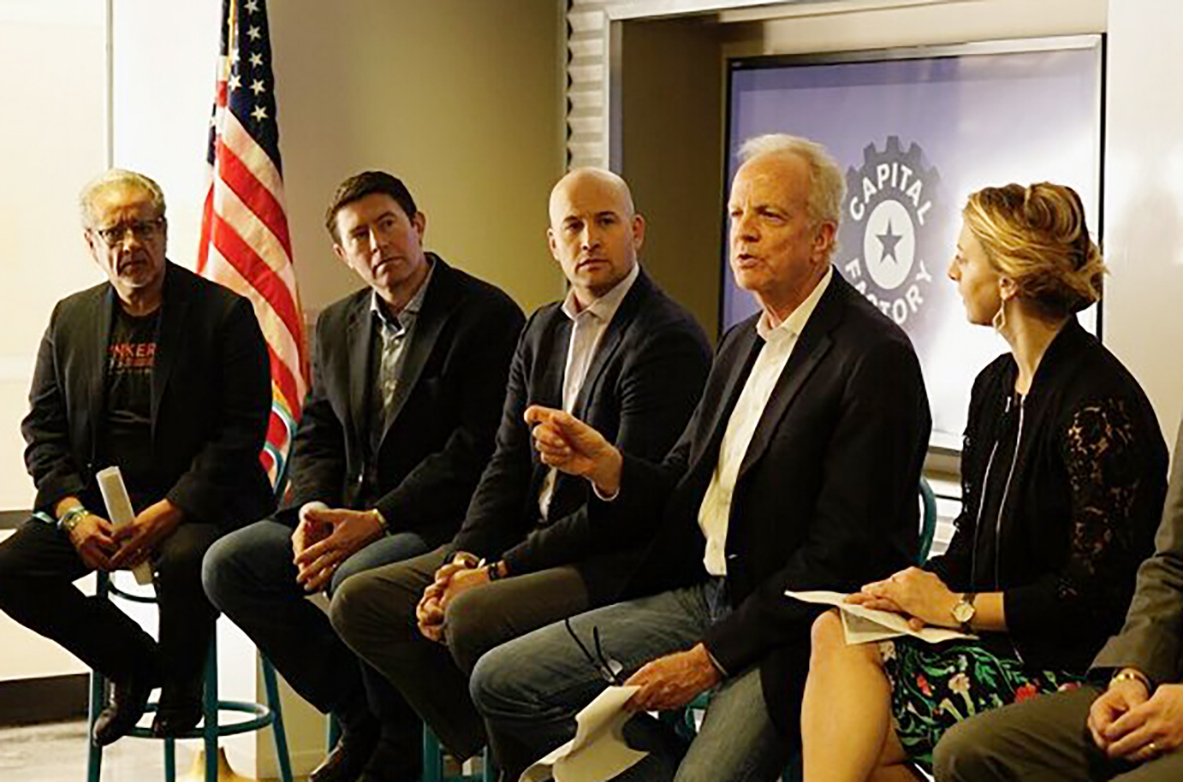
Jerry Moran at SXSW Interactive
The Republican senator’s most recent push for the entrepreneur bill — including an appearance earlier this month at SXSW Interactive in Austin — comes amid deportations in the media spotlight and ongoing, largely partisan fights over immigration issues. The Obama administration’s proposed DREAM Act and DACA (Deferred Action for Childhood Arrivals) program, both which dealt with creating a legal framework for undocumented immigrants already in the United States, have been key points of contention — causing even unrelated immigration topics to become controversial by association. (DACA was rescinded in September by the Trump administration.)
“Anything that has to do with immigration has had its challenges in Washington D.C., but we also believe that immigration may be among the most important components of our startup legislation. So we keep working to try to get either the legislation passed in its totality or passed in bits and pieces,” Moran said. “We’ve had some success in that regard … but we have our work cut out for us as we try to make certain that members of Congress from across the country understand the importance of the startup community and work to increase the chances that someone who starts a business has a better chance of succeeding.”
Expanding opportunities
Data from the Ewing Marion Kauffman Foundation points to a decline in the number of startups overall, Moran noted.
The rate of new entrepreneurs in the U.S. decreased in 2016 to 0.31 percent (from 0.33 percent), or 310 out of every 100,000 adults starting new businesses each month, according to the 2017 Kauffman Foundation Startup Activity Index.
But Kauffman’s research also shows that immigrants to the United States are nearly twice as likely as native-born Americans to start businesses, and first-generation immigrants now make up nearly 30 percent of all new U.S. entrepreneurs, Moran said.
“The percentage of business startups that occur by the hand of somebody who’s here on a foreign visa is nearly 40 percent,” he said. “So while the numbers generally are not trending in a favorable way, within the immigrant community starting a business is a more normal path to the American dream.”
The senator pointed to Kansas City entrepreneurs Davyeon Ross, co-founder of ShotTracker, and Reza Derakhshani, the UMKC School of Computing and Engineering professor behind the technology that made Zoloz (EyeVerify) a Kansas City startup success story, as noteworthy examples.
It’s a give and take, said Neelima Parasker, CEO, president and founder of Overland Park-based SnapIT Solutions and herself an immigrant from India.
“Based on the data, immigrant entrepreneurs have opened up businesses that have created more job opportunities in this country,” she said. “So there are opportunities this country provides for immigrants, and the immigrants are creating opportunities in the country.”

Super Dispatch
Hiring, but feeling hopeless
The immigration debate also is about filling gaps in the U.S. labor pool — especially as it relates to highly skilled workers, Super Dispatch’s Abdullayev said. A shortage of tech talent is acutely felt by area startups, he said.
On a recent trip to Washington D.C. with representatives from the Kauffman Foundation, the high-profile startup founder spoke with members of Congress about the challenges his rapidly-growing company is facing with finding new talent and his frustrations with U.S. immigration policy. An Uzbekistani immigrant who moved to Kansas City in 2001, Abdullayev is an advocate for reforming U.S. immigration law to help businesses in desperate need of highly-skilled labor, he said.
“For us to impact any kind of change in Washington, it takes incremental conversations with lawmakers so that they hear the voice of their constituents,” Abdullayev said. “When it comes to areas of entrepreneurship and immigration, they need a point of reference and knowledge that there are people in their base that are concerned with these issues.”
Super Dispatch, which created a tech platform that serves the trucking and hauling industries, plans to add about 100 new employees in the next two years. While many leaders in Congress hope to change immigration policy to help businesses, President Trump’s administration favors a slower approach that won’t help his company, Abdullayev said.
While still pushing for change, it was a frustrating trip from which he returned “feeling hopeless,” he said.
“What was really annoying was that they’d say ‘Well, if you need people, go to schools and universities. We need to train our workforce,’” Abdullayev said. “Don’t get me wrong, I have little kids and I want them to grow up with these skills to contribute to society but as a business owner, I don’t necessarily have 10 to 20 years to wait until we train the workforce to fill a job that we have today.”
Seeking a middle ground
Moran offered the three immigration-related provisions of the Startup Act as amendments to recent federal DACA legislation, which sought to fix the elements of the program that concerned President Trump and other Republicans. It ultimately failed to reach the 60 votes needed to pass the Senate, he said.

Jerry Moran at SXSW
“I would expect DACA to appear again before the United States Senate and we will continue to see if that can’t be a vehicle for these additional changes,” Moran said. “But the challenge that we face is that there are some in Congress who insist that we can only deal with immigration in a comprehensive way to deal with every item of immigration policy in one piece of legislation.”
It doesn’t have to be all or nothing, he said.
“We ought to take the things that do find broad support in Congress and enact them,” Moran said. “Sixty votes in the Senate for the provisions that are included in our startup legislation could be found. There was broad enough support for this kind of immigration change. While I’m certainly willing to have the debate about other issues within the immigration arena, I also am certainly willing to take a victory or success on these related to entrepreneurship.”
Taking his message to Austin earlier this month, Moran spoke during two panels at SXSW Interactive. For “Supporting Startups to Fuel American Competitiveness,” he joined Jason Wiens, Kauffman Foundation policy director in entrepreneurship, and Jason Tatge, co-founder and CEO of Kansas City-based Farmobile, to discuss the role of immigrants in the ecosystem.
It was Moran’s fifth trip to the festival in his seven years in the Senate, he said.
“The presence of a United States senator from Kansas lends itself toward a recognition that our state is interested in paying attention to the startup community and is trying to develop an ecosystem in which startups are honored and rewarded,” Moran said.
[divide]
Related stories:
• CEO warning: Talent pipeline collapsing with fewer immigrants; tech training needed at home
• Engineering KC: Global talent builds success for Taliaferro & Browne
• ICYMI: Freedom’s Carol Espinosa showcases path to creativity, opportunity
[divide]
Featured Business

2018 Startups to Watch
stats here
Related Posts on Startland News
KC’s first innovation officer reflects on work, city’s tech future
After more than two years of service, Ashley Hand is leaving the driver’s seat of Kansas City’s innovation efforts. Hand, who soon will be departing as Kansas City’s chief innovation officer, was tasked with implementing innovative strategies to improve how city government can better serve Kansas Citians. The city will be accepting applications for the…
Welcome to Startland News
Scrappy. Determined. Gritty. Those often were the words attributed to the Kansas City Royals as the team unexpectedly surged into the 2014 World Series and captured the national spotlight. Those very words are apt for this city, which has been built on the grit and determination of successful entrepreneurs like Ewing Kauffman, Joyce Hall, Henry…
Kansas budget woes render uncertainty for angel tax credits
As state budgetary concerns loom in the background, early-stage firms in Kansas are hoping a bill to extend the Sunflower State’s Angel Investor Tax Credit program will become a priority for legislators. Scheduled to sunset after the 2016 fiscal year, the program annually allocates $6 million in credits to entice investments in early-stage, growth-oriented companies…
KC virtual reality firm partners with KU, NFL coaches
A Kansas City-based virtual reality company hopes some marquee partnerships will plug it into a market projected to reach $150 billion in five years. Founded in 2013, Eon Sports VR recently landed the University of Kansas football team as a client for its mobile virtual reality platform to help players train without the risk of…