
Hyperloop One exec: KC route would create ‘mega-region’ along I-70
January 30, 2018 | Bobby Burch

When you’re hoping to move people and freight at near subsonic speeds, it pays to be straightforward.
At least that’s the case for Virgin Hyperloop One, which announced Tuesday it has embarked on the feasibility study of a high-speed route that would connect Kansas City and St. Louis in about 30 minutes.
“It’s a very straight route. Our engineers like straight routes because they know that on a straight route, you can get up to speed, maintain that speed and move people very quickly,” said Dan Katz, director of global public policy for Virgin Hyperloop One. “It’s an opportunity to test this concept out of going along an interstate highway (I-70) across an entire state. That’s an exciting thing.”
In a press junket Tuesday, Hyperloop One released details on its plan to analyze the prospective route in partnership with the State of Missouri, engineering firm Black & Veatch and a consortium of other private and public organizations in the Missouri Hyperloop Coalition.
The feasibility study on Missouri should take about seven to nine months, revealing technical needs as well as the potential economic impact and benefits of integrating Hyperloop into the I-70 corridor connecting Kansas City, Columbia, and St. Louis. The study will also outline the next steps required for an “eventual project” in the state, including the development of a cost estimate and funding model recommendations, the Missouri Hyperloop Coalition said in a release.
The Missouri route is a top five prospect for the company, Katz confirmed.
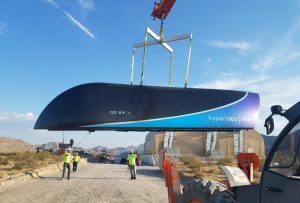
Photo by Hyperloop One
Hyperloop is also now conducting a feasibility study for the Pueblo-Denver-Cheyenne route, which spans 360 miles and is accessible to about 4.8 million people, according to Hyperloop.
The prospective Missouri route would connect a combined five million residents in Kansas City, Columbia, and St. Louis metro areas. Such a prospect would allow residents in those areas to work, study and play in communities across the state essentially creating a single, albeit expansive, metropolis.
“We’re also excited that you’re connecting two major cities, and a university in a way that would really create a mega-region. It’d turn the state into a mega-region along I-70,” Katz said. “It will transform things for the state and the economy and show what a Hyperloop can do to change local economies and turn distinct metro areas into a powerhouse mega-region.”
Think of the Hyperloop system as high-speed rail travel in a vacuum. Levitated pods are propelled at speeds reaching 640 miles per hour by electric motors through a series of interconnected tubes that create a low-pressure environment, allowing the pods to glide with limited friction at speeds that surpass air travel.
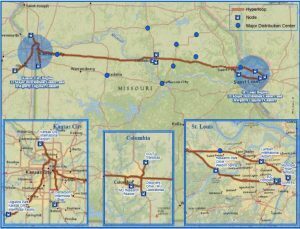
MoDOT’s proposed Hyperloop route
SpaceX CEO Elon Musk once described the technology behind Hyperloop as “a cross between a Concorde, a railgun and an air hockey table.”
For next steps of the study, Overland Park-based Black & Veatch is working with Hyperloop One and the Missouri Department of Transportation to set up parameters of the study, said David Leligdon, a vice president for Black & Veatch.
“The initial focus will be on the (technical) alignment using computer tools and GIS systems to look at different radiuses, curvature and elevation changes to try to maximize parameters for that,” Leligdon said. “There are also environmental components, an economics perspective with both cost and demand and the ways it could change the economic landscape of the region.”
As announced in October by the Missouri Hyperloop Coalition, the feasibility study is expected to cost between $1 million and $1.5 million, according to Patrick McKenna, commissioner of Missouri Department of Transportation.
The prospect of working on a novel transportation system is an exciting to Black & Veatch, Leligdon said.
“We’ve been in business 100 years and worked on a wide range of technologies all over the world,” he said.” To look at something new and see what we do here can help with that and bring that all together is going to be a great benefit to the study asking those questions that haven’t been asked or when we come up to a roadblock.”
Without a roadmap for an entirely new system, analogous technologies and transportation systems can help make sense of things, Leligdon said.
“Other linear, pipelines for water or natural gas and power transmission lines would be similar. There are elements of those in here,” Leligdon said. “Some of it is going to be interactive and moving forward and taking lessons learned from other industries and other practices and bringing the best in class ideas to this.”
While the technology is promising, the transportation system is still in the testing phase. Recently, Virgin Hyperloop One set a test speed record of nearly 240 miles per hour at its DevLoop facility, the world’s first full-scale hyperloop test site.
Listen to the audio story below to learn more about Hyperloop One’s plans.
Featured Business

2018 Startups to Watch
stats here
Related Posts on Startland News
This AI keyboard can write your next email with the push of just one button; its creator says it could revolutionize workplaces
Hardware — not just software — should be at the forefront of the AI’s future, Jerry Hsu shared. After the successful release of its GPT-powered AI mouse, Jethro V1, in late 2024, Overland Park-based Virtusx — which is revolutionizing workplaces through integrating hardware and software to make AI-driving products more accessible and user-friendly — has…
Alexa, show me the winners: Storytailor leads Pure Pitch Rally prize tally ahead of tech launch
Storytailor’s marquee Pure Pitch Rally win comes at the perfect time for the Kansas City startup, its founders said. They’re preparing to roll out a new immersive storytelling platform through a partnership with Amazon’s Alexa+ next year — a move expected to bring their tech to more than 200 million Prime users. “It’s the most…
LISTEN: How the Midwest opened this German agtech company’s eyes to opportunity in the US
On this episode of our 12-part Plug and Play Topeka podcast series, we connect with Débora Moretti, co-CEO of NutriSen — a Berlin-based agtech startup building real-time molecular sensors to measure nutrient concentrations in plants directly on the field. Moretti shares how her team, alongside co-founder Tobias Vöpel, is merging biosensor technology, data-driven insights and…
Crossing lanes: KC Streetcar collaborators back aboard for expansion, dropping new merch, anthem
Opening the extended KC Streetcar line Friday completes a loop for creatives whose collaborations with the popular public transit system first emerged nearly a decade ago along Main Street — a time when Kansas City’s surging vibrancy helped curb streetcar doubters. “For us, it’s always been about representing Kansas City — the people, the culture,…