
Great Jobs KC aims to impact 50,000 Kansas City scholars within a decade — one life at a time
October 8, 2025 | Brian Escobar

Editor’s note: The following story was written and first published by the Economic Development Corporation of Kansas City, Missouri (EDCKC). Click here to read the original story.
[divide]
Natalie Lewis is no stranger to complex work.
As chief operating officer of Great Jobs KC, she oversees programs that connect thousands of Kansas Citians with scholarships, tuition-free job training, and real employment opportunities. With a background in nonprofit leadership and a focus on equitable pathways to opportunity, Lewis has become a driving force in the region’s workforce strategy.
Her organization awards traditional college scholarships valued at up to $50,000 to high school juniors and adult learner scholarships valued at up to $25,000 to adults 24 years and older. Its programming was designed to change thousands of individual lives and transform the region by preparing the local future workforce and contributing to the regional economy.
So when Lewis talks about Great Jobs KC, she starts with scale and boldness.
“We’re serious, 50,000 individuals in our region in the next 10 years. We’re already serving 17,000. That’s a lot of people,” Lewis said. “The thing that makes it a reality is, No. 1, the boldness to even try.”
That boldness comes with a clear model: scholarships, tuition-free training, and wraparound support so people do not just earn credentials, they step into careers with benefits and long-term mobility.
How Great Jobs KC operates
At the center is ecosystem building paired with direct service. Great Jobs KC is not only awarding scholarships. It is wiring together education, employers, and community support so people can move.
- Scholarships and training — Residents can access college scholarships or tuition-free training built around in-demand careers. Training is short term and skills based. Many participants receive paid training so they can focus without losing income.
- Employer partnerships — Companies sit on advisory boards, co-design training, and in some cases co-fund upskilling. “If they have entry-level health care providers who want to move up, we will go fifty fifty with that employer,” Lewis explained. “That creates room for our scholars to enter those entry-level roles.”
- Wraparound support — The program anticipates real barriers. “A flat tire, a car that breaks down, or no childcare can knock a student out of the game,” Lewis said. “We are designing solutions so momentum does not stall.”
- Continuous learning — As industries change, training changes with them. “We have to build a community that is ready for continuous learning,” Lewis noted. “Short term training will be the way you upskill, period.”
This hybrid approach, direct support plus systemic partnership, allows the work to scale while staying personal.
Fueling growth with vision, funding
Great Jobs KC’s momentum shows up in enrollment growth, scholarship volume, employer involvement, and the ability to move people from a waitlist into paid training and jobs.
Lewis points to three ingredients that make this possible, and what each delivers:
- Funding that builds capacity — “Systemic level funding that lets you build. And that came through the Kauffman Foundation and Mr. Kauffman’s vision.” Investment turns pilots into programs, adds seats in short term training, and helps move people off the waitlist. It powers the push from serving about 17,000 people today toward the 10-year goal of 50,000.
- Leadership that scales what works — “It takes the right mind and heart. When CEO Earl Martin Phalen joined in 2022, our scholarship program was stable. Now we award almost four times as many.” Focused leadership lifts throughput. More awards, faster pathways, clearer accountability.
- Partnerships that align the ecosystem — “We could not do it without looking at what the ecosystem was already doing. Chambers, KC Rising, EDCKC, all of those entities were already trying to solve. So it takes partnerships.” Partners help match training to real openings, bring employers to the table as advisors and hirers, and surface barriers like transportation and childcare so solutions are built into the work.
Scaling to meet need
The demand is real. Great Jobs KC has secured about 136 million dollars toward a 250 million dollar need, and the waitlist continues to grow.
“Our most immediate need is assistance with getting people off the waitlist,” Lewis said. “We built this hope. People wondered if it was too good to be true. Now they are showing up, but we need the rest of the funding.”
Employer partners are another critical piece. The goal is at least 100 active companies engaged in shaping pathways and hiring from the pipeline.
“They are hiring our employees, they are advisors to us, and at a corporate level they are giving at a different level than they even anticipated. That is what it takes to solve systemic problems like unemployment and lack of access.”
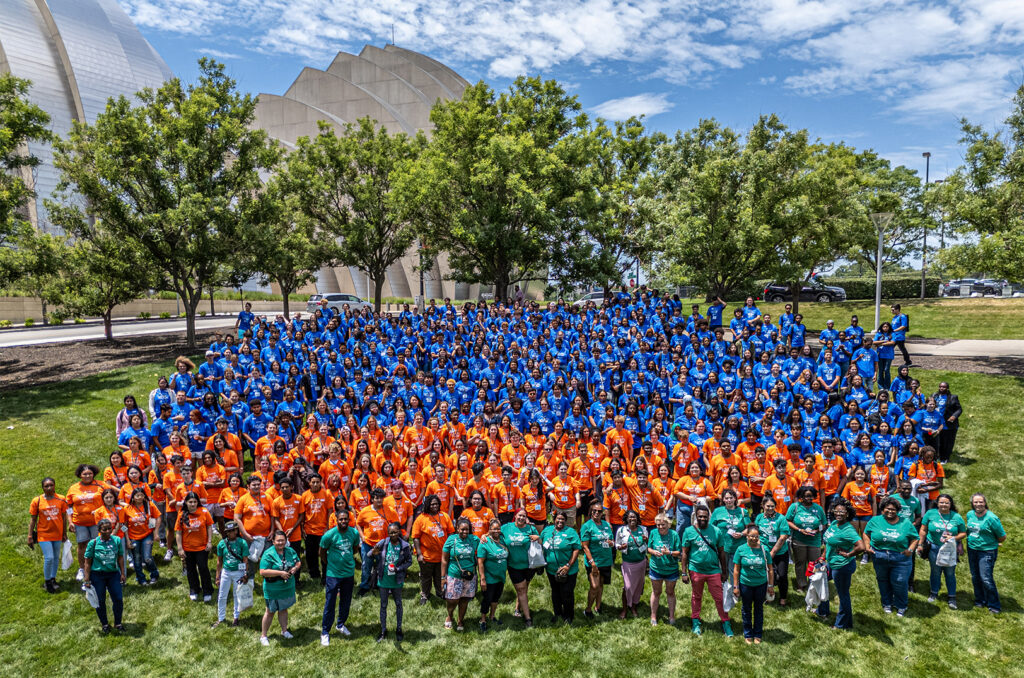
Great Jobs KC college scholarship awardees in 2024; courtesy photo
Lives changed, communities strengthened
Great Jobs KC offers tuition assistance to approved career training programs in high-demand industries, including construction, healthcare, information technology, logistics/warehousing, manufacturing, and service careers. With the support of Great Jobs KC, adults 17 and older can acquire the skills needed to secure a career making at least $45,000 per year in one year or less.
During the interview for this feature, Lewis pointed to a board behind her filled with names.
“Imagine 2,300 names already in better paying jobs, some coming to us homeless, some working two or three jobs,” she said. “One young woman finished a six-week program, landed a job, and within six months earned a promotion. Another graduate completed CDL training and is now making about 90,000 dollars a year with benefits.”
These individual wins ripple outward, Lewis added.
“One life becomes two lives, becomes a street, becomes a community,” she said. “That is how we are building a stronger Kansas City.”
For Lewis, the point is not only filling today’s openings. It is preparing people for what is next.
“There are jobs right now that we do not even know we will need,” she said. “Short term training will be the way you upskill, period.”
A call to action
So what can Kansas Citians do today? Lewis is specific.
- Residents — “I want people who need a better life and a better job to go to our website, GreatJobsKC.org. Be bold enough to take the first step, even if people have counted you out before.”
- Employers — “Call me. We want employer partners. Join our advisory board, tell us what you need, and co-create solutions.”
- Donors — “Help us move people off the waitlist. Every donation matters, and we also need systemic investment at scale.”
Lewis closes with the vision that keeps the team moving.
“When we are successful, and we will be successful, generational wealth becomes possible for people who not long ago were in poverty,” she said. “Our employers will thrive, and our region will thrive. That is the future we are building together.”

2025 Startups to Watch
stats here
Related Posts on Startland News
SNAP cuts are ‘worse than they look on paper’: Food access advocates warn shelves could go bare overnight
Chef Shanita McAfee-Bryant doesn’t mince words about perceptions of the hungry Kansas Citians she serves daily through her award-winning culinary social venture. “These are the people who — if you listen to the rhetoric — are deemed ‘lazy,’” the founder of The Prospect KC’s NourishKC Community Kitchen told Startland News. “We know the narratives being…
LISTEN: Fermenting a clean future through products from meat alternatives to skin creams and baby formula
On this episode of Startland News’ Plug and Play Topeka founder podcast series, we chat with Francesca Gallucci of Natáur, a Baltimore-based biotech company that’s reimagining how essential nutrients are made. Combining synthetic biology, metabolic engineering, and eco-friendly fermentation, they’re producing bio-based taurine (and other naturally occurring sulfur compounds) without relying on petroleum. Gallucci takes…
KCMO slashes fees for outdoor dining permits, launches dining trail for grant winning projects
Kansas City has officially eliminated outdoor dining permit fees, reducing the cost from $850 to zero, thanks to the momentum created by a city-led initiative to encourage investment in outdoor dining experiences, city leaders announced this week, unveiling new plans to promote funded businesses and their projects. Launched in 2024, the Outdoor Dining Enhancement Program…
World Cup will produce KC small biz millionaires in just weeks, leaders say, but it’s only the start
Kansas City can’t look at the World Cup in 2026 as one big event where businesses are going to make good money for a while, and then everything goes back to normal, said Wes Rogers. “This has to be the beginning of the next chapter of our city,” the 2nd District Councilman for Kansas City,…