
Grant Gooding: Marketing math breaks down the odds of getting your campaign right
April 2, 2018 | Grant Gooding

Editor’s note: The opinions expressed in this commentary are the author’s alone. Check out more from Grant Gooding here.
[divide]
With the seemingly unlimited places to spend your marketing dollars, clients ask us if we can nail down three things in almost every study we do:
- What is the right message to win over customers?
- Which customer segments should I be targeting?
- Which mediums should I be using to maximize ROI?
And they should be asking these three questions if they want to close more business. Just getting close on any one of these can be a game changer for any business. But when we start down this path with clients we typically find that they really don’t understand the magnitude of variables involved in their marketing campaigns.
Well, lucky for you the nerds at PROOF have done the math and will explain it in simple, relatable terms.
Most marketing campaigns involve making decisions in 6 stages; product, target market, messages, mediums, investment and measurement. Here is a simple example of a typical campaign cycle (Not necessarily in chronological order) to illustrate the variables associated with the process.
- Product: Select a product or service that you want to promote. Let’s say for the sake of simplicity that you only have 3 products or service offerings. In reality, I know you likely have many more.
- Target: How many target market segments do you have? This can vary widely depending on your business but let’s say you have only 10 possible targets segments (note: if you only have 10 target segments you better be incredibly specialized or you likely aren’t segmenting your customers effectively).
- Message: The actual number of possible messages you can communicate is infinite but typically marketing and leadership get together and make a short list and pick one or two to roll with. Let’s say that list only has 20 options and you pick 2 you think might work well.
- Medium: The number of marketing mediums are really countless, anything from a simple email drip campaign to Snapchatting and running Facebook Live while giving hot air balloon rides at an industry convention. Not all of them are applicable to every business so let’s say you are reasonably considering only 20 options and selecting 2 to invest in.
- Invest & Execute: Once you and your team have selected which product, target market, message and medium you are going to use all you have to do is organize, invest and execute your campaign. No problem, this is what you pay them for.
- Measure: Now let’s hope you have taken the proper steps to create your funnel and measure the effectiveness of this campaign. The overall campaign will look something like the chart below. Now it’s time to cross our fingers and pray for positive ROI …
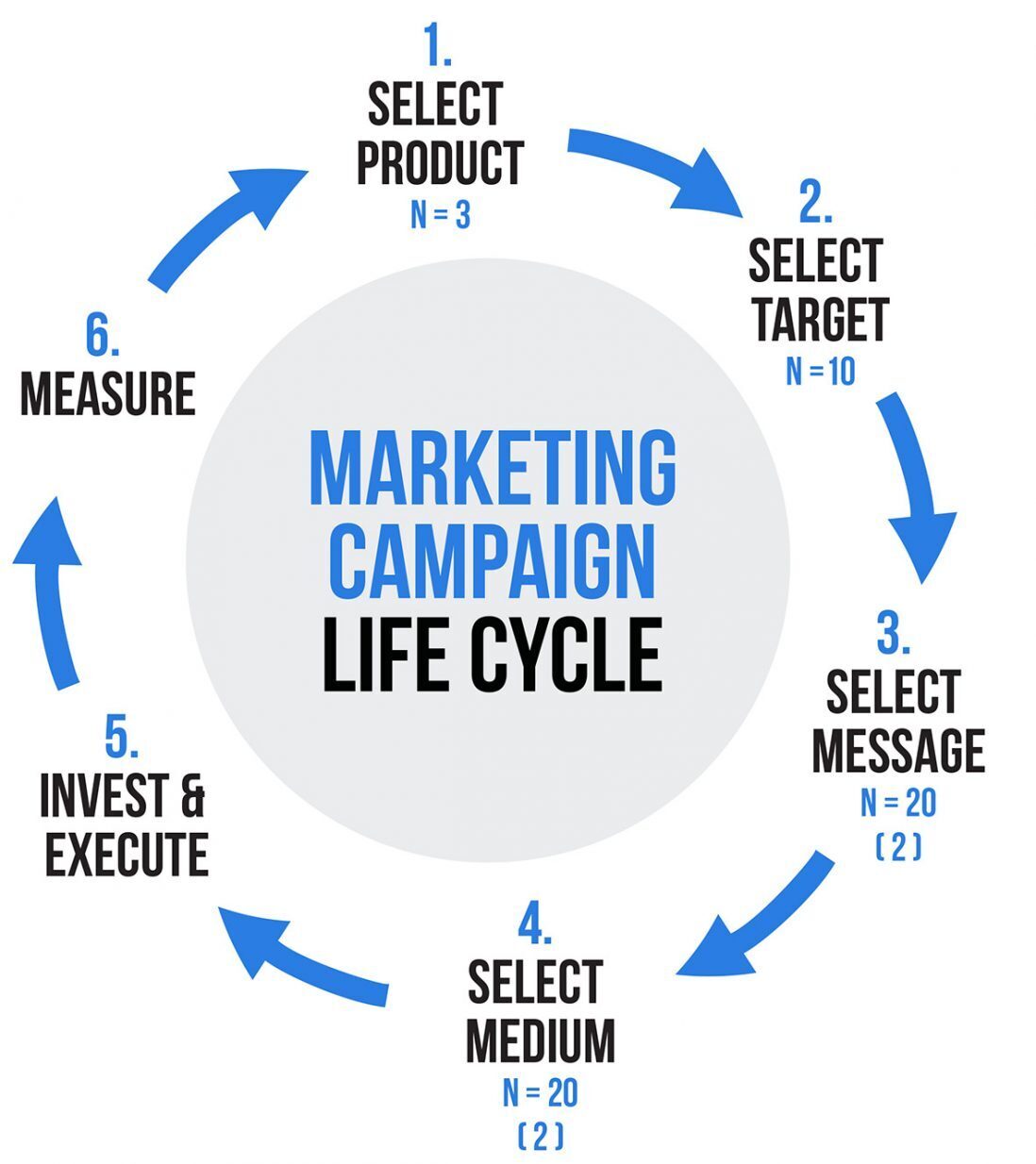
The actual number of possible combinations of this wildly simplified example is….
1,083,000
So that’s 1 in 1,083,000. Basically, you would have a better chance of being struck by lightning in the next 12 months (1 in 960,000) or being crushed by a meteorite (1 in 700,000). So, how probable do you think it is that you are getting the best results out of your marketing efforts? If you have been following along and you guessed “about 0%” you would be right – actually, it’s 0.000092336%.
What’s more troublesome is the fact that in the event you DID happen to get one or more of the variables correct there is no way to know. So, for instance, let’s say you got the target market correct based on the product you selected but you got every other variable wrong and your campaign had negative ROI. Most marketer’s instincts are to try an entirely new set of variables or simply A/B test one variable. Regardless of what you do or how well you measure behavioral output, there is simply no way you could know which parts of this equation you had correct and which you missed on.
What can you do to improve your odds?
- Keep Your Campaigns Clear. We see many campaigns that are really creative but they often lack a clear purpose, messaging and goals. A mentor of mine always said, “clarity above cleverness, always.” Good advice.
Show Discipline. - Marketing and advertising have turned into a slippery slope game of tactics and mediums. Our attention spans are shrinking and so is our patience to see results. Trying new things can be addicting especially when we don’t see immediate success. I’m sure you chose your campaign messages and tactics for a reason, so stick with them for a bit.
- Get Your Blocking and Tackling Nailed Down. Generally, we see that few organizations do any one thing really well on the marketing front while the more successful organizations we see execute one or two tactics incredibly well. Get really good at a couple of your basics that support your business strategy and align with your customer’s preferences (i.e. email and SEM) and leave the experimental mediums for when you are confident you are delivering your current efforts at a high level and have discretionary funds to do other things.
While it is easy to get overwhelmed with the number of possible options of products, targets, messages and mediums available, your best odds to produce positive ROI is to keep it simple and limit experimentation. If you are ready to experiment beyond your core marketing competencies it might make sense to engage an expert to help you understand the probabilities of success using different mediums to minimize wasted efforts and dollars.
[divide]
Grant Gooding is a brand strategist & CEO of Lenexa-based Proof Positioning, a firm that uses consumer insights to show business owners how to build a powerful brand by knowing, not guessing. Grant is passionate about educating in the areas of entrepreneurship and brand philosophy.

2018 Startups to Watch
stats here
Related Posts on Startland News
Roberts: Can’t stand the options? Disrupt elections with a vote for nobody
Editor’s Note: The following piece was written by Melissa Roberts on how voters who have made the decision not to vote for the available candidates should still submit a ballot — even if it’s blank. The opinions expressed in this commentary are hers. It’s election season, which means it’s probably best to avoid Facebook altogether. Despite…
The WTF Series: Triple constraint
One of the hardest parts of software development is managing stakeholder expectations. Of course, everyone wants as much as they can get, as fast as possible, for the lowest price. Why wouldn’t you? The problem is that most programmers get frustrated when a stakeholder asks for too much too fast, and don’t know how…