
How a former Sprint car driver’s quick pivot from HVAC filters to face masks put a North KC startup atop the nanofiber scoreboard
May 20, 2021 | Channa Steinmetz

Filti was less than weeks away from launching its state-of-the-art residential HVAC filter when the Coronavirus began its rapid spread throughout the U.S., Dakota Hendrickson recalled. Noticing a significant dip — yet high demand — for face masks, the former race car driver altered the company’s course.
“Never in a million years did I think we’d have this transition to face masks, and then be known as face mask experts. But we took it and ran right as things started getting crazy,” said Hendrickson, who co-founded Filti with Monte McDowell. “The whole pivot took about 10 to 12 days — it all happened so fast.”
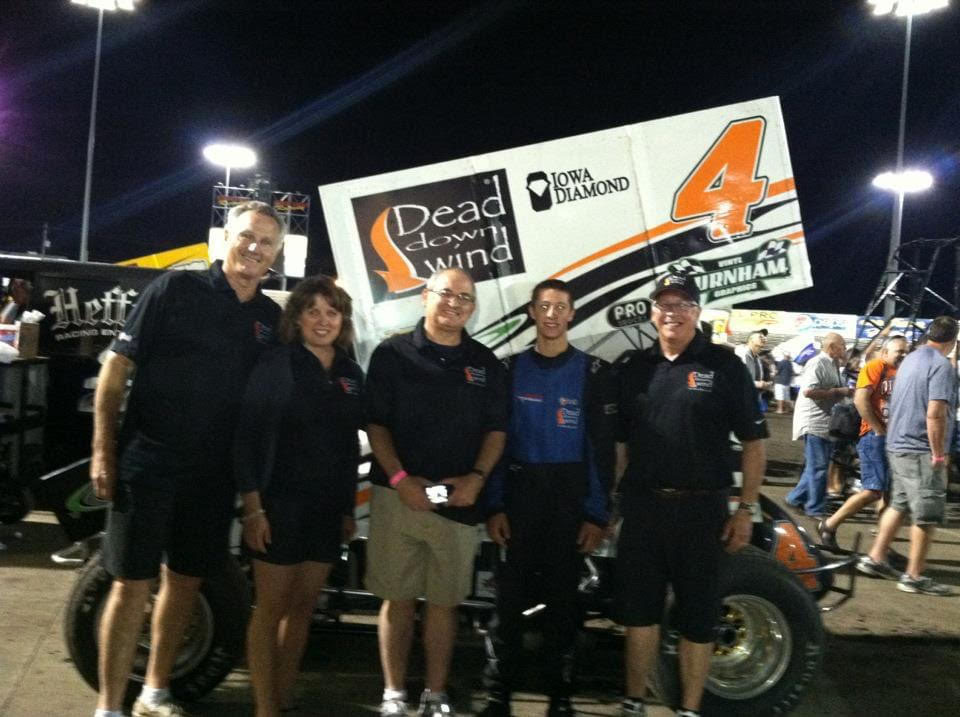
Monte McDowell and Dakota Hendrickson at an Iowa race track

Monte McDowell and Dakota Hendrickson, Filti
Hendrickson knows how to take a quick turn; before Filti, the 24-year-old was a professional Sprint car racer. Through the sport, Hendrickson met his co-founder McDowell, whose company, Dead Down Wind, was one of Hendrickson’s major sponsors.
McDowell also founded an air filtration company called NXTNANO in 2013.
“Monte tapped me, explaining he’d like to do some consumer-facing products with his air filtration technology,” Hendrickson said. “He asked if I would head up the consumer-facing side, so I moved down to Kansas City in January of 2019.”
NXTNANO serves as a partner of Filti and provides the nanofiber expertise, he emphasized.
After spending 15 months building out a washable HVAC filter, Filti was set to officially launch in March 2020 with its first product. Hendrickson and his team put the filters on hold when COVID struck, but used similar technology to create face mask materials, he noted.
“We decided that [Filti] was going to offer a product that’s essentially N95,” he said, explaining that “N95” means not resistant to oil and 95-percent efficient at 0.3 microns.
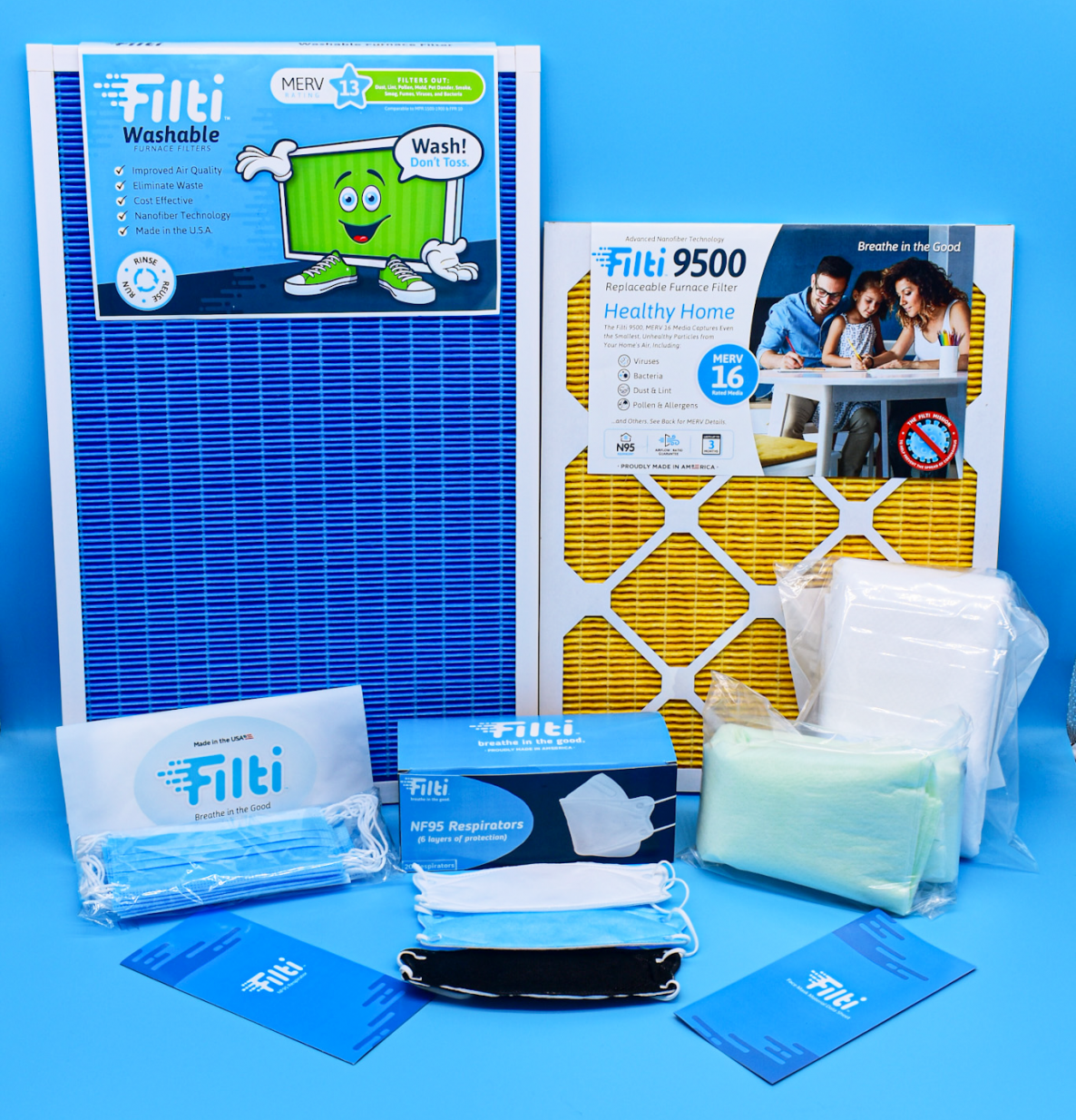
Filti product line
In the beginning, Filti sold its filtration material in rolls ranging between 21 square feet and 215 square feet. By the end of March, the Filti team was sending its face mask material out to mass manufactures, frontline workers, military personnel, sew shops, families — anyone in need, Hendrickson said.
Click here to learn more about Filti.
Within Filti’s first 45 days, the company had made $2 million in revenue. All orders within the company’s first 120 days were upgraded from UPS ground to UPS air free of charge.
“We shipped about 50,000 packages in the span of that 120 days,” Hendrickson said. “We ate that cost because we wanted to get these materials in our customer’s hands to keep their family and loved ones safe.”
By late summer, Hendrickson decided to take a vertical approach to face masks with Filti producing the final products in-house, he recalled.
“Our face masks are really efficient because we utilize nanofiber, so it’s very breathable and comfortable on your face,” he said. “Most surgical masks today are roughly 50-percent efficient at 0.3 microns, whereas outs are about 92 to 93-percent efficient at 0.3 microns.”
Filti sells a surgical style mask and NF95 respirator, as well as mask inserts.
Nanofiber technology
Returning to Filti’s original product line, the company launched its first HVAC filter — the Filti 9500 with a MERV rating of 16 — in September. It also debuted a washable filter in the fall with a MERV 13 rating.
[pullquote]
What is MERV?
Minimum Efficiency Reporting Values (MERV) report a filter’s ability to capture larger particles between 0.3 and 10 microns.
[/pullquote]
Filti products are different from other filters because of their core technology, Hendrickson noted.
“Most filters on the market actually attract particles to the filter via charge, so they put charges on the media here,” he explained, pointing to the body of a filter. “We utilize nanofiber, which has been used in the air filtration business — mostly in the industrial market — but the nanofiber has never been tapped to the consumer market.”
The advantage to nanofiber is that filters are able to capture extremely small particles, while simultaneously keeping a good air permeability, he continued.
And in contrast to Filti’s products, a majority of washable filters on the market use electrostatics, Hendrickson added.
“Now there’s one big issue with those filters: when you get water on an electrostatic filter it neutralizes the charge,” he said. “So as soon as there’s humidity in the air, you’ll get a reduction in your overall efficiency. Even though these electrostatic filters are washable — once you wash them for the first time, they are no longer efficient. Because we use nanofiber, we can actually wash [the filters] and maintain our efficiencies over time.”
Filti is in the final stages of approval for a patent, which is set to be fully complete in the next six months, Hendrickson said.
The company has various production and fulfillment facilities across North America, but Hendrickson aims to one day centralize all of Filti’s operations in Kansas City, he shared.
Young and serious

Dakota Hendrickson, Filti
All five employees leading the charge from Filti’s office in North Kansas City are all younger than 25.
“We’re just a lean, mean, young machine here,” Hendrickson said with a laugh. “… I don’t think it’s very known how young we are. But when we talk to other manufacturers or big businesses, they can sense we’re younger. For the most part, people have really trusted us and been impressed with what we’re doing.”
Dakota Hendrickson was featured on Forbes’ 30 Under 30 – Manufacturing & Industry 2021 list. Click here to read more.
After a first year of exponential growth for Filti and the young team, the plan is to continue to focus on air quality.
“Whether it’s air quality in your home, or air quality on the go with our face masks, we’re all about helping provide the best air quality,” Hendrickson said. “… We’ve managed to push through any adversity, keep a positive attitude and stay focused on our goals. At the end of the day, the most special thing is getting those customer emails saying they appreciate what we’ve done and that we’re helping those in need.”
Featured Business

2021 Startups to Watch
stats here
Related Posts on Startland News
KC’s first innovation officer reflects on work, city’s tech future
After more than two years of service, Ashley Hand is leaving the driver’s seat of Kansas City’s innovation efforts. Hand, who soon will be departing as Kansas City’s chief innovation officer, was tasked with implementing innovative strategies to improve how city government can better serve Kansas Citians. The city will be accepting applications for the…
Welcome to Startland News
Scrappy. Determined. Gritty. Those often were the words attributed to the Kansas City Royals as the team unexpectedly surged into the 2014 World Series and captured the national spotlight. Those very words are apt for this city, which has been built on the grit and determination of successful entrepreneurs like Ewing Kauffman, Joyce Hall, Henry…
Kansas budget woes render uncertainty for angel tax credits
As state budgetary concerns loom in the background, early-stage firms in Kansas are hoping a bill to extend the Sunflower State’s Angel Investor Tax Credit program will become a priority for legislators. Scheduled to sunset after the 2016 fiscal year, the program annually allocates $6 million in credits to entice investments in early-stage, growth-oriented companies…
KC virtual reality firm partners with KU, NFL coaches
A Kansas City-based virtual reality company hopes some marquee partnerships will plug it into a market projected to reach $150 billion in five years. Founded in 2013, Eon Sports VR recently landed the University of Kansas football team as a client for its mobile virtual reality platform to help players train without the risk of…