
Daddy-daughter candy business drops tongue-in-cheek lessons flavored with entrepreneurship
December 6, 2024 | Nikki Overfelt Chifalu

What started out as a joke about an inflatable unicorn sprinkler “tooting” out candy has turned into a meaningful daddy-daughter candy business, Lee Urban shared.
The Shawnee father launched Fantastical Droppings “for the little squirts that make your life complete,” he notes on the colorful packaging.

Bags of by Fantastical Droppings; photo by Nikki Overfelt Chifalu, Startland News
“I’m like, ‘I’m gonna create a company that I can spend time with her and then really teach her about entrepreneurship and giving back,’” Urban recalled of the idea to start the business with his daughter Charlotte, now 7. “So we don’t take any salaries. We just budget for donations.”
The company currently offers two products — Unicorn Ass Candy and the more-kid-friendly Troll Turds — both strawberry-flavored, soft Australian licorice, complete with poop jokes printed on the bottom, of course.
“Why did the toilet paper roll down the hill?” asked Charlotte, whose title is “little CEO and boss of the applesauce.” “To get to the bottom.”
The candy — distributed locally by Sunflower Foods in Lenexa — can be found at K-7 Liquors and Missie’s Discount Liquors in Shawnee, plus at pop-ups alongside Mr. D’s Donuts in Shawnee and Ice Cream Bae in Leawood. And the goal is to soon have it on local grocery store shelves.
Click here to shop Fantastical Droppings online.
“It’s really good,” Charlotte — official taste tester — noted of the licorice, “ really, really good.”

Fantastical Droppings licorice candy; photo by Austin Barnes, Startland News
Rolling with the joke
Urban — an attorney and former Kansas assistant attorney general — came up with the idea for the candy after a group chat with his wife and neighbors about how the inflatable sprinklers were keeping their kids busy, he shared.
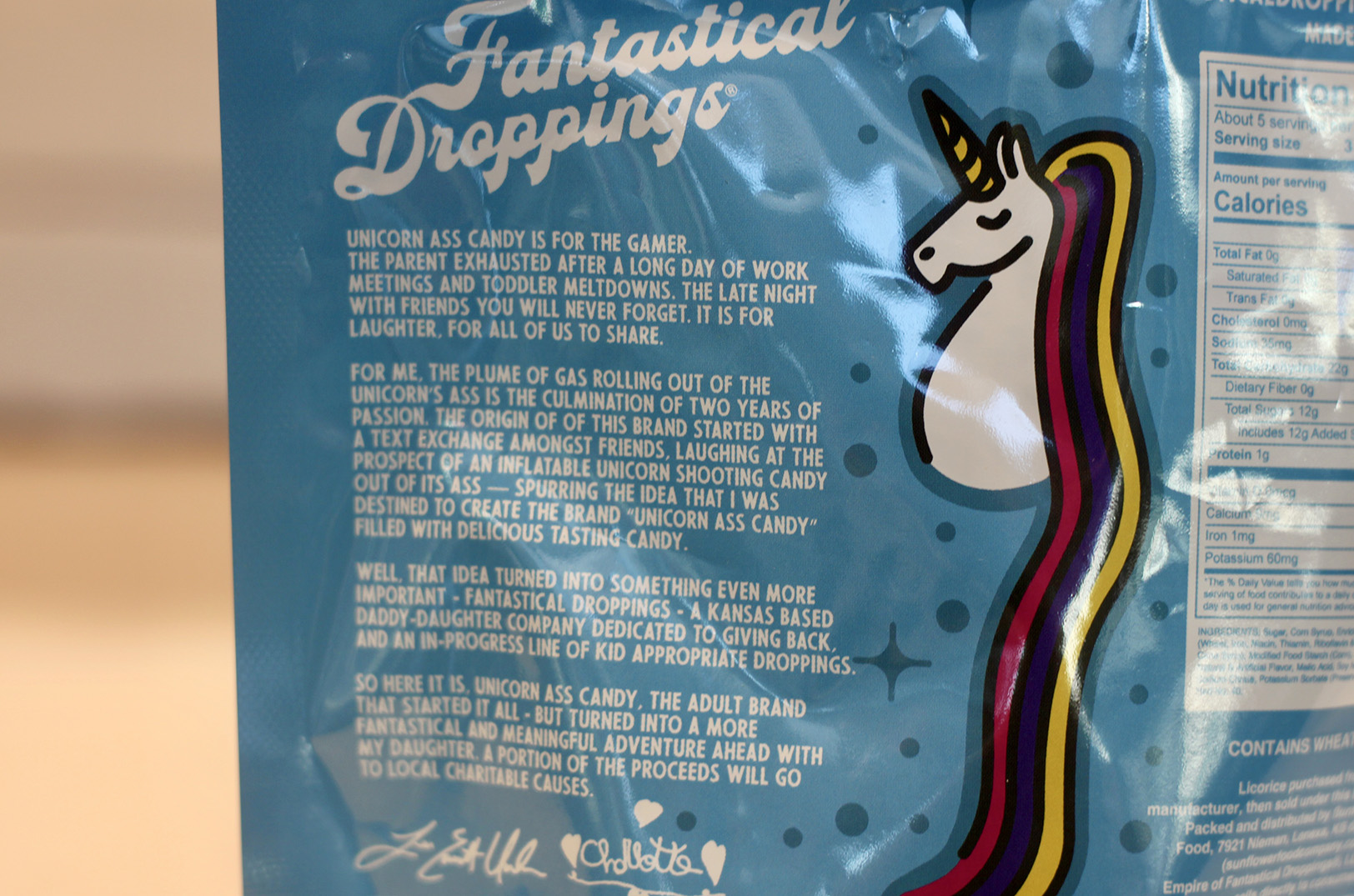
Packaging for Unicorn A** Candy by Fantastical Droppings; photo by Nikki Overfelt Chifalu, Startland News
“Somebody said, like, ‘Just imagine if the unicorn shot candy out of its ass,’” Urban recalled. “And we were just rolling. Then the joke was the kids would be out there for perpetuity and we wouldn’t have to get a babysitter.”
“I’m like, ‘Oh, I’m gonna look on the trademark site to see if it’s trademarked,’” he added. “‘If not, I’m gonna create a candy, because that’s funny.’”
About four years ago, he first reached out to a designer friend for help on where to start with building a candy company and then began calling candy executives, Urban continued. He spent a year figuring out details like the related supply chain challenges.
“I think the curiosity really got the best of me,” he noted, “and so it kept rolling.”
Urban landed on licorice — a favorite of his grandfather — he said. But he couldn’t find any local company that makes it. He even tried to make it himself.
“That was hard,” Urban added.
For six months, he and Charlotte taste tested various types and flavors of licorice before finding a local distributor.
“I’m really focused on quality, so I really wanted the best,” he said.
Charlotte first took interest in the business when she saw the designer’s drawing of the unicorn for the packaging, Urban said, noting a light switch flipped for him to start getting her more involved.
“I’m like, ‘What’s that?’” Charlotte recalled. “And why is that unicorn tooting?”
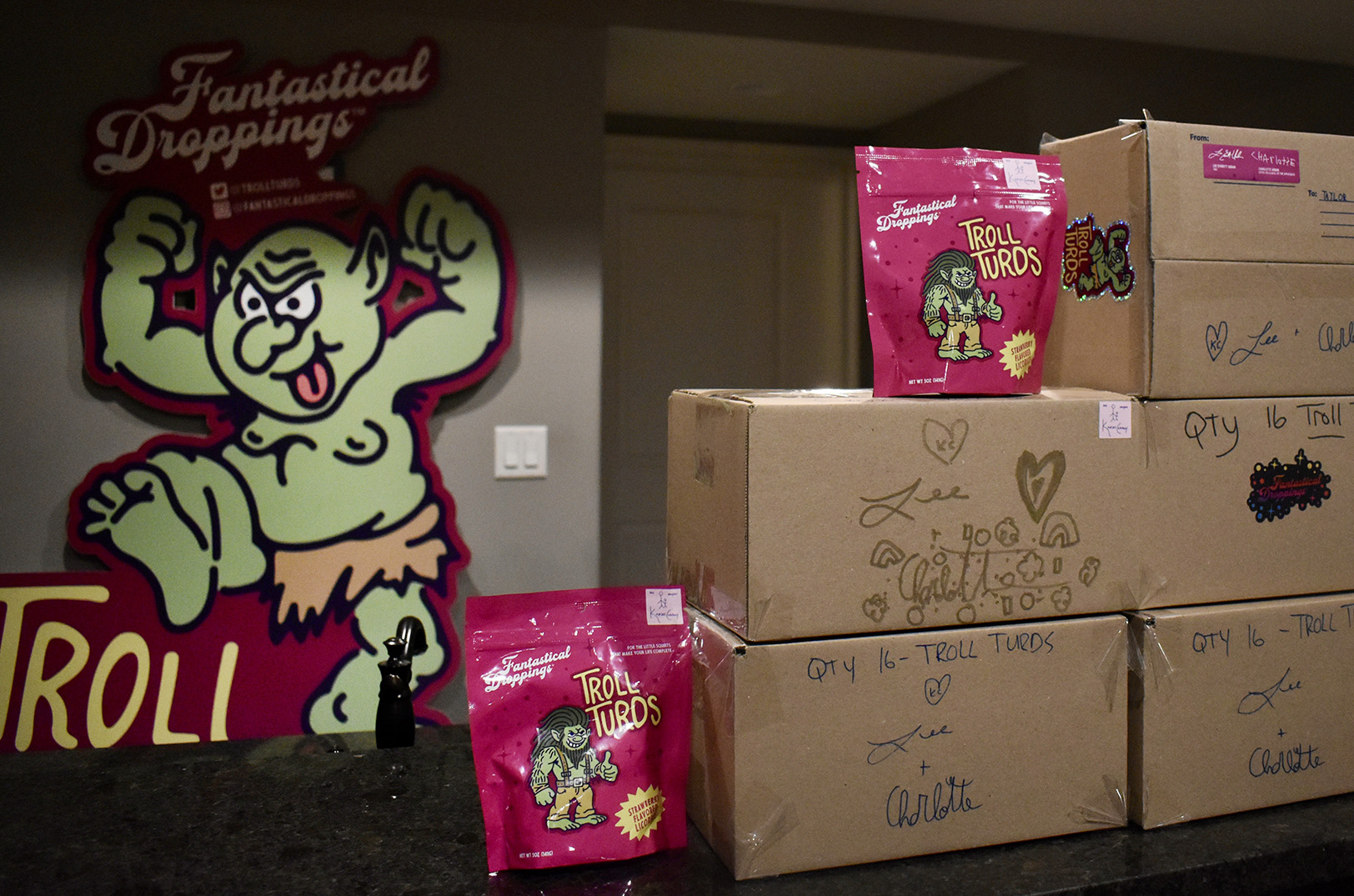
Boxes of Troll Turds by Fantastical Droppings; photo by Nikki Overfelt Chifalu, Startland News
Together, step by step
While Urban considers himself the visionary behind Fantastical Droppings, Charlotte is the creative, he shared. She makes signs for pop-ups, helps with packaging — signing, drawing on, and putting stickers on each box that’s shipped (even making one for Taylor Swift when they 13 bags leftover), and brainstorms new characters and flavors (according to Charlotte, “Dragon Dingleberry” is next, a purple licorice with possibly a different berry flavor).
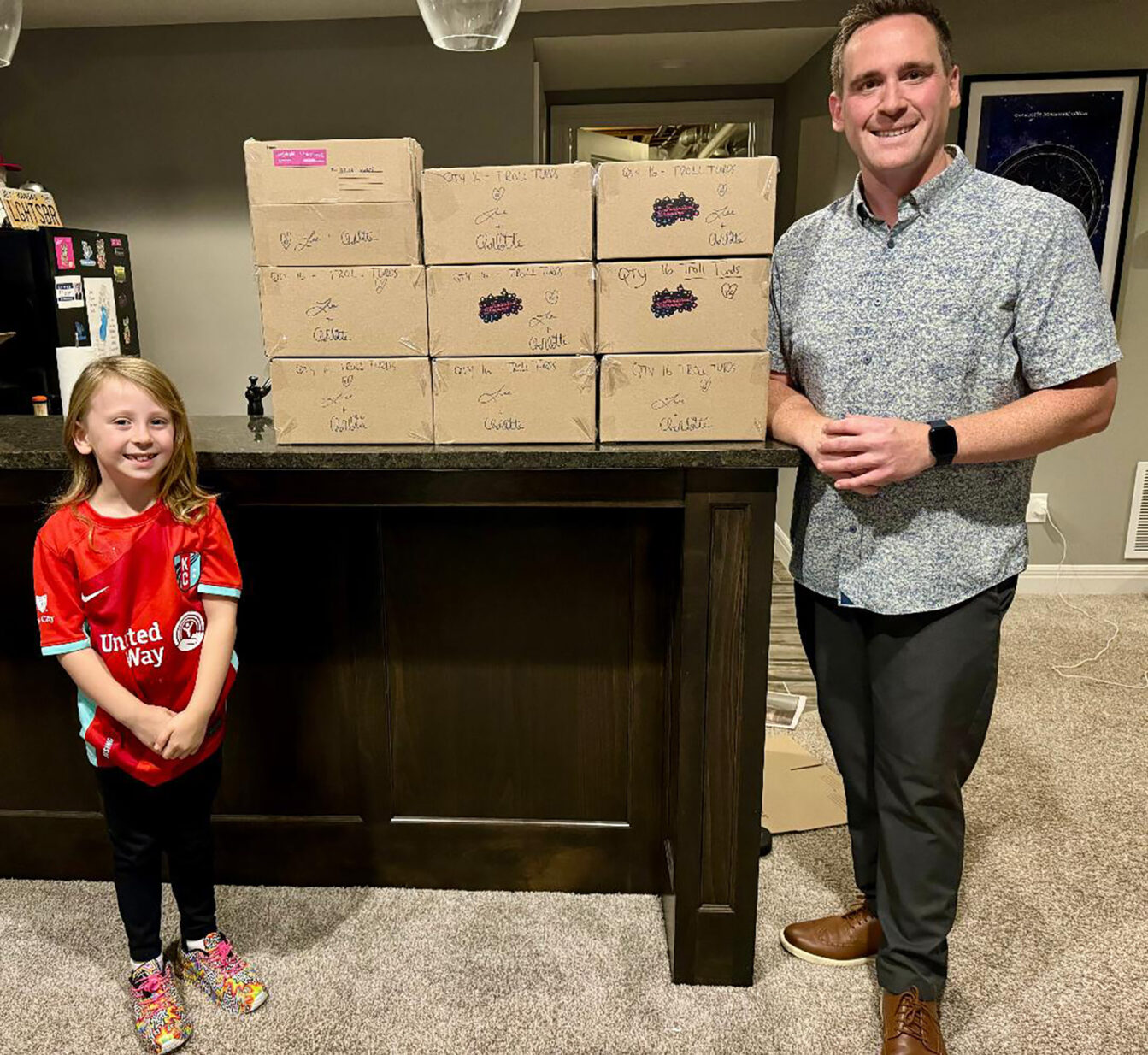
Charlotte and Lee Urban, Fantastical Droppings; courtesy photo
She also helps her dad with sales at pop-ups and by delivering donations to organizations like Children’s Mercy, KCSN Foundation, Melissa’s Second Chances Animal Shelter, and the Kansas City VA.
“Part of it is her exploring the creative side,” Urban explained. “So the teaching is just learning how she can unlock the creative side in different ways, but also then convert it into business. Or how do you take something that you’ve done creatively and put it onto a product?”
Each quarter they explore a different business lesson — like public relations — at her first grade level, he noted.
“They’re really basic lessons that hopefully build over time,” Urban continued. “But more so, it’s just the importance of creating a good quality product and then valuing spending time with each other.”
“It went from a joke to a business and it’s growing,” he added. “It’s taking it step by step and enjoying the ride.”
And what does Charlotte like most about helping to run the business?
“That we do it together,” she said.

2024 Startups to Watch
stats here
Related Posts on Startland News
ECJC relocates office, updates brand
The Enterprise Center in Johnson County is shaking things up. The non-profit organization that connects entrepreneurs to the resources they need to grow revealed Thursday an updated website, brand identity, and new office location. “This move is the culmination of a long, strategic transition to ensure that as Kansas City’s entrepreneurial community changes, we change…
Former Sprint COO LeMay dishes on KC capital, failure
There are few people in Kansas City more connected into the area’s investor, corporate and startup community than FarmLink CEO Ron LeMay. Also now managing director of Kansas City-based OpenAir Equity Partners, LeMay frequently sees the successes and failures of the metro area’s capital landscape. The former Sprint COO recently spoke with dozens of Kansas…
RFP365 partners with Kansas City, raises $950K
On the heels of a six-figure raise, area tech firm RFP365 recently landed the City of Kansas City as a client for its software that eases the request for proposal process. The company’s deal with Kansas City was born from the city’s “Innovation Partnership” program, which affords entrepreneurs the opportunity to “test drive” their technologies…
Study: Gov should take long-term approach to grow new businesses
A recent study by the Ewing Marion Kauffman Foundation reports that while governments have long supported entrepreneurship, new business creation is waning. The study — Guidelines for Local and State Governments to Promote Entrepreneurship — found that new businesses comprised about 8 percent of all U.S. businesses in 2011, down from roughly 15 percent in the…