
Eyeing the American dream, BLITAB creates tablet for blind people
November 5, 2016 | Meghan LeVota

Editor’s note: This content is sponsored by LaunchKC but independently produced by Startland News.
Kristina Tsvetanova is no stranger to obstacles.
She’s spanned the globe and learned three different languages en route to developing first-of-its-kind technology that aims to connect blind people to media in ways that rivals science fiction.
Touted as an “iPad” for the blind, BLITAB employs patented “smart liquid” tech to convert emails, stories or other text into braille. Imagine, for example, running your finger across a series of words on a tablet that’s then transformed to a tactile display that allows one to read text files, make notes and surf the Internet. The braille display shifts according to what the user needs and is supplemented by speech to text software.
After recently earning a $50,000 LaunchKC grant, Tsvetanova and her co-founder, Slavi Slavev, have identified Kansas City in particular as a prime locale to cultivate the technology.
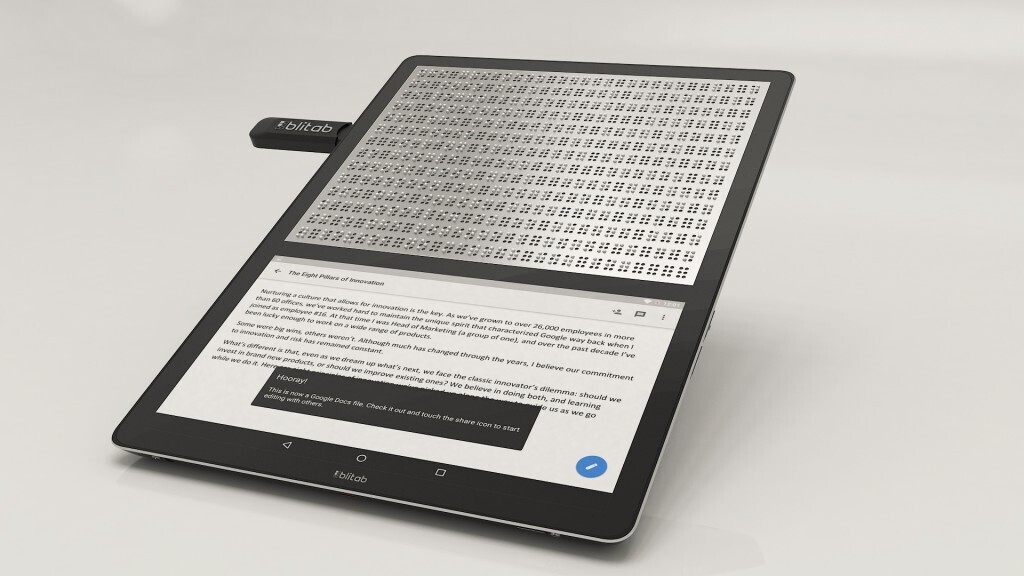
A BLITAB device.
“There are a lot of resources in Kansas City,” said Tsvetanova, CEO of BLITAB. “We like how the city has it as a goal to be attractive for entrepreneurs because you don’t find that in every city in Missouri. The whole atmosphere and support system is strong.”
Attracted by the “American dream,” Tsvetanova hopes the aspiration isn’t too good to be true. Born and raised in Bulgaria, she and Slavev were eager to find a better life. Bulgaria is rated the least-happy country in Europe.
Slavev attributes this to government corruption and low wages.
“There’s not so much opportunity in Bulgaria,” Slavev said. “No one is thinking about innovation. Instead, most people are thinking about what they’ll be eating that day.”
Thus in 2013, the two moved to Vienna, Austria.
Like Kansas Citians, Austrians pride themselves on a vibrant entrepreneurial ecosystem. While BLITAB has raised capital and tested their tablet on over 3,000 people while in Austria, Tsvetanova believes they can bring their product to market faster in the U.S.
“It’s because of the American perception,” Tsvetanova said. “You all are very open minded and open to innovation. The people in Austria are late-adopters and enjoy the calm, secure lifestyle of being an employee.”
Moving around the world, presenting an idea to a new culture and adapting your thinking isn’t necessarily an easy thing to do, Tsvetanova said. She maintains her drive thanks to a personal connection — her best friend is visually impaired.
“I watched my best friend get so frustrated trying to apply for classes with his phone’s (speech to text service),” she said. “There was just no easy way to do it.”
So, Tsvetanova asked herself a question familiar to many entrepreneurs: “If someone has to solve it, why not me?”
Armed with industrial engineering experience, she teamed up with the chemistry and business-savvy Slavev to build BLITAB.
Imagine a conventional touchscreen tablet, but attached to it is a similarly-sized display that converts text into braille. Featuring speech-to-text technology, the Android-based operating system hosts can also run any Android application.
The World Health Organization estimates that there are 285 million people with visual impairments, 39 million of which are blind. That’s why Tsvetanova says it’s important for the product to be not only accessible but also affordable.
“(People with visual impairments) are people like us, and are equal to us,” Tsvetanova said. “Without equal access, they will be excluded from the community.”
While the firm is thrilled to be in Kansas City, there is still one more obstacle to overcome: staying in the U.S.
“We cannot benefit from LaunchKC until we get the correct VISA,” Slavev said. “Until then, we cannot work or be employed in our own company.”
While the duo currently has a business VISA that allows them to temporarily stay in the U.S., they plan to soon permanently relocate to Kansas City.
“We hope that America values businesses that are doing something that is working,” Slavev said. “For example, in Austria, if I said I’m Bulgarian there is a discrimination kind of. But here, if I tell people I’ve created the first tablet for blind people worldwide — maybe it doesn’t matter if I’m Bulgarian. Or, so we hope. We will find out.”

2016 Startups to Watch
stats here
Related Posts on Startland News
Kansas budget woes render uncertainty for angel tax credits
As state budgetary concerns loom in the background, early-stage firms in Kansas are hoping a bill to extend the Sunflower State’s Angel Investor Tax Credit program will become a priority for legislators. Scheduled to sunset after the 2016 fiscal year, the program annually allocates $6 million in credits to entice investments in early-stage, growth-oriented companies…
KC virtual reality firm partners with KU, NFL coaches
A Kansas City-based virtual reality company hopes some marquee partnerships will plug it into a market projected to reach $150 billion in five years. Founded in 2013, Eon Sports VR recently landed the University of Kansas football team as a client for its mobile virtual reality platform to help players train without the risk of…
ECJC relocates office, updates brand
The Enterprise Center in Johnson County is shaking things up. The non-profit organization that connects entrepreneurs to the resources they need to grow revealed Thursday an updated website, brand identity, and new office location. “This move is the culmination of a long, strategic transition to ensure that as Kansas City’s entrepreneurial community changes, we change…
Former Sprint COO LeMay dishes on KC capital, failure
There are few people in Kansas City more connected into the area’s investor, corporate and startup community than FarmLink CEO Ron LeMay. Also now managing director of Kansas City-based OpenAir Equity Partners, LeMay frequently sees the successes and failures of the metro area’s capital landscape. The former Sprint COO recently spoke with dozens of Kansas…