
Questioning 1:1 initiatives: Tech devices don’t equal innovation, disillusioned parents argue
February 19, 2019 | Austin Barnes

[Editor’s note: The following is part of a limited Startland series, exploring parent advocates’ objections to 1:1 technology initiatives, which typically put a tablet device in the hands of each student and are popularly used as classroom innovation models across Kansas City and the nation.]
[divide]
A $20 million investment in tech-forward learning environments for the Shawnee Mission School District is generating concerns for parents — some of whom question whether intense screen time in the classroom is an effective use of innovative tools.
[pullquote]
Doubting Digital
Other stories in this series:
• Mother stresses lack of parental consent for school devices amid privacy, development worries
• Young brains rewired by non-stop screen time in classrooms, neurotherapist tells district
[/pullquote]
“It’s really about the model more than the technology,” Gretchen Shanahan, a parent with two children in a Shawnee Mission elementary school, said of the district’s 1:1 technology initiative.
“If you don’t have the model right — whether it’s you being a model yourself in your own home with technology or if it is a school not having the model right — the proper communication and boundaries, and teacher training … then problems can arise,” she said.
Designed to better prepare children for adulthood dominated by technology, SMSD launched its 1:1 initiative — an effort aimed at transforming teaching and learning outcomes by providing students with either a MacBook or an iPad — under the leadership of former superintendent Jim Hinson in 2014, the district explained at the time.
The Shawnee Mission School District did not respond to requests from Startland to participate in this series.
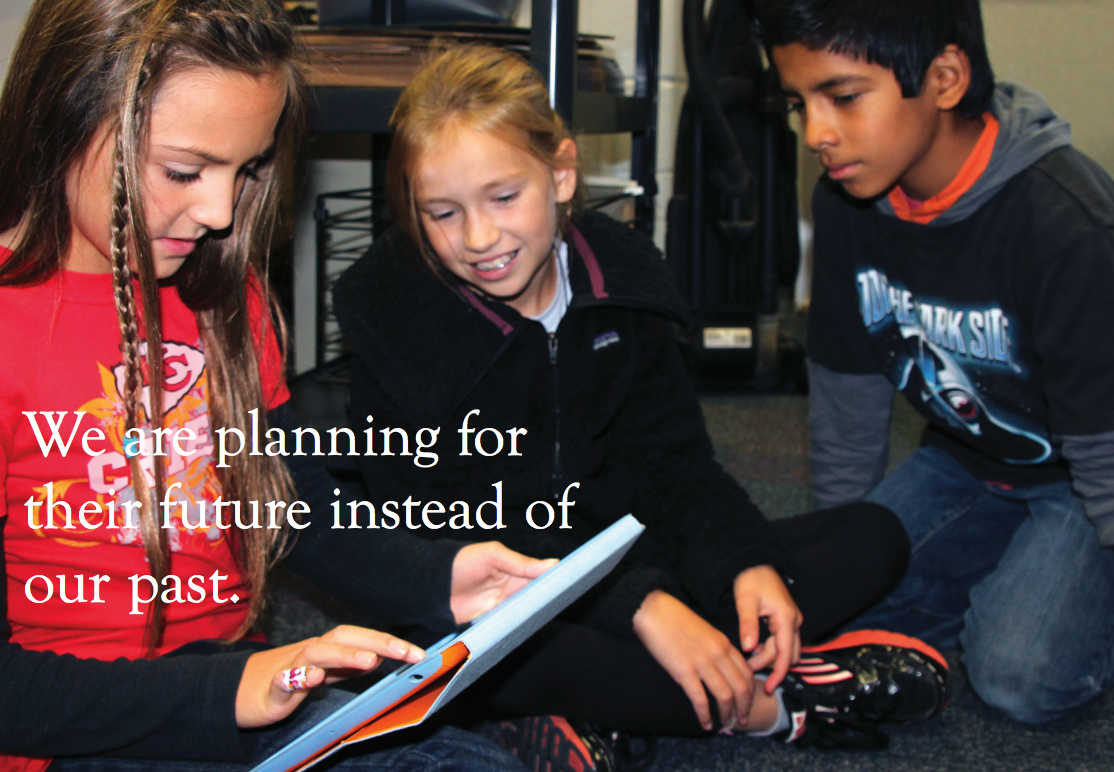
From the Shawnee Mission School District Strategic Plan, 2014-2015
“In order to improve achievement outcomes and prepare students for a future we cannot yet envision, the Shawnee Mission School District has taken an important step in making more resources available to students,” the district’s 2014-2015 strategic plan reads in a section on technology. “The Shawnee Mission Board of Education approved a digital learning initiative to transform educational delivery and access to information.”
For Shanahan, the initiative has been less of a resource and more a form of theft — potentially robbing childhood innocence from her third graders and their peers, she said with concern.
“[My daughter said] she saw something inappropriate on her iPad in art class and I’m like, ‘OK, first of all, why do you have your iPad in art class?’” Shanahan recalled thinking. “The teacher let her search [for something to draw] on Safari, which I didn’t even realize that my kids were allowed to do. … She should be using her imagination.”
Melanie Haas, another parent in the district, experienced a similar situation. Her daughter was exposed to real-time news alerts and accessed coverage of the 2017 mass shooting in Las Vegas, she recalled.
Click here to learn more about Haas’ concerns as both a parent and technologist.
Such breakdowns in communication led Shanahan to explore the limitations, or lack thereof, of activity on school-issued devices — revelations she found to have violated her personal parenting standards, she said.
“I’m trying to teach — in my home — responsible and limited use, time well spent. And now I’ve got a school that’s telling my kid, ‘Oh yeah, we’re going to carry these devices to all these different classes,” she said.
A loaded issue
While the image Shanahan’s daughter accessed in art class was less graphic than it could have been — showing a man flashing his middle finger — the ordeal has made Shanahan question what appropriate use of tech in the classroom looks like, she explained, noting that different teachers use a variety of teaching methods — providing students with non-standardized learning experiences that could potentially alter learning outcomes.
A crucial moment in Shanahan’s classroom crusade came when she discovered her kids were using their devices during indoor recess — promoting social isolation, she said.
“When I was their age and we had indoor recess, I would watch ‘Sesame Street’ out in the hall with the whole class — with the whole school. That was a shared experience. OK?,” Shanahan said. “So, there’s a difference between having something that only you experienced and that’s an important thing with developing children.”
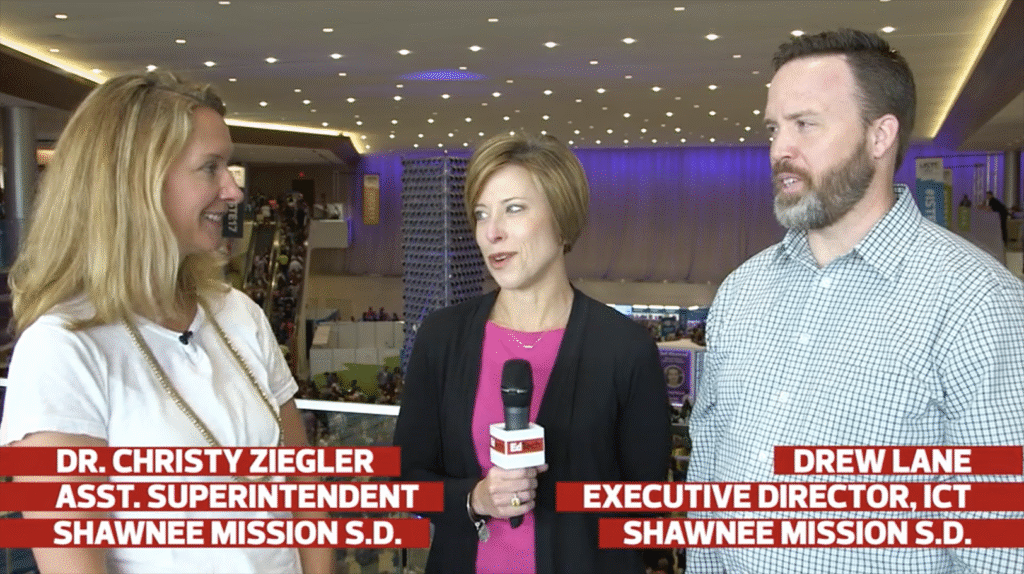
Among SMSD’s hopes for the initiative was increased student engagement, Dr. Christy Ziegler, assistant superintendent of personalized learning/interim director of special education, told EDTech — a digital magazine — in 2017.
“We also wanted to personalize the learning opportunities for our, our students and really transform instruction taking our opportunities for learning outside of the four walls of the classroom,” Ziegler said of the district’s goals for the initiative.
Social isolation could be just one impact of 1:1 initiatives on the developing brain — a growing research topic, said Susan Dunaway, an area neurotherapist and active member of the SMSD parent group that’s called on the district to improve its outlook on tech and to approach its use responsibility, Dunaway explained.
Click here to read more about Dunaway’s research.
Developmental impacts are also a concern for Shanahan, who said she wasn’t made aware of how often devices would be used, nor did she consent to such reliance on them.
“[Communication] is very important, with schools allowing your kids to do something that [they aren’t often exposed to] — and they’re not even getting your consent or making you aware of it. That’s concerning,” she said. “It’s not a positive — it’s a negative.”
While textbook use isn’t completely extinct, an ever-increasing amount of class activities are being loaded onto iPads as tech evolves, Shanahan said, arguing that teachers aren’t always aware of the impact tech has on their teaching.
“I had to educate the teacher on some things that she wasn’t aware of … that she could remove [from the device]. That should’ve been done by the district before the iPad was issued,” she said. “Somebody that’s not getting the training or isn’t really sure what the best uses are might just not be comfortable using [a device] for what it’s intended, and may instead fallback on using it as a break.”
Seeking balance
For their parts, the school district and Superintendent Michael Fulton in January announced a call for volunteers to re-form a Digital Learning Task Force that will explore ways to improve the current and future use of digital tools in the classroom, Fulton said during a November 2018 board meeting.
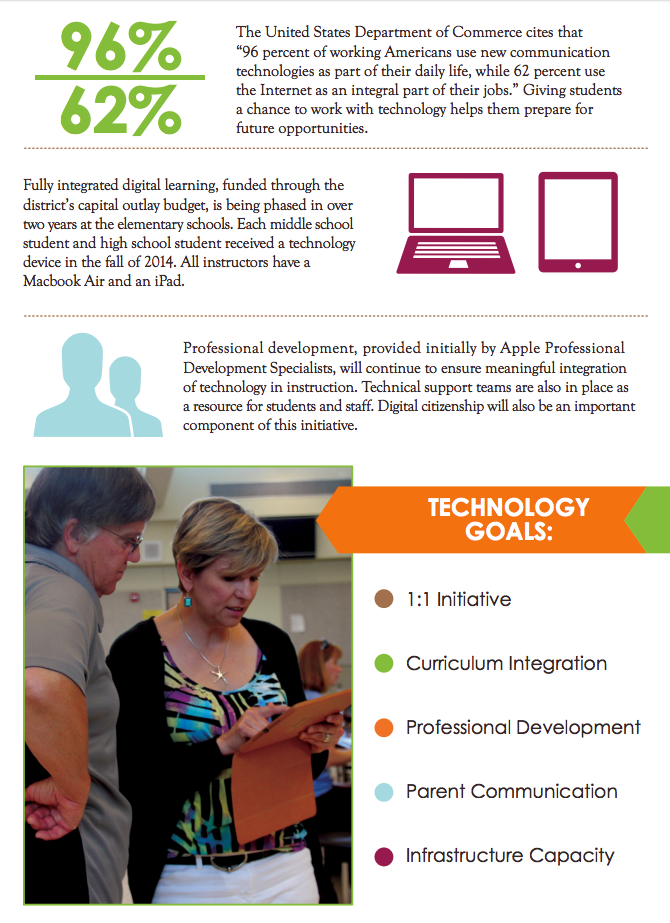
From the Shawnee Mission School District Strategic Plan, 2014-2015
“We’re thankful to have digital devices that are available to us for our students and we recognize that they’re great tools for learning — they need to be used appropriately — and very importantly, they also offer up the world of opportunity to our students 24/7 so that even students who may be limited in the resources they have at home have an equal footing with their peers at school,” he said at the meeting.
A group of teachers, staff, parents, and students originally helped develop the objectives of the district’s current initiative in 2014, Fulton recalled.
Both Ziegler and Lane will serve as co-chairs of the revived task force, made up of 30 parents — including Shanahan, she and the district announced Wednesday.
Click here to watch the meeting.
From a parent perspective, Shanahan is encouraged by the district’s decision and remains an active participant, committed to the evolution of the digital task force — assuming healthful boundaries and effective communication standards can be set to prevent further issues from arising and enabling her to protect her children when they’re out of her care, she said.
[divide]
Doubting Digital
Other stories in this series:
• Mother stresses lack of parental consent for school devices amid privacy, development worries
• Young brains rewired by non-stop screen time in classrooms, neurotherapist tells district
Featured Business

2019 Startups to Watch
stats here
Related Posts on Startland News
Coming UMKC innovation center to serve students, entrepreneurs
With funding shored up from private and public donors, the University of Missouri-Kansas City is planning to move ahead with its plan to build the Robert W. Plaster Free Enterprise Center to support students and entrepreneurs. Missouri Gov. Jay Nixon announced Tuesday that the state is allocating $7.4 million to the center, which represents half…
Security firm Nodal nabs $100K, ramps up hiring
Good news is stacking up for Kansas City-based Nodal Industries. The security hardware tech company recently snagged $100,000 in seed funding as part of an opportunity to participate in the 500 Startup accelerator program, based in Mountain View, Calif. The funding will allow Nodal to hire up to eight people, as well as ramp up production…
Play-It Health lands in top-ranked digital health accelerator
As with many successful startups, the idea for Play-It Health was born out of personal experience with an unsolved industry need. Kim Gandy, a former clinician and now the founder and CEO of Play-It Health, recognized that patients were having trouble engaging and adhering to their medical regimen. In the worst cases, this led to…
LaunchKC, Techweek to welcome 10 tech firms to KC in style
In roughly four months, Kansas City will welcome a crop of tech startups bolstered by thousands of dollars in funding and a rockstar arrival. Kansas City’s LaunchKC competition — which aims to attract 10 tech firms to relocate to KC with $50,000 grants — has partnered with national tech conference Techweek to offer the winners…