
Coty Beasley addresses ‘the Singularity’ and our impending doom
July 27, 2016 | Coty Beasley

Editor’s note: On a daily basis, Coty Beasley translates the jargon-filled world of technology for clients of his tech consultancy. The Words that Frustrate (WTF) series aims to offer readers some clarity in an industry dominated by techies’ confusing argot. The opinions expressed in this commentary are the author’s alone.
Let’s start with a mind experiment: you’ve just consumed a significant amount of barbeque and beer, and you’ve fallen ill. You stumble into bed shaking from meat sweats and slip into a Kurzweilian fever dream.

Coty Beasley
At the nexus of philosophy and futurism, a cluster of neurons connect to form a heavy question in your mind. Will humans ever progress so far that they can control their own evolution or perhaps be displaced by their own creations?
Typical Thursday afternoon, amirite?
Well, dear reader, this question has flashed across the minds of many great thinkers like Ray Kurzweil, Isaac Asimov and William Gibson, growing over time to form the hypothesis of “the Singularity.”
In all likelihood, you’re already familiar with the idea even if you don’t already know it yet.
Remember that little film from Spike Jonze called Her? Maybe you saw the critically demonized movies Lucy or Transcendence? Hell, even the space baby from 2001 — they all play with the concept. One day, we either become gods through our technological progress, masters of the physical universe around us, or our technology will become sentient and grow past us. (By the way, go see Her. It’s maybe one of the best movies ever. Seriously.)
While this seems far-fetched, the Singularity might simply be a logical arrival if we continue surviving and growing as a species.
Take a look at this chart:
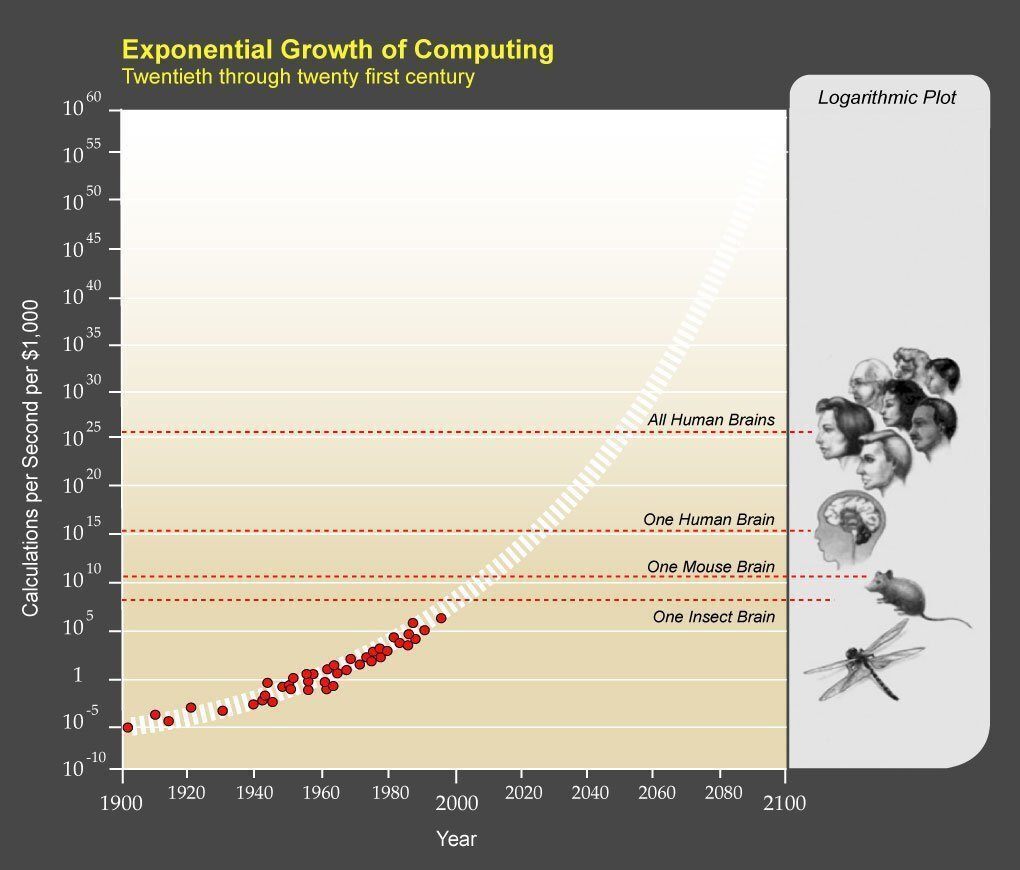
If we continue our computational trends in the exponential fashion we have so far, this is what we’re looking at for technological chutzpah; we’ll out-compute insects, then simple animals, and finally a human mind. In short order, we’ll have machines that can outthink the combined power of all of humanity.
For a modern context, researchers believe that a human mind can think about 30 times better than our best supercomputers. Given that computers could only rub a couple bits together a few decades ago, that shows the progress we’ve made in a very, very short time.
In films I, Robot, Terminator, and Ex Machina, we see this play out with a robot developing sentience and sometimes deciding to harm their creators in the process. On the other side of this is the idea of Transhumanism, which is a variable in Singularity discourse, where we merge with technology to progress ourselves. This is related to the concepts of cyborgs and intelligence augmentation over sentient technology such as artificial intelligence.
So, in short, we’re looking at either overtaking our evolutionary path with advanced technology or creating technology that develops itself past our control and becomes a new lifeform that outstrips us intellectually. Inevitably, the endgame plays out with humans probably getting wiped out by our androids or humans transcending the physical plane.
Space babies, yo.
That’s what we’re dealing with, in a nutshell, though this article just scratches the surface of what’s out there on the subject. If you’re looking for more information, here’s some good places to start:
- IEEE Singularity Hub
- http://whatistranshumanism.org
- Mashable – Why ‘Her’ Is the Best Movie Ever Made About the Singularity
- Kurzweil’s The Singularity Is Near: When Humans Transcend Biology
- TechCrunch – Is Singularity Near?
All in all, we either get cool robots, become cool robots, or create a new race of robot frenemies. I’ll chock that up as a win. Or an extinction event.
It’ll be interesting, I guess?
Coty Beasley is co-founder of Edge Up Sports, which uses machine learning and IBM Watson to provide sports data insights. Connect with Coty on Twitter @beacrea.

2016 Startups to Watch
stats here