

Their diagnoses were just the beginning: How tech app, community tap into co-founders’ own chronic illnesses
January 4, 2022 | Blythe Dorrian
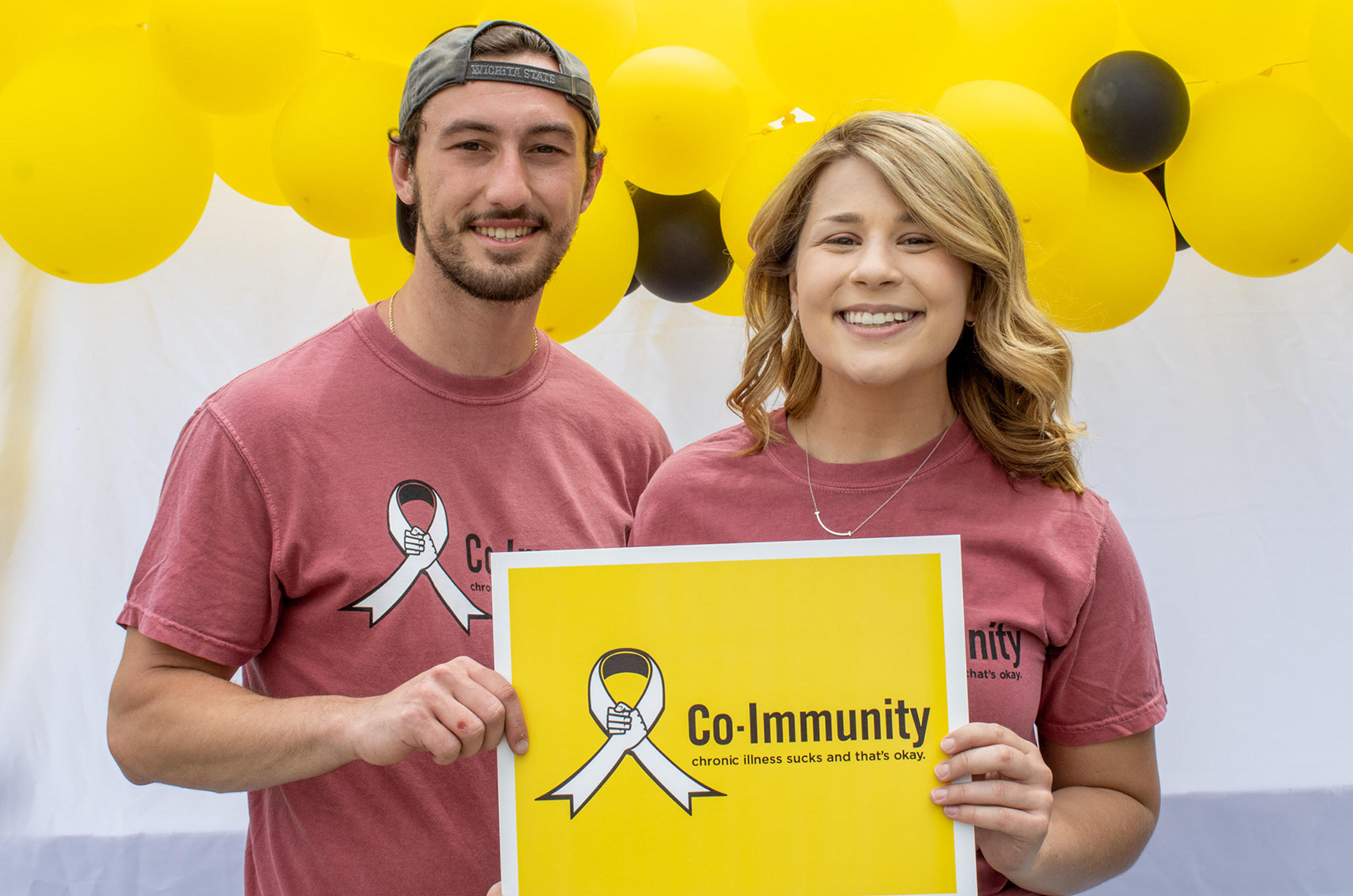
Startland News’ Startup Road Trip series explores innovative and uncommon ideas finding success in rural America and Midwestern startup hubs outside the Kansas City metro. This series is possible thanks to the Ewing Marion Kauffman Foundation, which leads a collaborative, nationwide effort to identify and remove large and small barriers to new business creation.
[divide]
WICHITA — An app launched to help patients take control of their chronic illnesses has origins in its co-founders’ own journeys in dealing with the day-to-day physical and emotional tolls of their ongoing health conditions, as well as efforts to better communicate with doctors.
“I personally struggled with trying to remember all the symptoms,” said Maddie Shonka, a lupus and narcolepsy patient who co-founded Wichita-based Co-Immunity Technology Solutions and its non-profit arm, Co-Immunity Foundation. “How accurately you describe your symptoms dictates your treatment plan and diagnosis, especially for diseases that don’t have labs or tests that correlate.”
The startup’s first tech tool, the app CoVstat — the name of which reflects CEO Shonka and co-founder and COO Kyle Manera’s Czech heritage, with “stat” meaning “to get up through difficulty” — was designated to help eliminate frustration and anxiety before appointments.
Click here to begin exploring Co-Immunity and CoVstat.
Participants currently can track their symptoms for free, but a subscription option is coming soon.
“We want to be the Disney of health care,” Shonka said, describing her hope that users can live a full life, doing what they love, but recognizing they’ll have to push themselves.
“I think it’s important that this culture of chronic illness where you can’t achieve anything is combated because it’s not true,” she continued. “You just have to do things differently.”
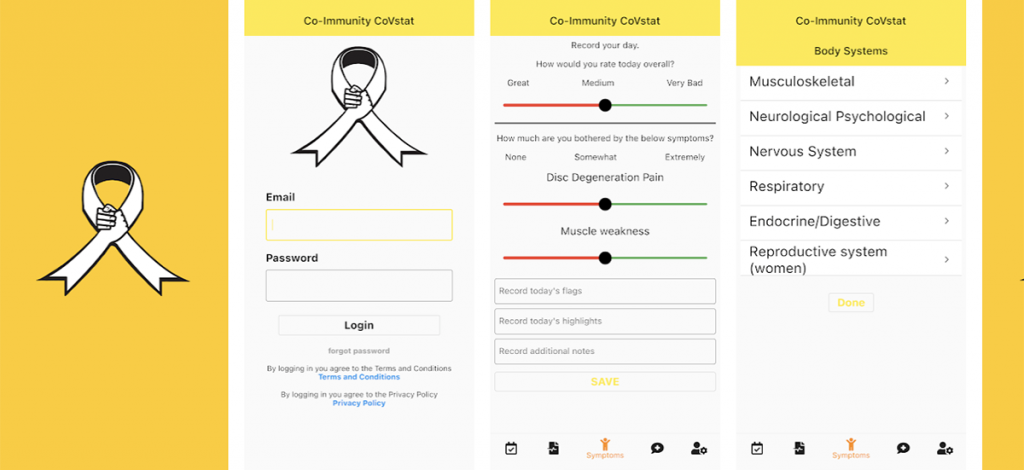
CoVstat allows people to choose a specific medical area to track their symptoms based on their needs. “When you have a chronic condition at our age, it can sometimes take longer because the test results people are looking for don’t always flag the same as those who are diagnosed at 40,” Maddie Shonka said. “It’s rare to be diagnosed with these rheumatology diseases in your 20s and younger.”
Regretting ‘right’
Before her diagnosis of lupus and narcolepsy with cataplexy in high school, Shonka would wake up at 6 a.m. for cheer practice and fall asleep stretching. When she’d go to her first class, she would fall asleep within the first 20 minutes. She’d even have to nap before driving five minutes home.
“I got swine flu in fourth grade that triggered the narcolepsy, and I had mono in sixth grade that triggered lupus,” Shonka explained.
Her health problems, however, began much earlier, she said.
Shonka’s mother had a traumatic three-day labor where they both almost died. Shonka had pneumonia for the first time at 8 weeks old. Also suffering from chronic asthma, she had to wake up every night for breathing treatments.
“I knew I always wanted to be a doctor growing up,” Shonka said. “I was a super nerd who read medical terminology for fun.”
She also knew something was wrong in sixth grade. She remembers asking her doctor to run tests for lupus, a chronic autoimmune disorder. This search continued in Wichita until she was a sophomore in high school.
After traveling to the Mayo Clinic, she finally received answers 18 months later. Shonka learned she had narcolepsy the summer before her senior year of high school and lupus in December of that year.
“When I was finally diagnosed with lupus, I didn’t have a normal reaction,” Shonka said. “My mom was sitting there crying. I started celebrating because I was so happy I was right, and then it hit me.”
During her senior year, Shonka completed an EMT course through which she learned more about the initial prognosis of her new diagnoses.
“When I was studying for my practicals, I was reading about how one of the causes of a collapsed lung was lupus,” Shonka said. “It took me a few months to really hit me. This is a diagnosis that can and already impacts my life. Maybe I didn’t want to be right about it.”
Shonka and her family had been looking for signs of lupus for years, but the diagnosis with narcolepsy came as a surprise.
“The narcolepsy affected me more,” Shonka said. “It came out of nowhere. I felt like I had slept my life away. Having a name for it made me really angry.”
Watch an interview below between Maddie Shonka and Chris Rehkamp, UMKC Tech Ventures Studio, then keep reading.
Changing the stigma
Shonka initially launched the Co-Immunity Foundation in July 2019 while attending Wichita State University, where she studied health care administration and management.
“I was really sick my freshman year of college,” Shonka said. “There were about two months where I couldn’t drive, walk, or talk. I was supposed to go to KU, and here I am watching all my friends partying. It’s really crazy to live this double life where you look normal, but at the same time your reality is completely different.”
Starting the non-profit seemed like a way to cope and help others, she said.
“I rely on gut feelings a lot,” Shonka said. “I just had this feeling that I needed to do this, and that the timing was right.”
Shonka attended E-Launch — a program at Wichita State designed to help foster entrepreneurship and commercialize ideas — interviewing several patients with chronic illnesses. Her first interviewee (and eventual co-founder), Manera, had just been diagnosed with hypothyroidism.
“When I started the tech company, he was in the pilot program,” Shonka said. “He’s an aerospace engineer and is definitely more technical than I am. I was shocked when he said ‘yes.’”
She then launched a Sur(THRIVE)al program as a virtual support group on the non-profit side of Co-Immunity to unite people by age and not disease, she said.
Sixty-five participants from across the country joined Shonka in the program this year starting in September. They were split into middle school, high school, college, “adultish” for people 22 to 30 and adults older than 30.
“Our tagline is ‘chronic illness sucks, and that’s okay,” Shonka said. “Our goal is to acknowledge the ‘suck’ of chronic illness, but instill an attitude of resilience in people.”
“A lot of times you doom scroll on Facebook,” she continued. “I was reading this forum of everything that could go wrong with me, and it made me panic.”
The program runs for 12 months. Participants are challenged to do a chapter of the survival guide on their own to establish their feelings before talking once a month in a group.
“In the middle of COVID, I realized a lot of people were struggling,” Shonka said. “I had written a workbook that walked through the seven stages of grief. I decided to make that the foundation for support groups.”
People with all kinds of conditions are welcomed to the groups, she said, which share perspectives and resources on what has worked for various members.
“We talk a lot about pushing yourself and balancing your disease,” Shonka said. “Everyone has an excuse to not participate.”
Whether working with the nonprofit community or tech startup sides of the endeavor, Shonka continues lean on her own experience, she said.
“I used to run half marathons in Disney with my mom when I was 17 years old,” Shonka said. “Doing a half marathon at all is a big feat. I use the marathon as a metaphor. There were metaphors where I had a personal record, and there were metaphors where I was completely flared and I limped the last four miles, but I finished.”
[divide]

This story is possible thanks to support from the Ewing Marion Kauffman Foundation, a private, nonpartisan foundation that works together with communities in education and entrepreneurship to create uncommon solutions and empower people to shape their futures and be successful.
For more information, visit www.kauffman.org and connect at www.twitter.com/kauffmanfdn and www.facebook.com/kauffmanfdn

Featured Business


2022 Startups to Watch
stats here
Related Posts on Startland News

Welcome to Startland News
Scrappy. Determined. Gritty. Those often were the words attributed to the Kansas City Royals as the team unexpectedly surged into the 2014 World Series and captured the national spotlight. Those very words are apt for this city, which has been built on the grit and determination of successful entrepreneurs like Ewing Kauffman, Joyce Hall, Henry…

Kansas budget woes render uncertainty for angel tax credits
As state budgetary concerns loom in the background, early-stage firms in Kansas are hoping a bill to extend the Sunflower State’s Angel Investor Tax Credit program will become a priority for legislators. Scheduled to sunset after the 2016 fiscal year, the program annually allocates $6 million in credits to entice investments in early-stage, growth-oriented companies…

KC virtual reality firm partners with KU, NFL coaches
A Kansas City-based virtual reality company hopes some marquee partnerships will plug it into a market projected to reach $150 billion in five years. Founded in 2013, Eon Sports VR recently landed the University of Kansas football team as a client for its mobile virtual reality platform to help players train without the risk of…

ECJC relocates office, updates brand
The Enterprise Center in Johnson County is shaking things up. The non-profit organization that connects entrepreneurs to the resources they need to grow revealed Thursday an updated website, brand identity, and new office location. “This move is the culmination of a long, strategic transition to ensure that as Kansas City’s entrepreneurial community changes, we change…