
Brown: ‘Most entrepreneurial city’ should act like it with Airbnb regulations
February 25, 2016 | Chris Brown

Editor’s note: Kansas City is mulling regulations that would affect the operations of more than 300 “home-sharing” properties in the area. The proposed regulations would impose a $600 permitting fee and a host of other stipulations on hosts of Airbnb, VRBO and other similar services.
New technology brings promises of a better future.
But it also creates problems in that government officials don’t understand the degree of risk the technology presents to society. As a result, they look at existing regulations and try to fit the new technology into the existing regulations.

Chris Brown
For example, when trying to regulate ride-sharing platforms like Uber and Lyft in 2015, Kansas City unsuccessfully turned to traditional vehicle-for-hire regulations that regulated taxi and limo companies.
Today, Kansas City is trying to regulate home-sharing platforms like Airbnb and HomeAway using traditional hotel and bed-and-breakfast regulations.
That concept just doesn’t make sense – using old regulatory systems to regulate new, innovative platforms doesn’t advance or help our community. In fact, it hurts our community.
Sure, the new platforms provide the same basic service as their traditional counterparts (a ride from point A to point B, or a place to sleep), but they do so using vastly different business models.
And one of the core features of these new business models is the vast amount of data they collect. I’ll come back to that in a moment. First, let’s look at what Kansas City does today.
How Kansas City regulates today (Regulation 1.0)
Kansas City places heavy burdens on entrepreneurs starting new business through a “permission-based” model. Entrepreneurs spend a lot of time and money asking the government for permission to operate and, if approved, they can operate in private without much oversight or accountability.
It works like this:
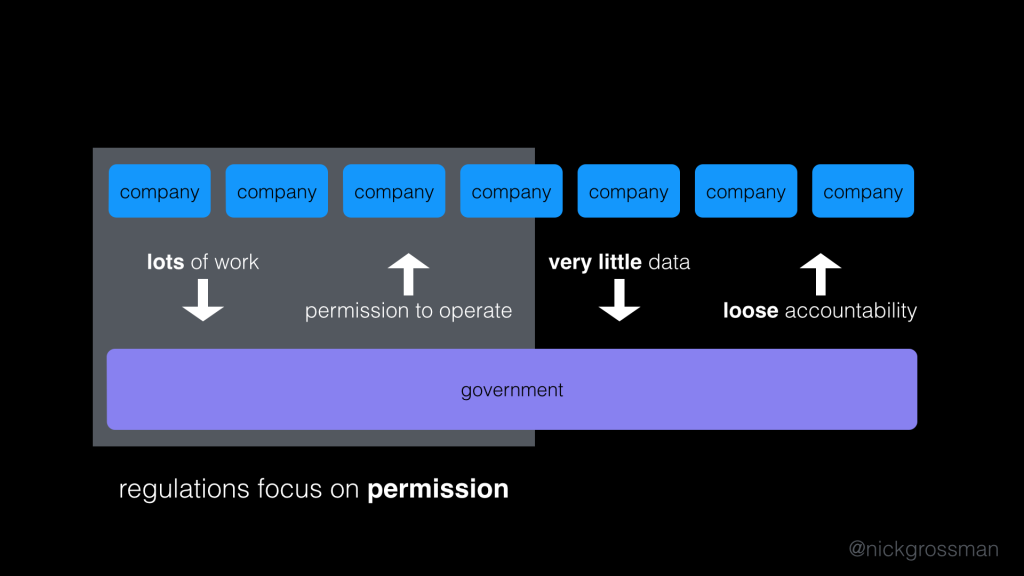
As an example, Kansas City proposed regulations for home-sharing that contemplate a high $600 application fee plus going through the special-use permit process that requires mailing notices to the community, a city planning commission hearing, and a board of zoning adjustment hearing. And a host might have to do that every other year!
That just doesn’t make sense for someone that wants to occasionally rent out their house on a home-sharing platform.
Regulation 1.0 doesn’t work. So what might?
What Kansas City should do (Regulation 2.0)
Nick Grossman, with Union Square Ventures in New York, proposes a smarter way to regulate new technology and platforms. He calls it “Regulation 2.0.”
What Grossman proposes is that we move from the “permission” model towards a “data-driven accountability” model – what he calls Regulation 2.0.
Under the concept, businesses get permission to operate without much effort or money, but are then expected to share data with the government and accept more public oversight and accountability.
Regulation 2.0 works like this:
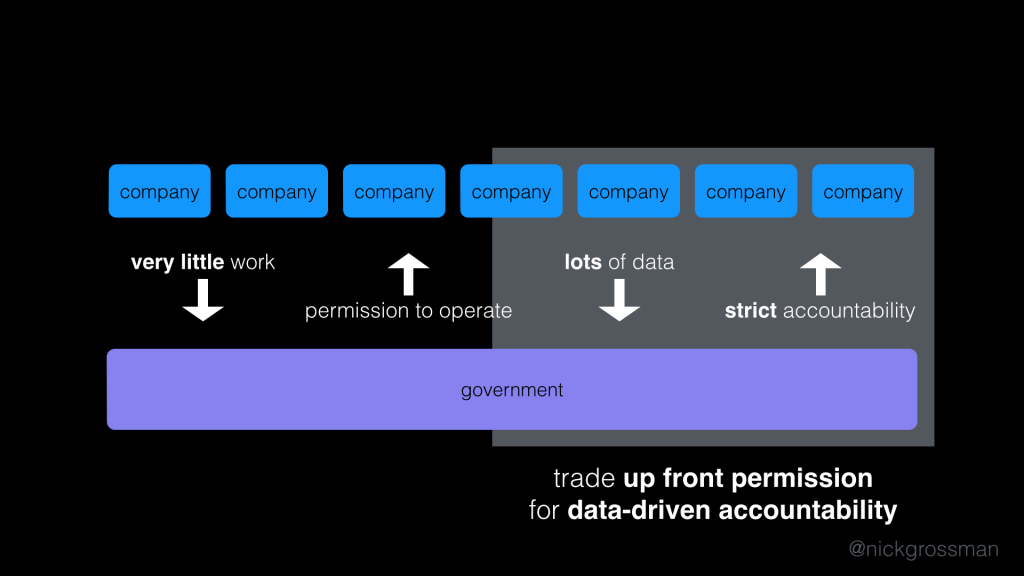
Regulation 2.0 might not work in every industry. But for platform-based businesses that collect large amounts of data, it can produce a better and safer community. That’s because it is easier than ever to aggregate, analyze and share data.
Governments can use that data to hold businesses accountable and gain a better understanding of what regulation is actually needed to protect our community rather than just guessing based on old business models. Further, by changing to the data-driven accountability model, entrepreneurs and startups will be able to start operating faster, create more jobs, improve our local economy and provide better technology to our society.
Of course, as Grossman argues, Regulation 2.0 requires a lot of cooperation from the platform-based businesses. But I predict that they will cooperate because it is in their own interests to move away from the permission-based model to a data-driven accountability model so they can grow faster and increase their user bases.
A challenge to Kansas City government officials
I challenge the city officials in Kansas City to follow through on their goal of making Kansas City the “most entrepreneurial city” by making our city among the first in the country to put Regulation 2.0 into place.
And now’s the time to do it. While I applaud the city for attempting to accommodate home-sharing through revised regulations, the proposed draft regulations simply don’t work. The city is trying to fit home-sharing platforms into existing regulatory systems that were designed for a different business model. Doing so doesn’t advance the interests of our community. Further, it doesn’t match how home-sharing platforms actually work day-to-day.
Let’s go big!
Let’s create experiential city regulations. If a platform-based business (such as Airbnb and HomeAway) is willing to cooperate, share data and accept more public oversight, they can get a fast track to permission to operate. Kansas City can then use the data from those platforms to create entrepreneur-friendly city regulations that actually advance our community.
I don’t know about you, but a city willing to try that approach sure does sound like “the most entrepreneurial city” in America.
Chris Brown is the founder of b.Legal Marketing and of Venture Legal and is a member of the KCnext board of advisors. Follow Chris on Twitter @CSBCounsel. Regulation 2.0 images provided by Nick Grossman.
Featured Business

2016 Startups to Watch
stats here
Related Posts on Startland News
‘Stablecoin summer’: Crypto community greets GENIUS Act with optimism, caution
Editor’s note: This story was originally published by Missouri Business Alert, a member of the Kansas City Media Collective, which also includes Startland News, KCUR 89.3, American Public Square, Kansas City PBS/Flatland, and The Kansas City Beacon. Click here to read the original story. [divide] A new federal cryptocurrency law has sparked a range of reactions across…
Match this: ‘Ted Lasso’ filming in KC another win for city’s tax credit pitch, mayor says
Scoring state-side shooting locations for the newest season of “Ted Lasso” reflects a strategy by the KC Film Office that’s straight from the hit Apple TV+ series’ playbook: the harder you work, the luckier you get. “‘Ted Lasso’ filming in Kansas City represents everything we’ve been working toward,” said Rachel Kephart, director of the KC…