

Tariffs are driving up costs for American coffee roasters: ‘We’ve never seen anything like this’
December 1, 2025 | Skyler Rossi

Editor’s note: The following story was published by Harvest Public Media and KCUR, Kansas City’s NPR member station, and a fellow member of the KC Media Collective. Click here to read the original story or here to sign up for KCUR’s email newsletter.
Coffee has gotten a lot more expensive in the U.S. as tariffs seep into the price tag; even as the Trump administration considers offering some tariff relief, that’s putting a strain on roasters, who have no choice but to pass on some of the extra cost to coffee drinkers
Hundreds of coffee beans tumble inside a tall metal machine at Broadway Roasting Company in Kansas City, Missouri.
Co-owner Jon Cates and his team, equipped with stopwatches and clipboards, watch closely to make sure the beans roast for just the right amount of time.
“At this point, it’s like seconds could make a huge difference on the flavor of the coffee,” Cates said, as the beans approached the end of their cycle.
The team roasts hundreds of pounds of coffee each week, stocking the company’s cafe down the street, along with other businesses nearby.
But long before the beans enter the roasting machines, they are shipped from around the world.
“Colombia, Brazil, Indonesia, all over Central America, Guatemala, Nicaragua,” Cates said, listing just a few examples.
This year, the Trump administration placed tariffs on all of those countries and more. That means companies like Broadway Roasting are paying a lot more to get their coffee in the door — placing them in the painful position of deciding how much of that extra cost to pass onto customers and how much to absorb.
In recent days, the administration has signaled relief could be on its way, including lifting tariffs on goods in a handful of countries, yet coffee shops around the country have already felt the squeeze.
Cates said he’s paid at least a 10% tariff on most of the coffee currently at his roastery. He’s had to increase prices for his customers because of it.
“We’ve been in business for 30 years, and we’ve never seen anything like this before,” he said. “Where you raise your price, and it’s for no reason other than to stay in business.”
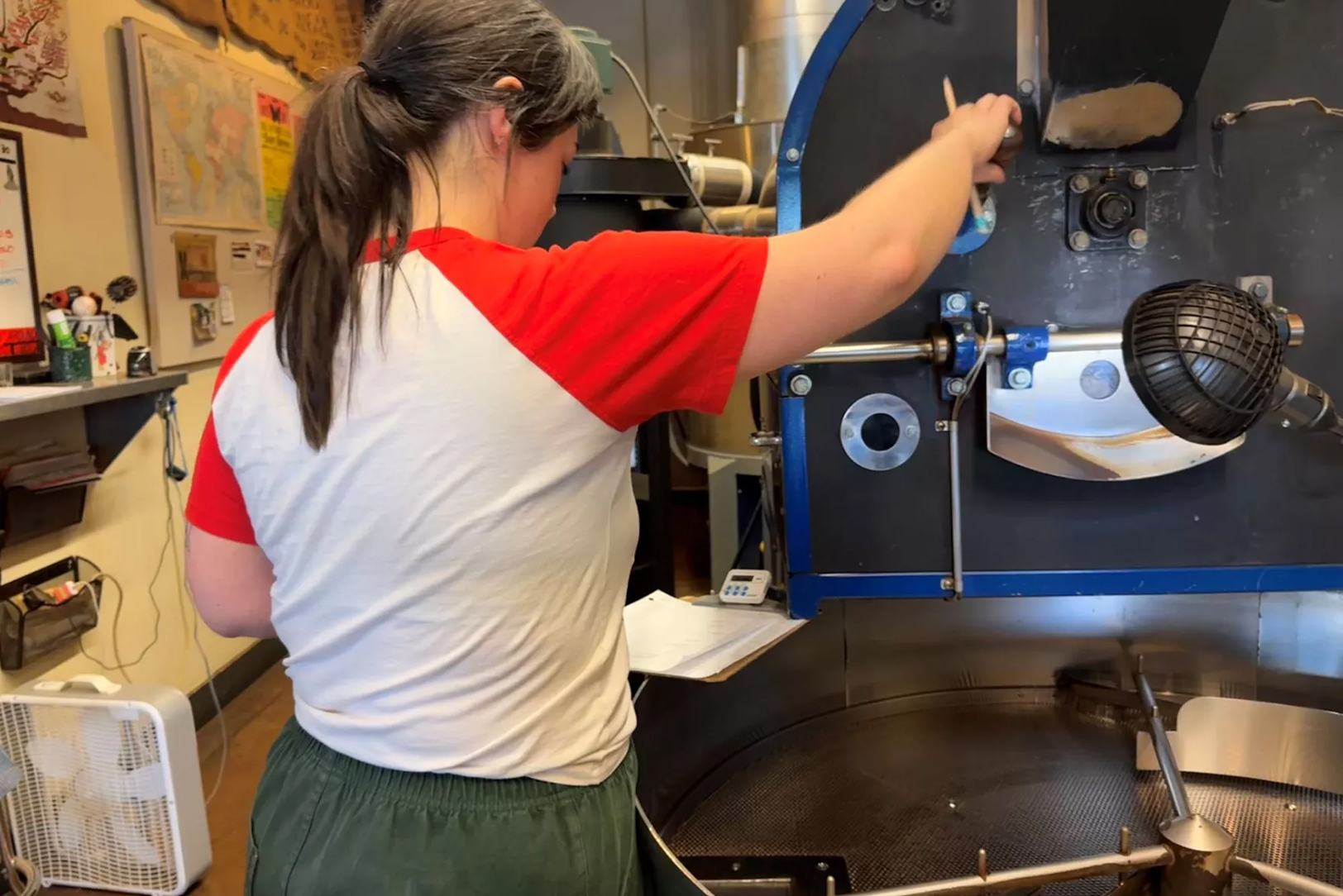
Ellen Collingwood monitors a large roasting machine at Broadway Roasting Company in Kansas City, Missouri. It takes about 20 minutes for the beans to transform from raw, green coffee to a roast that tastes good; photo by Skyler Rossi, Harvest Public Media
Climbing coffee prices
The cost of a pound of ground coffee at the grocery store has climbed more than 40% in the past year to an average of $9.14 in September, according to the consumer price index. That’s the most expensive it’s ever been.
Prices have been ticking up for several months, as extreme weather like drought and flooding has hurt coffee harvests worldwide.
But tariffs on coffee-producing countries are now pushing the price tag even higher, said David Ortega, a food economist at Michigan State University.
“About a third of the coffee that we consume comes from Brazil,” he said. “They are the largest producer. They are the largest exporter of coffee. And we are currently imposing a 50% tariff.”
The rising cost of coffee is making it harder for roasters to turn a profit. Craig Batory owns Craig’s Coffee in Detroit, Michigan. He said he’s paying up to 50% more for his coffee than he was a year ago. He’s absorbed some of that cost, he said, but he’s also had to increase what he’s charging customers twice this year.
“I care about my customers, and I understand that a price increase affects them directly,” said Batory. “But it’s also for the sake of the business.”
Taking on these extra costs stifles the company’s ability to keep growing, said Batory, who started the company in 2020. He can’t hire new employees or raise wages.
“We want to maintain our customer base,” Batory said. “But I think there’s also a little bit of justified fear – I don’t like to use that word, but we don’t want to increase our prices so much to where our customers don’t want to buy our products anymore.”
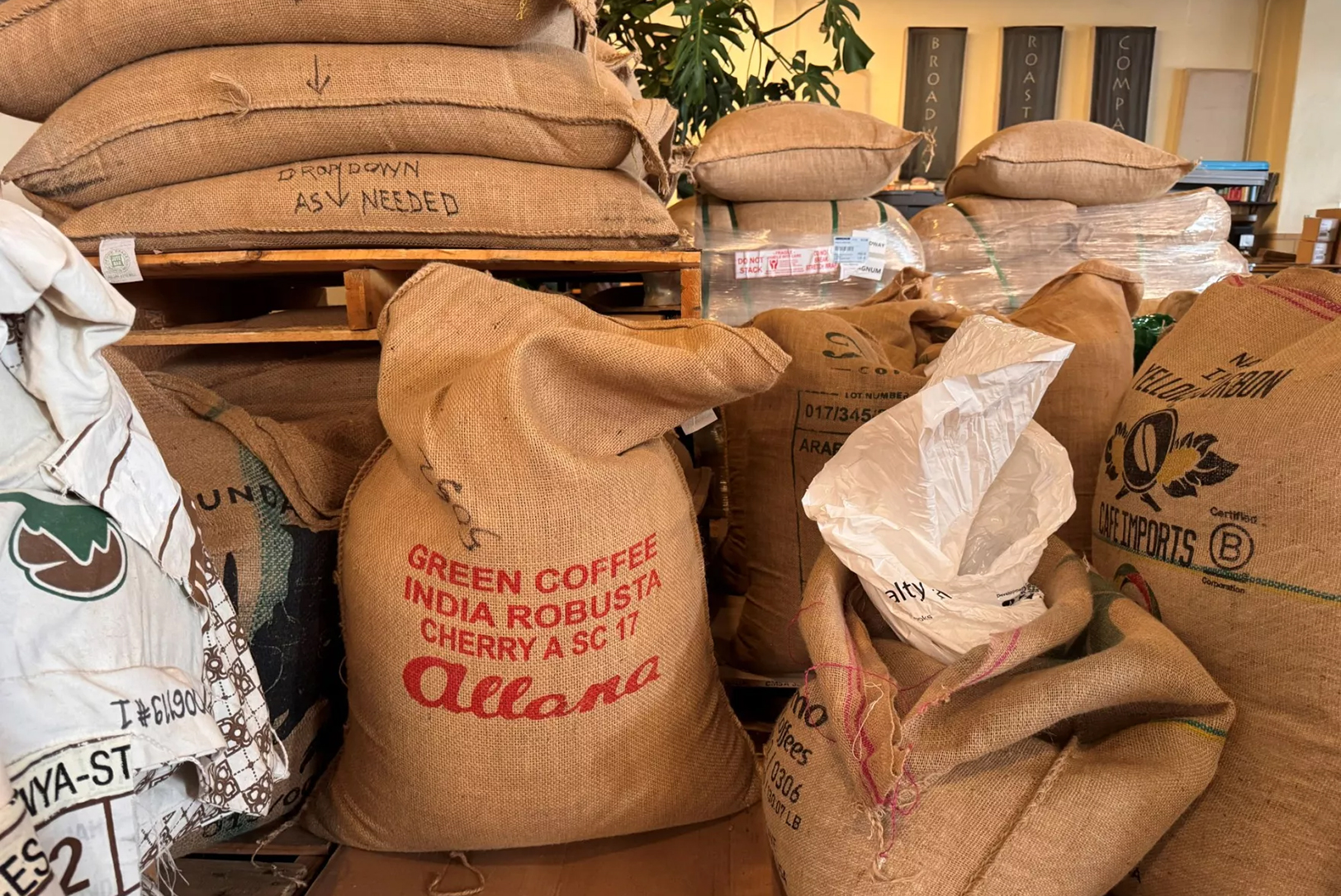
Large burlap sacks store green coffee at Broadway Roasting Company in Kansas City, Missouri. Owner Jon Cates says he’s considering changing where he buys some of his coffee beans to avoid the steepest tariffs. But it’s not as easy as just switching suppliers. “That supply chain has to be built, and you can’t just do that overnight,” he said; photo by Skyler Rossi, Harvest Public Media
Despite record-high prices, it’s unlikely that the millions of Americans who drink coffee every day are going to abruptly stop.
Coffee is what economists call an inelastic good, or an item that people tend to keep buying regardless of price changes. And unlike some other products, Ortega, the Michigan State University food economist, said there are very few replacements.
“You know, some people might switch to tea,” Ortega said. “I’m a big coffee drinker. Tea is no good substitute for coffee in my book. And I think that’s probably the case for many Americans.”
Coffee drinkers may be willing to make a few changes, especially as prices reach unprecedented levels.
Abby Sussman is a marketing professor at the University of Chicago Booth School of Business who researches how people make decisions about their money. She said people may turn to less expensive versions of coffee, like cheaper brands or making more coffee at home, before cutting it out of their budgets altogether.
“I think for a lot of people, you may have sort of non-negotiable expenses that are just an important part of your life,” Sussman said. “And so I could imagine for many people that coffee is part of that.”
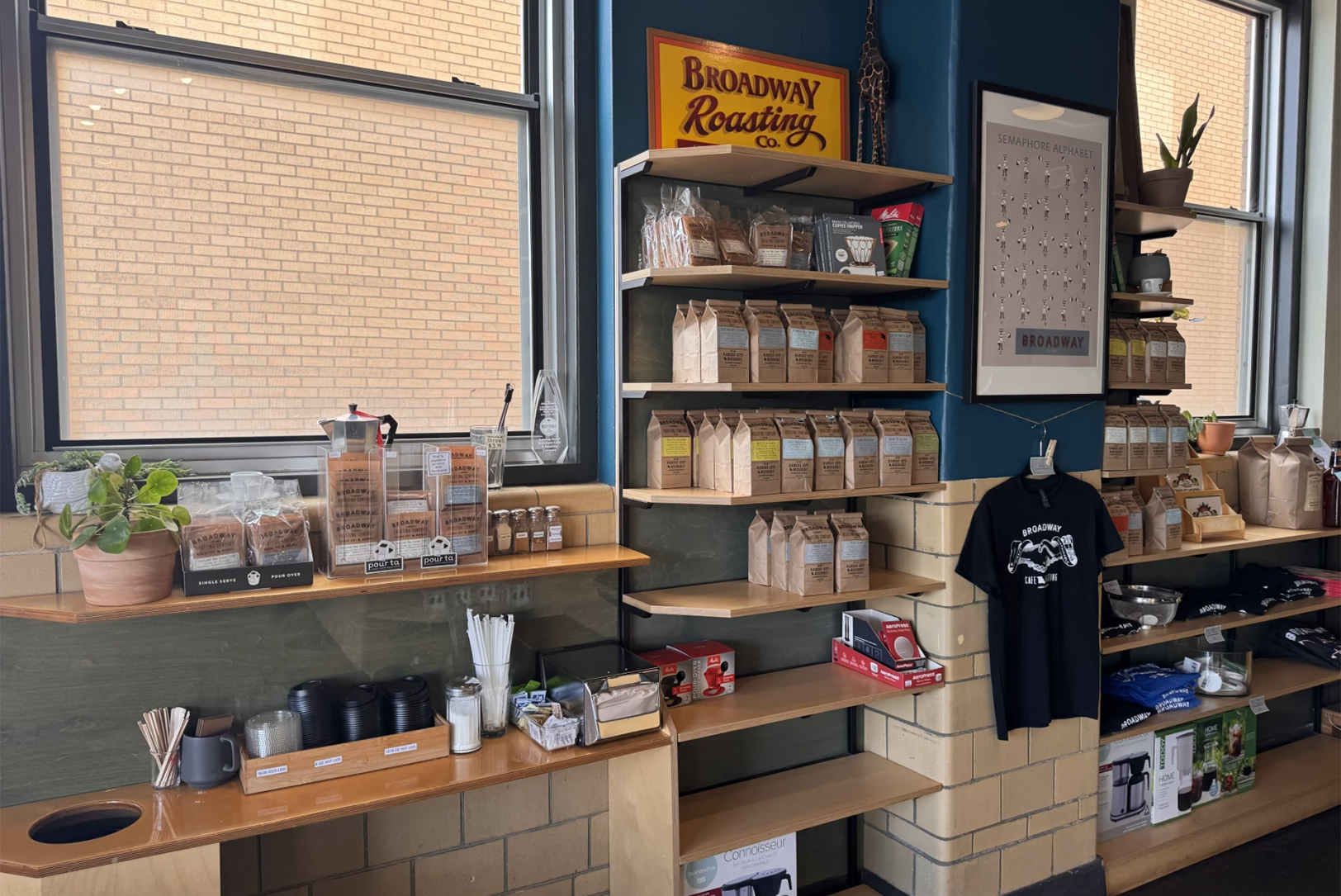
Broadway Roasting Company sells drinks and bags of its roasted coffee in Kansas City, Missouri. The business also has a cafe down the street; photo by Skyler Rossi, Harvest Public Media
Changing budgets
Colleen Bailey stopped by Broadway Cafe in Kansas City on a recent October morning for a pumpkin spice latte. A daily coffee drinker, Bailey said she’s been making more coffee at home as prices have increased. But she said it’s not the same as the lattes she can get at the coffee shop— or the same experience.
“I just like the atmosphere of coffee places,” she said. “Whenever I need to work on something outside of work, like a drawing or something, I actually find it easier to focus here sometimes.”
As people make changes to tighten their budgets, some coffee shops are trying to meet them where they are. At Hardy Coffee Company in Omaha, Nebraska, owner Autumn Pruitt said she’s selling more bags of roasted beans so people can brew their own coffee.
“I know that might mean that people will stop in our shop less often, but at least they’re still making Hardy Coffee at home,” Pruitt said. “And that’s a way that we can be part of their daily rhythm there.”
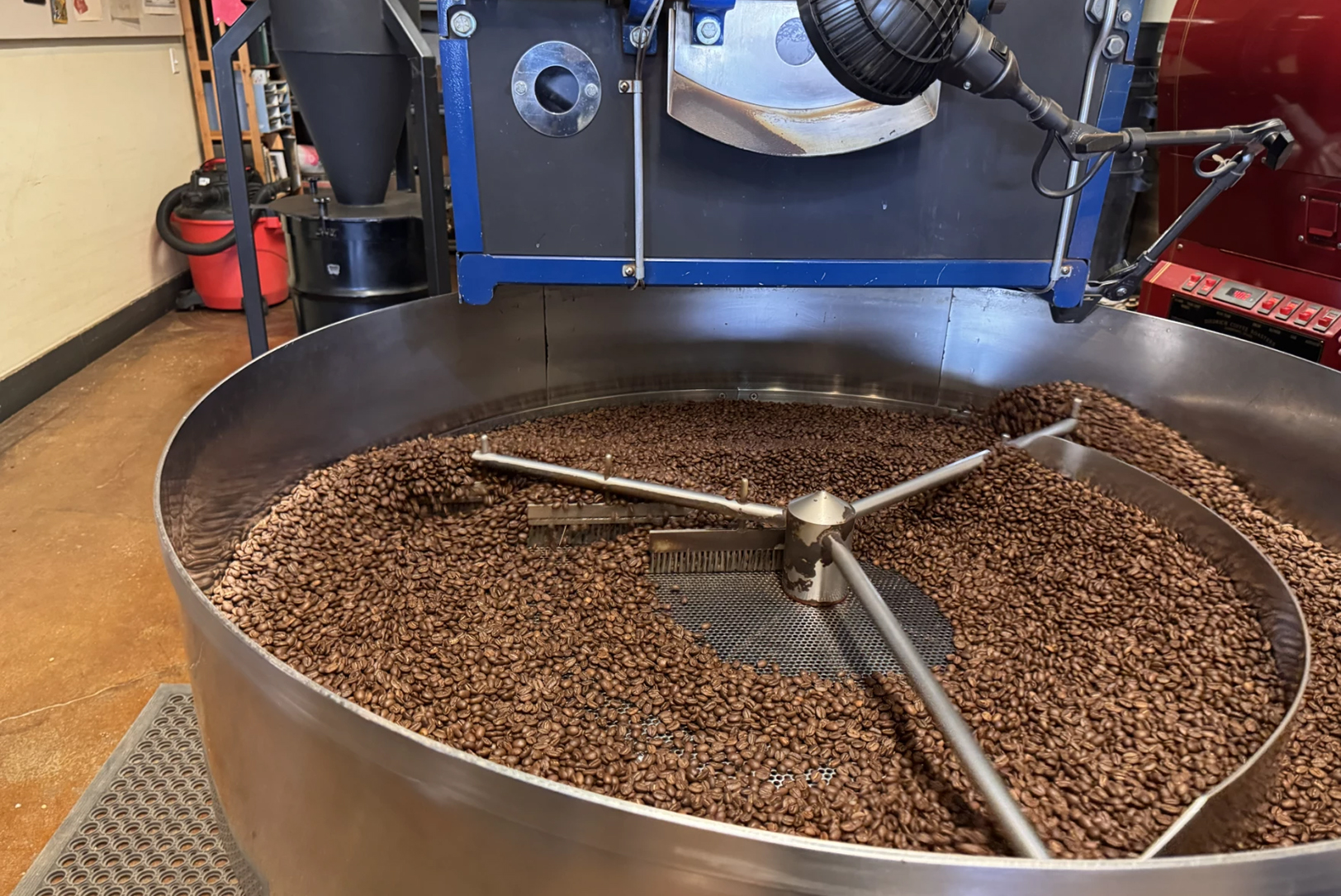
Broadway Roasting Company roasts hundreds of pounds of coffee beans each week in Kansas City, Missouri; photo by Skyler Rossi, Harvest Public Media
Hardy Coffee has explored other coffee options, Pruitt said. Once she runs out of her current stock of Brazilian coffee, she said she won’t buy more from the country because of the high tariffs.
But not all coffee tastes the same, and Pruitt is not willing to sacrifice quality.
“When coffee is the foundation of everything you do, we don’t have the option to not buy coffee,” she said. “We just need to find the best way to do it.”
Possible relief
There are some indications that Washington is trying to provide at least some coffee tariff relief.
The Trump administration announced agreements with four countries this week that would ease tariffs on coffee and other products that can’t be grown in the U.S. In late October, President Trump said he planned to lift coffee tariffs in Vietnam, while the U.S. Senate approved legislation that would eliminate tariffs on Brazil. The Supreme Court is also currently deciding whether Trump’s tariff policies are legal after a group of small businesses sued.
But even if tariffs were to end, food economist David Ortega said that doesn’t necessarily translate to cheaper coffee right away. Food prices tend to rise quickly and take a while to come back down. And he said the uncertainty around the Trump administration’s tariff policies makes it harder for companies to lower prices.
“These tariffs, they change – sometimes over the course of a day,” Ortega said. “And that uncertainty in and of itself can increase the cost of business in an industry like coffee.”
Hardy Coffee in Omaha raised its prices for wholesale customers this summer, and Pruitt said she’s getting ready to raise prices for the customers at the company’s four coffee shops. But she’s being very selective about which drinks will cost more.
“It’s really tricky, because we see the strain our customers are going through, too,” she said.
This story was produced in partnership with Harvest Public Media, a collaboration of public media newsrooms in the Midwest and Great Plains. It reports on food systems, agriculture and rural issues.


2025 Startups to Watch
stats here
Related Posts on Startland News

Keystone launching corporate engagement accelerator to boost low-friction startup collabs
Kansas City’s entrepreneurial ecosystem gets its fair share of positive press thanks to a decade of momentum, Kevin McGinnis noted, but the region’s ability to scale innovative ideas to their potential remains stalled because corporations and startups lack an easy on-ramp for collaboration. “We have been listening for years to the ecosystem, to the community,…

Just funded: AltCap Your Biz cycles trio of winners from KC’s diverse hospitality scene
Persistence pays off, said Ruben Alonso, celebrating a decade of the AltCap Your Biz Pitch Competition and its role as an energy boost for Kansas City small businesses. The latest winning founders walked away with $60,000 in checks Wednesday at Union Station. Two of this year’s top three winners were returning finalists, the AltCap CEO…

Innovation check(s): Angels scout potential KC investments at NXTUS nano-pitch event
A startup showcase Tuesday in the heart of Johnson County’s innovation community put impact on display as NXTUS’ Accelerate Venture Partners organized a nano-pitch event for its network of angel investors amid Global Entrepreneurship Week-Kansas City festivities. The Wichita-based entrepreneurial support organization — which has mobilized over $8.5 million for entrepreneurs in the Heartland since…

KC favorites eye World Cup: How to become ‘the spot’ for visitors without losing KC flavor
Even a visitor can become a repeat customer, said Dulcinea Herrera, stressing the importance of Kansas City businesses making their establishments a destination — not just a one-time stopover or accidental find — for international fans and other out-of-town guests when the FIFA World Cup arrives next summer. The goal: Win them over with intentional…