

Tesseract pairs one-button robotic badge with real-time, multi-industry workforce tracking
November 18, 2025 | Startland News Staff

A new site management platform — complete with wearable robots designed to automatically document work as it happens — is expected to help construction, infrastructure, and military teams gain real-time clarity across their projects and workforce, said John Boucard.
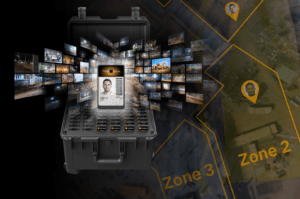
Tesseract’s Prism Vision Badge and Site Manager; illustration courtesy of Tesseract
“Instead of relying on spreadsheets, manual reporting, or guesswork, leaders now have continuous visual and sensor data that shows exactly what is happening on their sites, moment by moment,” explained Boucard, CEO of Overland Park-built Tesseract. “And most importantly, workers get to see their contributions reflected honestly and proudly every day.”
Tesseract’s Prism Vision Badge is a small, rugged robot that clips onto a worker’s vest or helmet. Throughout the day, it automatically captures photos at set intervals, adds time and location information, and stores everything securely on the device. At the end of a shift, workers simply place the badge in a charging dock where real time data is uploaded and organized. The badge requires no training beyond pressing one button, making it as easy to use as a walkie talkie.
Tesseract is an invention company that builds advanced hardware, software, and AI driven systems for construction, defense, critical infrastructure, and agriculture. The company develops integrated platforms that combine real time sensing, digital twins, robotics, and intelligent automation to give organizations a complete operational picture of their sites. Tesseract works closely with field teams, military partners, and enterprise clients to create technologies that are practical, reliable, and designed to improve safety, clarity, and productivity.
When paired with Tesseract Site Manager, the Vision Badge becomes a powerful workforce amplifier, Boucard said, noting the platform brings together data from the badges, Prism location trackers, access control points, security cameras, internet connectivity, and environmental sensors. All of this information appears in a clean dashboard that shows who is on site, what work was completed, where equipment is located, and whether any issues require attention. The system creates a digital twin of the job site and gives managers a real time map of field activity.
Features of the just-released tech include:
- Automatic visual documentation of daily work with no manual photos or missing information;
- Real-time tracking of people, tools, and equipment for better planning and safety;
- Secure access control and credentialing for workers and visitors;
- Oversight of multiple sites from one central dashboard;
- Simple device management for badges, sensors, and cameras; and
- Scalable and low cost for large field teams.
As workers move through the site, their Vision Badges help create a roving human powered sensor network that captures progress, safety conditions, craftsmanship, and productivity at the speed of the work itself. Workers are able to showcase their contribution in a way that has never been possible, and many take pride in seeing their tasks, installations, and finished work appear in the daily record for their team to review and celebrate.
Both the platform and robotic badges are designed for fast deployment, immediate ease of use, and full compatibility with existing systems.
With Site Manager as the central command platform and the Prism Vision Badge acting as each worker’s eyes on the ground, Tesseract delivers a complete operational picture that strengthens safety, transparency, and pride in craft across any job site, Boucard said.


2025 Startups to Watch
stats here
Related Posts on Startland News

Kansas City-built Boddle earns $500K Yass Prize Finalist Award, hits 2M monthly users
MIAMI — Winning a coveted award from Stop for Education is expected to empower Boddle Learning to reach a broader audience than ever before, as well as significantly expanding its curriculum and advancing its cutting-edge AI-powered education tools. Boddle, which launched and grew in Kansas City before relocating to Tulsa, Oklahoma, was announced as a…

Chan Zuckerberg funds KC nonprofit to help AI tech empower educators, innovators
A nearly $1 million grant from the Chan Zuckerberg Initiative is expected to help a Kansas City-based nonprofit expand and strengthen the infrastructure of its national education research and development coalition, its founder said. The funding specifically supports Leanlab Education’s American Group of Innovative Learning Environments (AGILE) Network, a national education R&D network and collective…

Design-Zyme, KU researchers latch onto $3M SBIR award for Lyme disease vaccine
Startland News’ Startup Road Trip series explores innovative and uncommon ideas finding success in rural America and Midwestern startup hubs outside the Kansas City metro. LAWRENCE — Vaccine development at KU Innovation Park could help stop an uptick in Lyme disease in its tracks, using a just-announced $3 million in federal funds to bring a…

Crown prime location: How two KC foodies are creating Museum of BBQ in one of the world’s barbecue capitals
A new museum — showcasing Kansas City as a barbecue capital of the world, as well as how meat takes on its famous flavors — is set to open in spring 2025 the Crown Center Shops, led by two veterans of the local food scene, and complete with barbecue baked beans ball pit. The aptly…