

Autotech startup revs after patent stall; signature tech removes emissions, waste from diesel logistics
November 6, 2025 | Nikki Overfelt Chifalu

Fresh fuel is pumping into NORDEF after the Kansas City autotech company finally received patent approval for its signature product, co-founder William Walls said, pushing the pedal on its mission to disrupt the automotive fluid industry.
Four years after applying for a provisional patent for its technology to produce diesel exhaust fluid on-demand — and receiving money from Digital Sandbox KC (when branded as AWA Technologies) as the very last group to get funds towards patent filing, he noted — the NORDEF team is partnering with an engineering firm in West Virginia to develop its MVP and is working on raising capital.

“The patent was kind of a natural lull because we hadn’t heard from them,” Walls said, “like, ‘Do we continue to work on this if we can even carve out a niche and convince the patent office that we are unique in this way and novel?’ But in the end, we got the patent and it put a little more life back in the project. And we’re still working on it constantly.”
Walls — along with co-founders Austin Hausmann and Adam Bronge; all veterans in the trucking industry — developed technology that reintroduces water to diesel exhaust fluid, which is required to meet EPA diesel engine emissions standards. The mix occurs at the point of use with localized feed water, urea pods, and an in-depot mixing machine.
“We’re not trying to redefine the product,” Walls explained. “We’re trying to redefine the route to market. That’s the inefficient and wasteful part of all of this.”
“When we first started talking about it, people thought we were trying to redefine diesel,” he continued. “It’s like, ‘No, no, no, no. That’s not what we’re doing. We’re just fixing the way the fluid gets to the market.’ And it’s not novel. Campbell’s did it by taking water out of Campbell’s soup. Tide did it with Tide Pods by not shipping the water. That’s the same thing we’re doing.”
According to NORDEF, the result is the potential removal of millions of tons of harmful NOx emissions from upstream logistics and millions of tons of single-use plastics from landfills, while providing high-quality, long-life diesel exhaust fluid as it’s highly susceptible to sunlight, temperature, and has an overall limited shelf life
“For a product that has a six-month shelf life, half of that time is eaten up just getting to the end user, the customer,” Walls noted. “Then once there, it sits on the shelf for a little bit. So the majority of its whole life has just been spent shipping it around. And with the dynamic costs of the world we’re in today, freight costs, fuel costs and last-mile handling fees, it’s just very inefficient.”
On top of eating up the shelf life, he continued, it’s wasteful to ship a product that is two-thirds water via trucks consuming diesel fuel all over the country.
“So not only are we solving a problem,” he added, “we’re also helping — in a roundabout way — reduce the number of trucks that are having to be driven to deliver products and all those single-use plastics that just end up in landfills and creeks.”
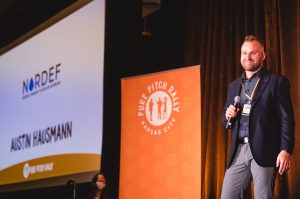
Austin Hausmann, AWA Technology, Pure Pitch Rally 2020; photo by Mikaela Wendel Photography
NORDEF — which won the 2023 Farm Bureau Ag Innovation Challenge and participated in Pure Pitch Rally in 2020 (as AWA Technologies) — is now working with a product engineering firm in West Virginia to get the technology from proof of concept to MVP, Walls shared.
“Then the idea is to deploy 10 to 20 of these hyper-local diesel exhaust fluid machines throughout the Midwest, probably Kansas, Missouri, Iowa, Nebraska,” he continued.
Parallel to that activity, he noted, the team plans to raise capital.
“We’ve been living off contests,” he explained, noting the team aims to deploy the technology while further learning, iterating and refining its product along the way.

Featured Business

2025 Startups to Watch
stats here
Related Posts on Startland News

Novel Capital teams with Crux KC to offer growth-focused marketing to early-stage tech companies
An exclusive partnership between two Kansas City-based innovators is expected to help remove a traditional financial hurdle to business growth, said Ethan Whitehill, president and chief strategy officer for the KC Chamber-lauded marketing firm Crux KC. The collaboration between Crux and Overland Park-headquartered capital provider Novel Capital is expected to offer B2B SaaS and tech…
Neighborhood smart cans help Kansas Citians save the planet from their kitchens
Newly introduced composting technology is already turning new ground in Kansas City, Kristan Chamberlain said, with more solar-powered compost cans arriving later this spring across the metro’s urban landscape. Her social venture, KC Can Compost, installed three of the devices in October — free to use for KCMO residents wanting to deposit their soil-making food…

Voodoo Volleyball bounces back in OP: Father-daughter duo doubles as new venture’s setters
Quinn Austin put several sports to the test as a preteen — racing from basketball practice to softball to volleyball. But she latched on to just one. “Volleyball. It was my sport. Everyone was having a good time,” she said. “We just loved the cheers — a cheer when we got a hit, a cheer…

Black farmers are losing ground in the fight to feed their communities, advocates say
More than a century of systemic land dispossession and discriminatory practices has left Black farmers with less than 0.6 percent of U.S. farmland — less than a third of the 16 million acres they operated in 1910, according to local urban farming advocates. They gathered Tuesday at Independence Boulevard Christian Church to confront this history…