

Harvesting KCMO’s urban-to-rural development wins means taking down silos, EDCKC leader says
September 11, 2025 | Taylor Wilmore

Editor’s note: The following is part of an ongoing feature series exploring impacts of initiatives within the Economic Development Corporation of Kansas City through a paid partnership with EDCKC.
Kansas City’s growth isn’t just shaped by skyline-changing projects, said Heather Brown, describing a simple formula — and delicate balance — that keeps the region building upon its potential and a foundation community stewardship that stretches from industrial areas to green fields.

“We want prosperity for everybody,” said Brown, vice president of administration at the Economic Development Corporation of Kansas City (EDCKC). “I know it sounds kind of corny, but that’s the goal. We want people to succeed and be happy and prosperous.”
“When people ask me what EDCKC does, or what I do, I always say we try to retain and create jobs,” she continued. “We do business development, real estate development in blighted areas, and we support entrepreneurship and lending programs.”
Brown brings decades of public service and legal experience to the job. In addition to managing EDCKC’s internal operations, she leads two major agencies: the Tax Increment Financing Commission (TIF) and the Industrial Development Authority (IDA).
After retiring from her role in economic development law for the City of Kansas City, Missouri, Brown joined EDCKC and later served as interim president. Now, she helps connect people, policy, and projects that move the city forward.
Leading through TIF and IDA
Through her leadership at TIF and IDA, Brown helps make possible many of the large-scale development projects shaping Kansas City.
“TIF is a land development financing agency, and IDA is basically a bonding agency,” she said. “IDA issues bonds for affordable housing, commercial development, infrastructure, even big projects like the airport terminal.”
The financial tools IDAoffers can make a major difference for developers and the city alike.
“The interest on those bonds is exempt from federal taxation,” Brown explained. “That’s a big benefit. You can get lower interest rates on the bonds because bondholders don’t pay income tax on the interest they earn and the cost of the project goes down.”
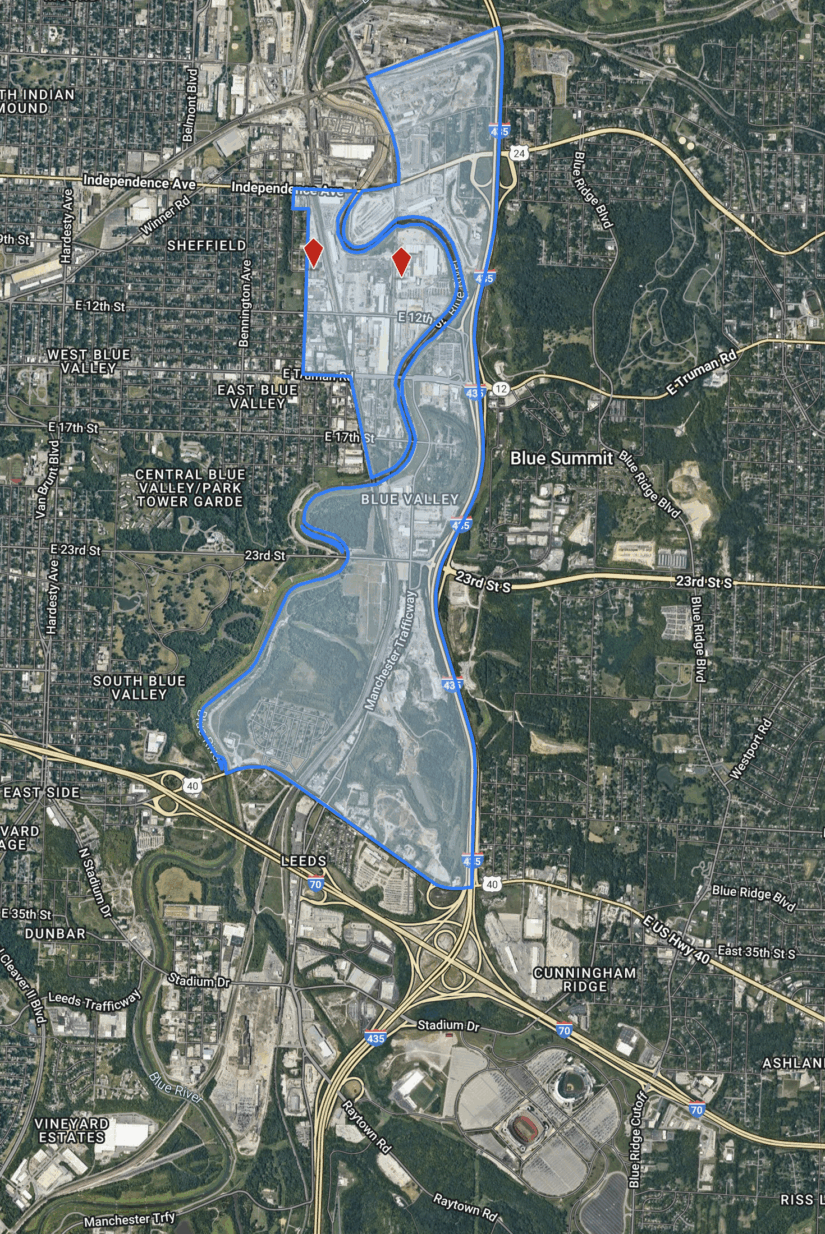
Map of the Blue Valley industrial area near the Truman Sports Complex; image courtesy of Loopnet and Google Maps
Reviving the ‘Donut Hole’ and a sprawling city
One of EDCKC’s top priorities is redeveloping the Blue Valley industrial area near the Truman Sports Complex.
Brown believes the 6,000-acre site has huge potential, envisioning it as a hub where residents could even walk or bike to work.
“It really was an industrial base,” she said. “We feel like if we could bring that area back and put industry in there and create really great jobs and well paying industrial jobs that are also eco friendly, it would be just a huge win for Kansas City.”
Kansas City’s size adds complexity to its economic planning. It’s one of the largest U.S. cities by land area, with rural, suburban, and urban areas all within city limits.
“Kansas City is such a geographically big city that it’s different from a lot of other places,” Brown said. “We have farmland, so we can almost have rural projects here, and we also have denser projects in the urban core.”
That spread creates challenges when it comes to infrastructure.
“We just have a lot of open green fields,” she said. “That becomes a budget issue for the city, building and maintaining roads, utilities, and infrastructure for such a large area. TIF economic development plans, which only fund public infrastructure, can help in developing those areas.”
To address that, EDCKC also focuses on infill development, which uses existing infrastructure and supports walkable neighborhoods and housing density.
ICYMI: Leave KC better than you found it: How matching growth to city’s needs is paying off
A culture of collaboration
Despite overseeing multiple departments and agencies, Brown emphasized that EDCKC works hard to foster a collaborative internal culture.
“We could easily have silos, but we don’t really,” she said. “Our land development team and business development officers work closely together. They’ll come to us and say, ‘I’ve got a client looking for space, are there any developments that might be a fit?’”
That collaboration is supported by regular all-staff meetings and an open office layout that encourages ongoing conversation.
“We try to make sure everybody’s aware of what’s going on and potential projects coming down the pipeline,” Brown said.
That same spirit of teamwork extends to external partners. EDCKC has made progress in building trust with school districts and taxing jurisdictions, especially through the AdvanceKC process.
“When I first started at the TIF Commission, our relationship with the Kansas City Public Schools wasn’t good,” she recalled. “There wasn’t a lot of communication, but I think we’ve really turned that corner, and I think that’s a credit to both the taxing jurisdictions and to our team.”
RELATED: KC’s next big wins require all players join EDCKC in the field, leader says
Bringing in projects that matter
Brown is most proud of projects that directly benefit neighborhoods. One example is the Price Chopper near 95th and I-435, which opened in 2021 in a former food desert near Bannister Road.
“The neighborhood couldn’t wait to have it,” she said. “It’s doing really well, exceeding expectations.”
She also highlighted the IDA’s role in supporting the new airport terminal and mentioned upcoming TIF projects in the West Bottoms and at 63rd and Prospect.
“We’re crossing our fingers that Southpointe at 63rd will come to fruition,” she said. Although her work often happens out of the spotlight, Brown stays fixed on her bigger purpose.
“I want to focus on things that matter to the people who live here, and to visitors and potential employers who might want to come to Kansas City,” Brown added.

Featured Business

Taylor Wilmore
Taylor Wilmore, hailing from Lee’s Summit, is a dedicated reporter and a recent graduate of the University of Missouri, where she earned her Bachelor’s degree in Journalism. Taylor channels her deep-seated passion for writing and storytelling to create compelling narratives that shed light on the diverse residents of Kansas City.
Prior to her role at Startland News, Taylor made valuable contributions as a reporter for the Columbia Missourian newspaper, where she covered a wide range of community news and higher education stories.
2025 Startups to Watch
stats here
Related Posts on Startland News

The WTF Series: Encryption and Apple’s predicament
For those of you who have been living under a rock the last month, there’s a “little” snafu going on between Apple and the FBI. The FBI handed Apple a court order demanding access to the password-protected iPhone of a mass shooter. In an open letter to customers, Apple CEO Tim Cook explained that the…

Kansas’ angel tax credits score first victory but hurdles remain
A bill extending Kansas’ popular Angel Investor Tax Credits scored its first victory Thursday, but legislators must make quick work of the measure if the program is to survive. The Kansas House Committee on Taxation unanimously approved a measure to continue the program, which offers accredited investors a tax credit of up to $50,000 on…
Roberts: Can’t stand the options? Disrupt elections with a vote for nobody
Editor’s Note: The following piece was written by Melissa Roberts on how voters who have made the decision not to vote for the available candidates should still submit a ballot — even if it’s blank. The opinions expressed in this commentary are hers. It’s election season, which means it’s probably best to avoid Facebook altogether. Despite…

Sharing economy labors over lawsuits, paradigm shift for cyber security law
Here’s this week’s dish on the sharing economy, the issues with backdoor encryption, and corporate-to-startup collaboration. Check out more in this series here. AustinInno – The gig economy is at a crossroads as lawsuits, innovative benefits expand As the sharing or “gig” economy expands with companies like Uber and Lyft, it’s not just permit…