

KC Tech Council celebrates tax fix in Trump’s ‘One Big Beautiful Bill’ that boosts growing businesses
July 23, 2025 | Tommy Felts

A tax fix included in the recently signed “One Big Beautiful Bill” — sprawling legislation meant to overhaul taxes in the United States — marks a major win for Kansas City’s tech and innovation economy, said Kara Lowe.
At issue: a long-awaited change to Section 174 research and development expensing that now allows businesses to fully and permanently expense such investments, explained Lowe, CEO of KC Tech Council, which championed the fix alongside TECNA (Technology Councils of North America).

Additionally, companies with less than $31 million in receipts can retroactively claim refunds on past expenses as part of the fix, she noted.
“Hopefully, we’ll see any reticence around research and development evaporate, increasing innovation and allowing for more growth in our small and midmarket tech sector,” Lowe told Startland News.
The One Big Beautiful Bill Act became law July 4 with President Donald Trump’s signature.
KC Tech Council has supported reforming the expensing rule for years, once the long-term impact of previous tax alterations became clear to tech advocacy organizations, Lowe said.
“In 2017, a legislative change to the tax code allowed for companies to immediately deduct R&D expenses in the same year they were incurred,” she explained. “That change expired a couple years back, meaning that companies had to wait for R&D expenses to be deducted by amortizing over a period of years.”
“This makes it very difficult for companies to access the savings created under the previous structure, creating cash flow problems and disincentivizing R&D expenses, stifling innovation,” Lowe continued. “Together with our federal advocacy partners, we’ve been working to reinstate full deduction of R&D expenses since the expiration.”
KC Tech Council members were among those feeling the pain of the deduction allowance expiration, which created significant cash flow challenges when paying taxes, she said.
“For some companies, that meant a slower hiring period because cash flow was tight. For others, it meant that R&D was stalled since expenses related to it could no longer be tax deductible in that same year,” Lowe said. “This was especially profound at early-stage and SMB tech companies.”
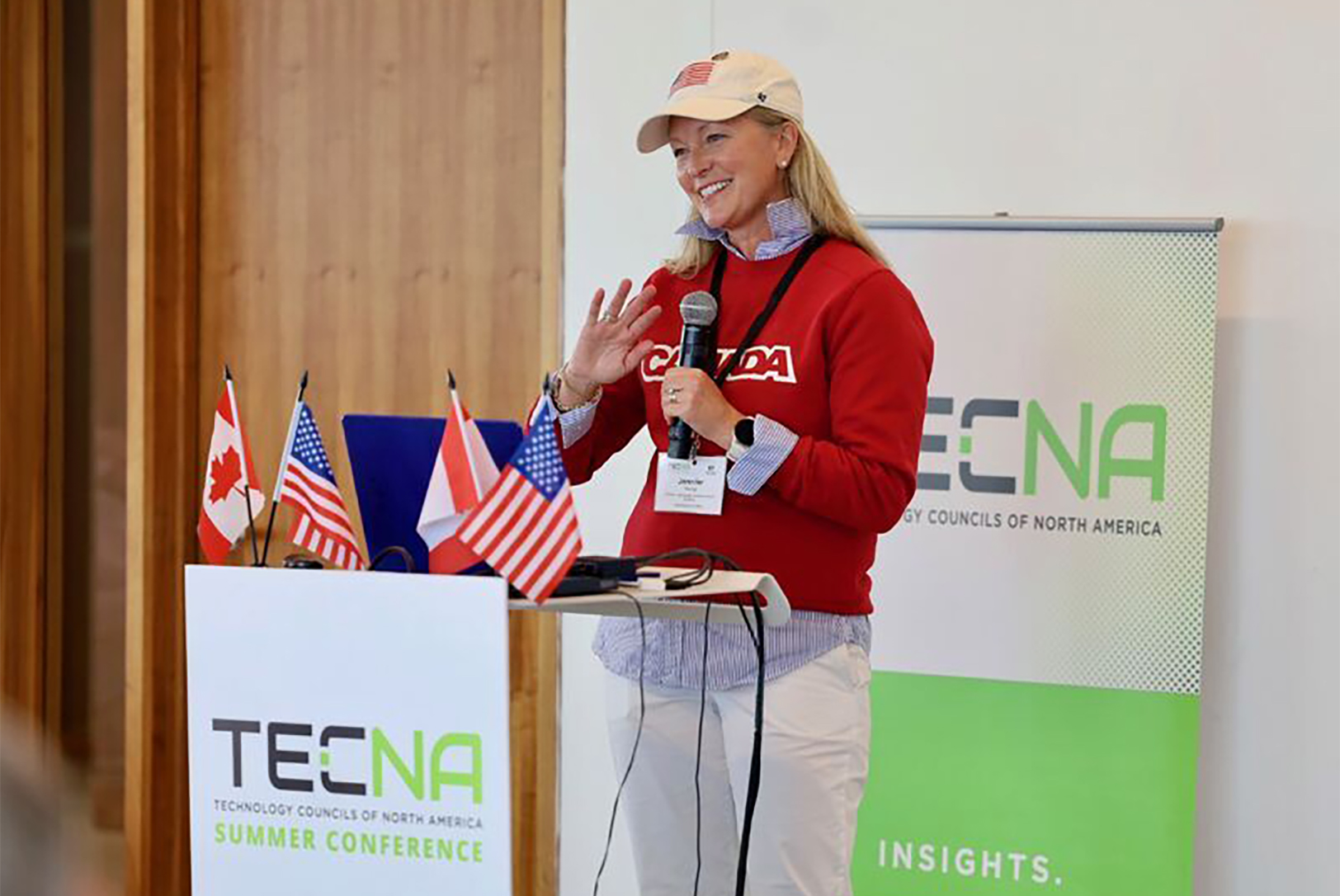
Jennifer Young, CEO of TECNA, welcomes the U.S.-Canadian delegation to Montreal earlier in July at the TECNA (Technology Councils of North America) summer conference in Quebec; courtesy photo
 Coordinating with larger groups like TECNA on policy goals allows the KC Tech Council to advocate for Kansas City businesses while also reflecting a unique and unified voice on behalf of the tech industry, she emphasized. Lowe was appointed to the TECNA board of directors in January 2024, and now serves as treasurer of the organization.
“The 60+ member councils (within TECNA) serve their individual states and regions, and know them well. Our collective membership base numbers tens of thousands of companies, most of which are SMB, midmarket, growing tech employers,” Lowe said. “This is where the vast majority of tech talent works, and is responsible for a significant part of our GDP. Our collective voice runs both wide and deep into our communities, making for a powerful legislative partner and advocate.”
And that policy work continues well after any one piece of legislation is passed or defeated, she added.
“In a federally unregulated AI landscape, we’ll advocate for risk-based, consumer- and innovation-friendly AI regulation that mitigates the possible future of a busy patchwork of state statutes,” Lowe said. “TECNA, as a North American organization, also represents a unified effort between U.S.-based and Canadian-based organizations, allowing for open dialogue and collaboration between our countries’ tech organizations during a complicated period geopolitically.”


2025 Startups to Watch
stats here
Related Posts on Startland News

This hard swap plays easy: How one KC producer juggles community, breaking the club music cookie cutter
Tyler Jordan’s new spin on DJing: amplify fellow artists and unite people through music, he shared. Jordan — who produces electronic music and DJs under the name Oblivinatti (a mashup of his favorite video game growing up, The Elder Scrolls: Oblivion, and his interest in conspiracy theories) — is evolving his sound production business Vibration…

Art and technology too often butt heads, festival planners say; River Market event paints a reality where they coexist
The River Market Art Festival is back after a 20-year hiatus — with a nod to the past and an eye toward the future, shared The AI Hub’s Taylor Burris and James Spikes, startup founders who are hosting the event in partnership with the River Market Community Association. The revival of the art festival —…
PayIt co-founder: No one-size-fits-all formula for scaling one of KC biggest startup ideas
Mike Plunkett’s journey with PayIt came to an early, but critical crossroads when a wealthy entrepreneur offered half-million dollars to support the Kansas City-built govtech venture, he recalled. The catch: this investor insisted on imposing control and veto power as they committed more funds. Despite being low on funds, the PayIt team — led by…

Pure Pitch Rally reveals 2023 competitors: Meet 8 founders redefining the future of tech
One of KC’s most-anticipated startup events is set to tease a room full of sharks with the innovations of tomorrow — being built in Kansas City today, said Karen Fenaroli, announcing the eight competitors set for the Oct. 23 Pure Pitch Rally stage. The one-of-a-kind event helps startups grow by offering nondilutive spot-cash funding to…