

KC Tech Council celebrates tax fix in Trump’s ‘One Big Beautiful Bill’ that boosts growing businesses
July 23, 2025 | Tommy Felts

A tax fix included in the recently signed “One Big Beautiful Bill” — sprawling legislation meant to overhaul taxes in the United States — marks a major win for Kansas City’s tech and innovation economy, said Kara Lowe.
At issue: a long-awaited change to Section 174 research and development expensing that now allows businesses to fully and permanently expense such investments, explained Lowe, CEO of KC Tech Council, which championed the fix alongside TECNA (Technology Councils of North America).

Additionally, companies with less than $31 million in receipts can retroactively claim refunds on past expenses as part of the fix, she noted.
“Hopefully, we’ll see any reticence around research and development evaporate, increasing innovation and allowing for more growth in our small and midmarket tech sector,” Lowe told Startland News.
The One Big Beautiful Bill Act became law July 4 with President Donald Trump’s signature.
KC Tech Council has supported reforming the expensing rule for years, once the long-term impact of previous tax alterations became clear to tech advocacy organizations, Lowe said.
“In 2017, a legislative change to the tax code allowed for companies to immediately deduct R&D expenses in the same year they were incurred,” she explained. “That change expired a couple years back, meaning that companies had to wait for R&D expenses to be deducted by amortizing over a period of years.”
“This makes it very difficult for companies to access the savings created under the previous structure, creating cash flow problems and disincentivizing R&D expenses, stifling innovation,” Lowe continued. “Together with our federal advocacy partners, we’ve been working to reinstate full deduction of R&D expenses since the expiration.”
KC Tech Council members were among those feeling the pain of the deduction allowance expiration, which created significant cash flow challenges when paying taxes, she said.
“For some companies, that meant a slower hiring period because cash flow was tight. For others, it meant that R&D was stalled since expenses related to it could no longer be tax deductible in that same year,” Lowe said. “This was especially profound at early-stage and SMB tech companies.”
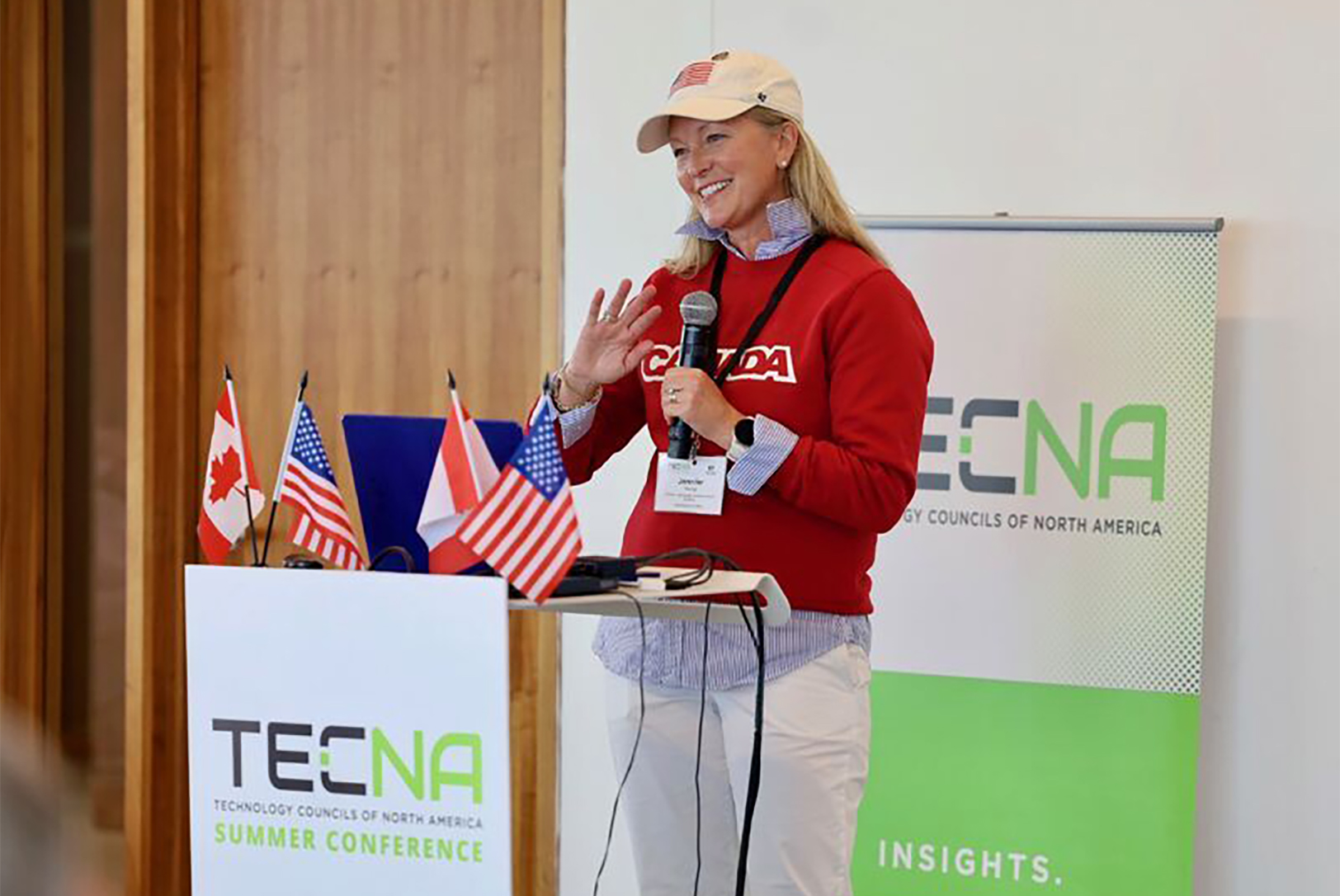
Jennifer Young, CEO of TECNA, welcomes the U.S.-Canadian delegation to Montreal earlier in July at the TECNA (Technology Councils of North America) summer conference in Quebec; courtesy photo
 Coordinating with larger groups like TECNA on policy goals allows the KC Tech Council to advocate for Kansas City businesses while also reflecting a unique and unified voice on behalf of the tech industry, she emphasized. Lowe was appointed to the TECNA board of directors in January 2024, and now serves as treasurer of the organization.
“The 60+ member councils (within TECNA) serve their individual states and regions, and know them well. Our collective membership base numbers tens of thousands of companies, most of which are SMB, midmarket, growing tech employers,” Lowe said. “This is where the vast majority of tech talent works, and is responsible for a significant part of our GDP. Our collective voice runs both wide and deep into our communities, making for a powerful legislative partner and advocate.”
And that policy work continues well after any one piece of legislation is passed or defeated, she added.
“In a federally unregulated AI landscape, we’ll advocate for risk-based, consumer- and innovation-friendly AI regulation that mitigates the possible future of a busy patchwork of state statutes,” Lowe said. “TECNA, as a North American organization, also represents a unified effort between U.S.-based and Canadian-based organizations, allowing for open dialogue and collaboration between our countries’ tech organizations during a complicated period geopolitically.”


2025 Startups to Watch
stats here
Related Posts on Startland News
What comes after the World Cup? Leaders ponder KC’s next phase (and how to get there)
Editor’s note: The following is the first in a four-part series exploring the verticals and impact of initiatives within the Economic Development Corporation of Kansas City through a paid partnership with EDCKC. EDCKC leader: Tapping Kansas City’s full potential requires coordinated eco devo strategy across region Tracey Lewis has lived and worked in some of…

Clock is ticking on World Cup 2026: Small businesses urged to prepare before this buzzer-beater
A massive influx of visitors are expected next year when more than 600,000 fans descend on Kansas City for its piece of the FIFA World Cup 2026 prize, but potential roadblocks lie ahead for small business owners who are waiting for the action instead of preparing now to capitalize on it, said local leaders. “This…
Why KCMO pushed to lock down ‘Kansas City’ brand ahead of its biggest sports event yet
With World Cup visitors already eyeing plane tickets to Kansas City for matches opening in June 2026, clarity around what constitutes “Kansas City” will be key, said Quinton Lucas, who in late 2024 made moves to restrict labeling the city’s name on certain projects. The effort aims to authentically represent KCMO on the world’s stage,…

Downtown KCMO ballpark remains in play as Kansas aggressively pursues Royals
Editor’s note: The perspectives expressed in this commentary are the author’s alone. Gib Kerr is the chair of the Downtown Council of Kansas City, Missouri, managing director at Cushman & Wakefield, and an author. This piece was first published by the Downtown Council. Where should the Royals play baseball? Last year, the debate was whether…